
LangGraph Development Services
Checkpointed, auditable AI agents on LangGraph, for engineering leaders whose prototype agent stopped being trustworthy the moment real traffic hit it.
AlphaCorp AI's LangGraph development services design, build, and deploy agents on LangGraph, the MIT-licensed orchestration runtime that models an agent as a directed graph of nodes, edges, and shared state, with built-in checkpointing, human-in-the-loop pauses, and step-level tracing. We take a workflow that currently lives in a fragile prompt loop and turn it into an explicit graph your team can inspect, resume after a crash, gate with human approval, and evaluate decision by decision. We build on LangGraph 1.0, generally available since October 22, 2025, in Python or LangGraph.js, and deploy to your own cloud, LangSmith, Amazon Bedrock, or Microsoft Foundry. The service fits mid-to-large teams in healthcare, financial services, SaaS, and logistics that need an agent to hold up under an audit.

Creators of RustyRAG
Realtime RAG, built in Rust · Sub-200ms end-to-end 10+ years delivering AI solutionsIgnas Vaitukaitis · Founder & CEO
 VersarWashington, DC
 GynisusNew York
 CampusReelNew York
 LuniqGermany
 HospitalityFlowSingapore
LangGraph development services by the numbers
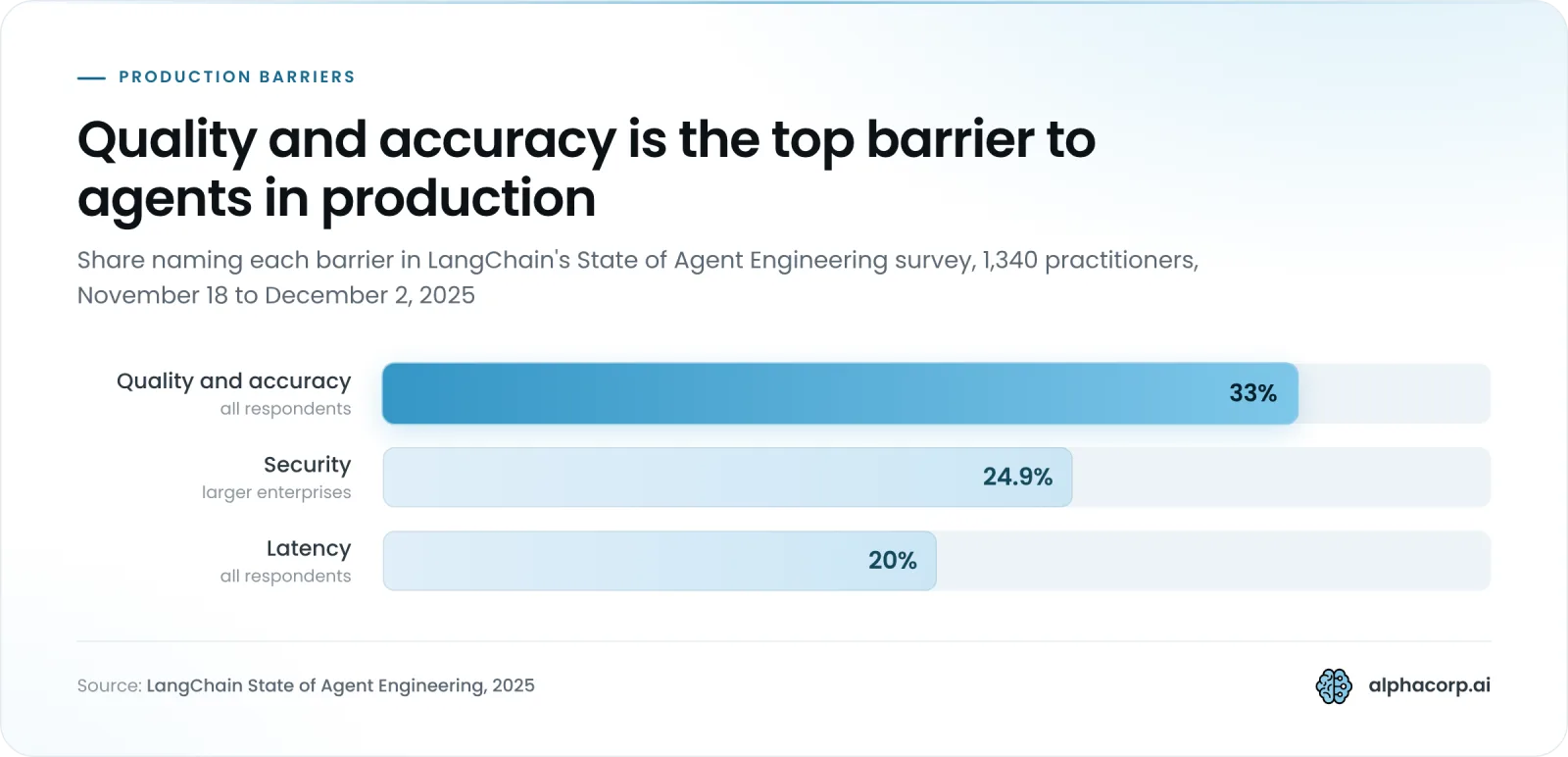
Agents reached production in 2025. Most of the ones that fail do so for reasons a graph runtime is built to remove.
What our LangGraph development services build
AlphaCorp AI builds the six layers a LangGraph agent needs before it can run unattended: the graph, its state, its pause points, its sub-agents, its retrieval, and its observability. Each one maps to a concrete deliverable.
The Stack We Ship On
We pick the best tool for each job, not the trendiest. This is what runs behind the agents, retrieval pipelines and automation we put into production.
 AWS
AWS Azure
AzureHow a LangGraph development services engagement runs
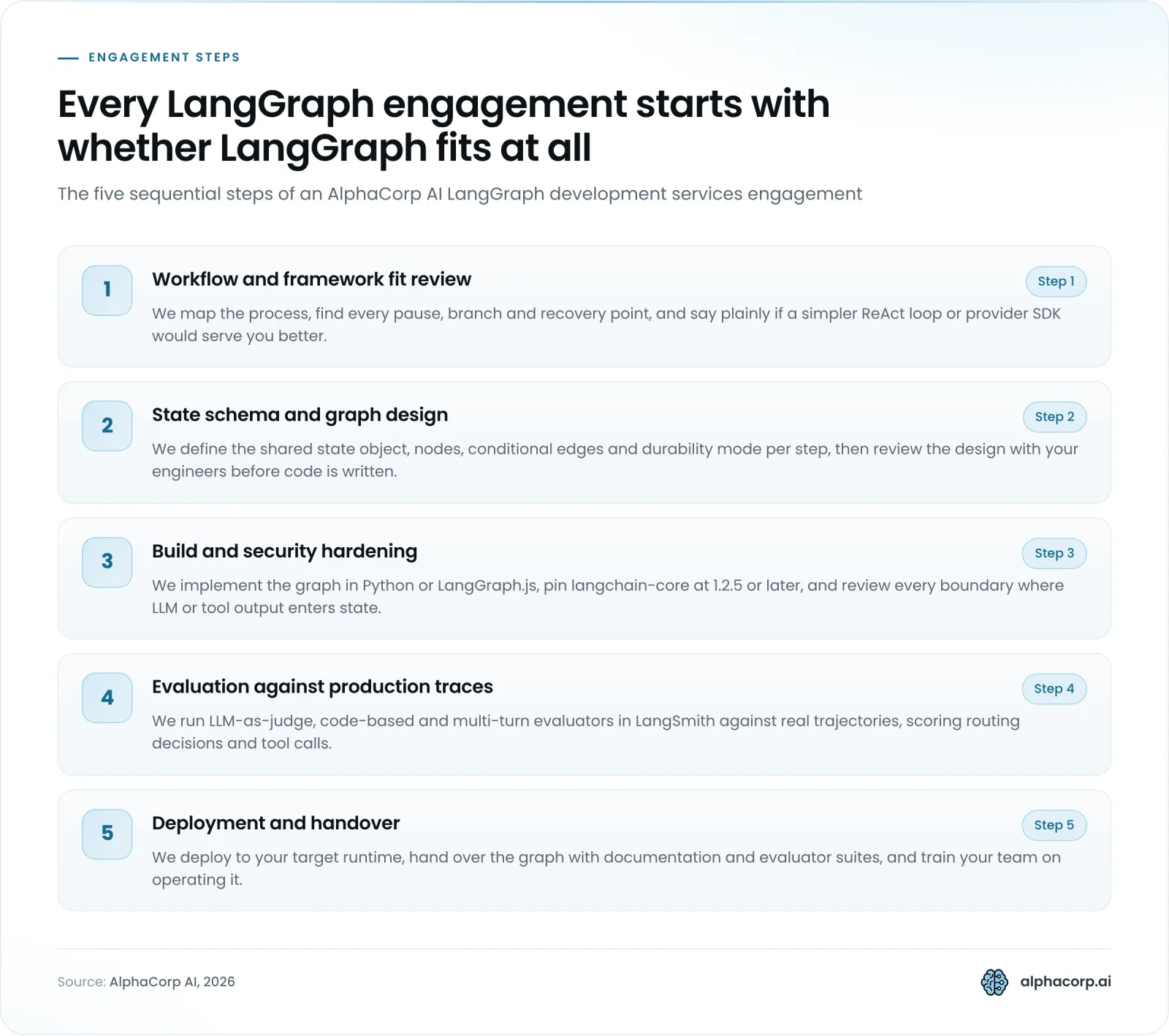
An engagement runs in five sequential steps, and the first one decides whether LangGraph is the right tool at all.
Why invest in LangGraph development services
A LangGraph build pays for itself by removing the specific failure modes that get agent projects canceled: silent crashes, unreviewable decisions, and no way to prove what the agent did.
Why teams pick AlphaCorp AI for LangGraph development services
AlphaCorp AI is the engineering studio behind RustyRAG, an open-source sub-200ms RAG engine, and the engineers you meet on the first call are the ones who write your graph. The team works remote-first from Rio de Janeiro on US Eastern hours, in English, Portuguese, and Spanish. The framework carries its own track record: LangChain reports LangGraph running in production at Klarna, Uber, LinkedIn, Replit, and Elastic before the 1.0 release, which are vendor-published case studies, so weigh them accordingly.
We name the overkill case up front. A July 2026 practitioner paper on graph-based agents cautions that for basic tool-use tasks a plain ReAct loop or a provider SDK can outperform LangGraph. We agree. If your workflow has no pauses, no branching, and no need to recover mid-run, step one of our engagement ends with that recommendation and a much smaller scope.
Evaluation is part of the deliverable. Observability adoption hit 89% in LangChain's 2025 survey while online evaluation sat at 37.3%. Most teams can see their traces and still cannot say whether the agent is getting better. Trajectory evaluators ship with our graphs, and so does the baseline they were measured against.
We review the serialization boundary. Two of the three LangChain-ecosystem vulnerabilities disclosed in 2025 were serialization-injection flaws, and the third was indirect prompt injection through an email toolkit. Orchestration logic is the easy part. We spend real time on where untrusted output enters state.
The tradeoff we accept. LangGraph adds a layer between you and the model provider, and that layer has a dependency chain you must patch. We pin versions, monitor advisories, and hand you a runbook, and you should budget engineering time for it after launch. Read about how the studio works.
Security in our LangGraph development services
AlphaCorp AI treats every LangGraph agent as software that executes tool calls on untrusted input, and hardens it on that assumption. We do not claim certifications on your behalf; we build the practices below into the graph and document them for your auditors.
Patched serialization boundaries. We pin langchain-core to 1.2.5 or later, 0.3.81 on the 0.3 line, the versions that closed CVE-2025-68664 and CVE-2025-68665, and we review any code path where a model-produced dictionary could reach the serializer.
Untrusted content stays untrusted. Inbox content, web pages, and tool results enter state as data and never as instructions, the lesson from CVE-2025-46059's Gmail toolkit exploit path in July 2025.
Approval gates on side effects. Any node that moves money, edits records, or sends messages sits behind a human-in-the-loop interrupt until your evaluators earn it autonomy.
Your data stays in your runtime. We deploy inside your cloud account, whether that is self-hosted, Amazon Bedrock, or Microsoft Foundry's managed LangGraph runtime, so prompts and state never leave your perimeter unless you choose LangSmith cloud tracing. LangChain 1.0's middleware system also lets us inject PII redaction and conversation summarization into the agent loop, keeping sensitive fields out of traces.