
Wave of light particles flowing through faint circuit traces on a dark background
Stack

Python Development Services

Production Python back ends, APIs, data pipelines, and AI services, built by senior engineers who start before your next hiring round closes.

AlphaCorp AI's Python development services design, build, and maintain the Python systems your product runs on: FastAPI and Django back ends, data pipelines, automation, and the inference and LLM services behind AI features. Our remote-first team works from Rio de Janeiro on US Eastern hours and delivers into your repositories with pinned dependencies, reviewed pull requests, and secure release practices. We build on Python 3.14, released October 7, 2025, and take on both new systems and upgrades of codebases that have fallen behind. The service fits engineering leaders who need working Python software in production and cannot wait out a developer shortage to get it.

RustyRAG logo
Track record

Creators of RustyRAG

Realtime RAG, built in Rust
Ignas Vaitukaitis, Founder and CEO of AlphaCorp AI10+ years delivering AI solutionsIgnas Vaitukaitis · Founder & CEO

Read RustyRAG’s source before you sign.
Shipped for
  • Versar logoVersarWashington, DC
  • Gynisus logoGynisusNew York
  • CampusReel logoCampusReelNew York
  • Luniq logoLuniqGermany
  • HospitalityFlow logoHospitalityFlowSingapore

The numbers behind demand for Python development services

Demand for Python development services comes from two measured pressures: too few developers to hire, and a Python ecosystem that moves faster than most teams keep up with. Each figure below stands on its own.

38%of Python developers now use FastAPI, up from 29% a year earlierPSF and JetBrains, 2025
10.5MICT specialists employed in the EU in 2025, against a 20 million target for 2030European Commission, 2026
500+packages compromised by the self-replicating Shai-Hulud supply-chain wormCISA, 2025
Overview

What our Python development services build

AlphaCorp AI's Python development services cover six kinds of build, from a single FastAPI inference endpoint to a full Django platform with the pipelines behind it. Each card names what we produce and how it works.
01

FastAPI and Django back ends

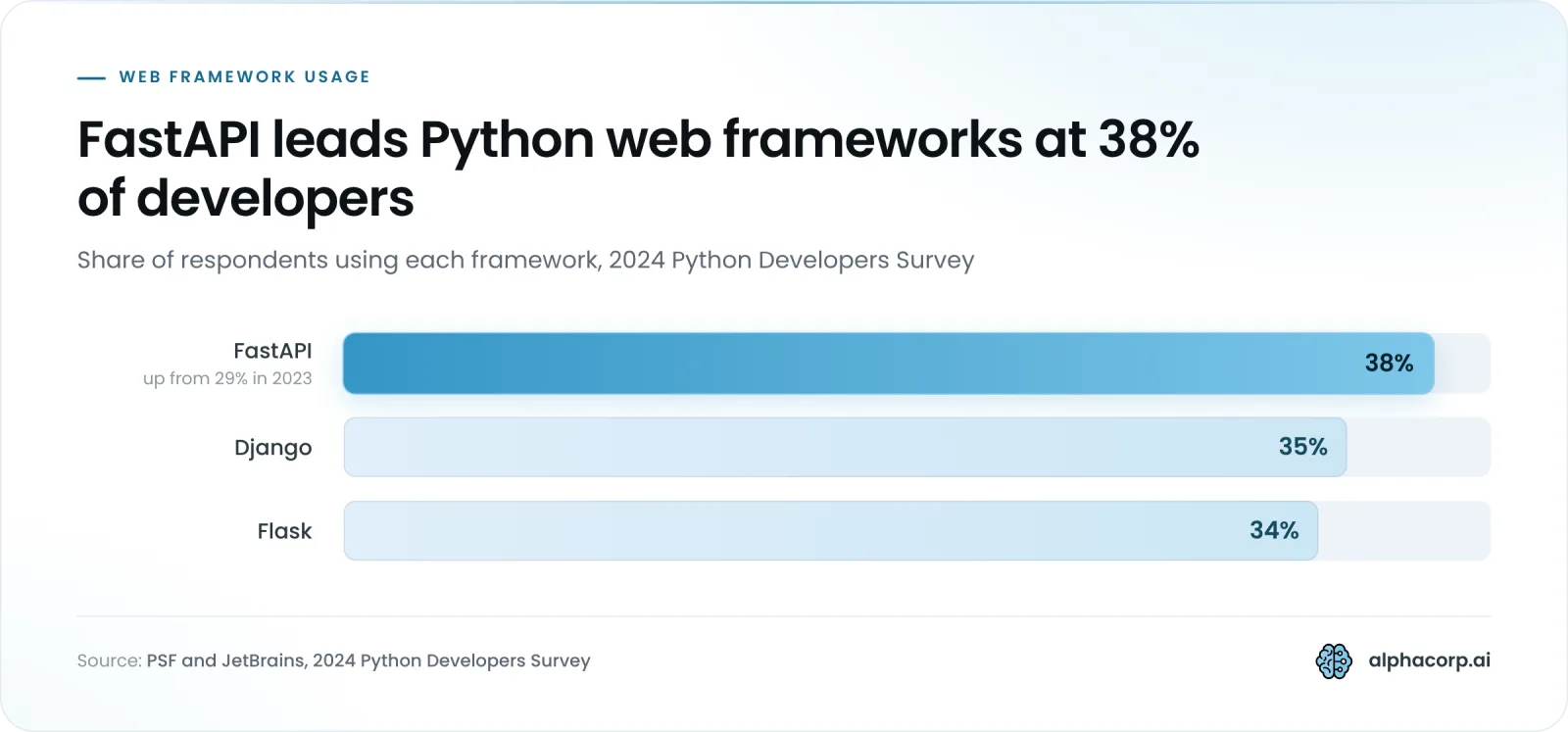
We build new API and inference services on FastAPI, the framework 38% of Python developers now use, and full-stack applications on Django where you need the ORM, admin, and auth out of the box. You get typed endpoints, a test suite, and a container that runs the same way locally and in your cloud.

02

Data pipelines and processing

Batch and scheduled pipelines in pandas and NumPy that pull from your sources, validate schemas, and load into your warehouse or feature store. Failures alert instead of silently producing stale tables.

03

AI and LLM service integration

Python is where the LLM tooling lives, so we build the model-serving layer, the LLM SDK integration, and the evaluation harness in it, whether the model is a hosted API or one you fine-tuned. For retrieval-backed features we plug in our RAG development work, and for multi-step tasks our AI agent development service.

04

Automation and internal tooling

Scripts that one person runs by hand become services with logging, retries, and an owner. This is usually where the fastest payback sits.

05

Python version upgrades and maintenance

With 83% of Python developers running a version at least a year behind the latest release, upgrade work is a large share of what we do: moving to Python 3.14, replacing abandoned packages, pinning what remains, and adding tests where none existed.

06

Deployment and MLOps for Python services

Containers, CI pipelines, and monitoring for the services above, delivered through our MLOps and DevOps practice so the code we write is also the code that runs.

Bar chart of Python web framework usage in the 2024 Python Developers Survey. FastAPI is highest at 38 percent, up from 29 percent in 2023. Django follows at 35 percent and Flask at 34 percent.
FastAPI reached 38% of Python developers in 2024, up from 29% a year earlier, ahead of Django at 35% and Flask at 34%. PSF and JetBrains, 2024 Python Developers Survey
03Stack

The Stack We Ship On

We pick the best tool for each job, not the trendiest. This is what runs behind the agents, retrieval pipelines and automation we put into production.

Languages
PythonRustTypeScript
Foundation Models
AnthropicOpenAIGeminiLlamaMistralHugging Face
Fast Inference
GroqCerebrasOpenRouterReplicateOllamavLLM
Agents & Orchestration
LangGraphLangChainLlamaIndexCrewAIn8n
Vector & Memory
MilvusPineconepgvectorChromaWeaviateRedis
Voice, Image & Fine-Tuning
ElevenLabsLiveKitVapiComfyUIPyTorch / LoRAModal
Cloud & Delivery
AWSAzureGoogle CloudDockerKubernetesVercel
Evals & Observability
LangSmithLangfuseWeights & BiasesGrafana
Process

How a Python development services engagement runs

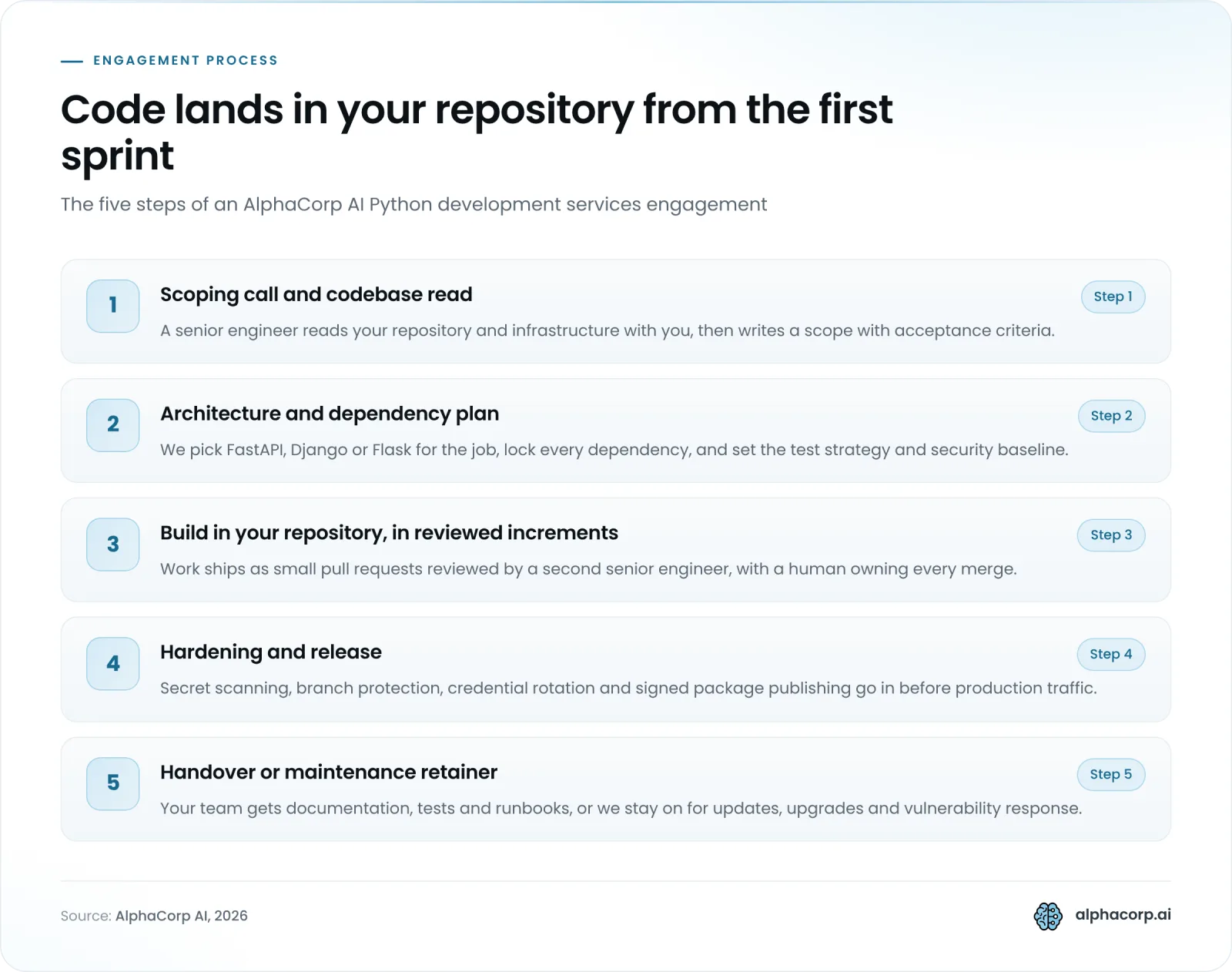
An engagement runs in five steps, from a scoping call to either handover or ongoing maintenance, with code landing in your repository from the first sprint. Nothing waits for a big-bang launch.
01

Scoping call and codebase read

A senior engineer reads your repository and infrastructure with you, names the Python version, framework, and dependency state, and writes a scope with acceptance criteria.

02

Architecture and dependency plan

We choose FastAPI, Django, or Flask based on the job, lock every dependency, define the test strategy, and set the security baseline before the first feature.

03

Build in your repository

Work ships as small pull requests reviewed by a second senior engineer. AI coding tools speed up the typing; a human owns every merge.

04

Hardening and release

Secret scanning, branch protection, credential rotation, and signed package publishing go in before the service takes production traffic.

05

Handover or maintenance retainer

Your team gets documentation, tests, and runbooks, or we stay on for dependency updates, version upgrades, and vulnerability response.

Vertical process diagram with five ordered steps. Step 1, scoping call and codebase read: a senior engineer reads your repository and infrastructure with you and writes a scope with acceptance criteria. Step 2, architecture and dependency plan: choose FastAPI, Django or Flask, lock dependencies, set the test strategy and security baseline. Step 3, build in your repository in reviewed increments: small pull requests reviewed by a second senior engineer, with a human owning every merge. Step 4, hardening and release: secret scanning, branch protection, credential rotation and signed package publishing before production traffic. Step 5, handover or maintenance retainer: documentation, tests and runbooks for your team, or ongoing dependency updates, version upgrades and vulnerability response.
Every engagement runs the same five steps, from the free scoping call to handover or an ongoing maintenance retainer.
Benefits

Why invest in Python development services instead of waiting to hire

Investing in Python development services gets senior Python engineers working on your system now, while the US market leaves 106,100 software developer, QA analyst, and tester openings a year to fill through 2035. Hiring is the slow option.

01

Senior hands in a junior-heavy market

Half of the respondents to the 2024 Python Developers Survey had under two years of professional coding experience. The engineer who reads your codebase on the scoping call is the engineer who writes the pull requests.

02

A codebase that stops falling behind

Python 3.14 brought free-threaded support (PEP 779), deferred annotation evaluation (PEP 649), template strings (PEP 750), and multiple interpreters in the standard library (PEP 734). You get those on upgrade. We do not plan capacity around the experimental interpreter's preliminary 3 to 5% pyperformance gain, because it needs a source build and varies by platform.

03

AI features in the language the ecosystem chose

GitHub's Octoverse 2025 report counts 582,196 Python repositories inside AI-tagged projects and 1.1 million public repositories using an LLM SDK, 693,867 of them created in the prior 12 months. PyTorch and TensorFlow, the two dominant deep-learning frameworks, are both Python-first.

04

A team that starts without a requisition

No job posting, no three-month search, no relocation. AlphaCorp AI's Python development services start with a scoping call and a signed scope.

Why AlphaCorp AI

Why teams pick AlphaCorp AI for Python development services

AlphaCorp AI is the engineering studio behind RustyRAG, an open-source RAG engine that returns answers in under 200 milliseconds, and we bring the same production standard to client Python work. Founded by Ignas Vaitukaitis, the team works remote-first from Rio de Janeiro, on US Eastern hours, in English, Portuguese, and Spanish. The people you talk to are the people who build.

Nearshore, on your working hours. A mixed-methods study of 80 client organizations, posted to arXiv in February 2026, found nearshore outsourcing beat far-offshore on project success, quality, schedule adherence, and communication overhead, and recommended it for Agile and communication-heavy projects. Rio de Janeiro on US Eastern hours is that model. The tradeoff is honest: a nearshore team costs more per hour than a far-offshore bench, and you are paying for the overlap that the same study says moves outcomes.

AI-assisted, human-reviewed. Microsoft Research's 2023 controlled experiment found developers using GitHub Copilot finished a constrained HTTP-server task 55.8% faster, and a 2026 observational dose-response study shows the gain depends on the task and the developer's experience. A 2026 ACL study of eight large language models found they default to Python in 58% of cases even for high-performance tasks and overuse NumPy in up to 45% of cases. We use the tools, and a senior engineer reviews the output, which is how NumPy stays out of a request handler that needed a list.

We say when Python is wrong. Python is the default for AI and data work and a poor fit for some latency-bound paths. When a budget calls for another language, you hear it before the build starts, and our Rust development services are usually where that conversation goes next.

The builders are on the call. No account-manager layer sits between you and the engineers. Questions get answered by the person who wrote the code.

Security practices inside our Python development services

AlphaCorp AI's Python development services treat the package supply chain as the primary attack surface and build the controls CISA recommends into every delivery.

Pinned package versions and lockfiles ship in every service, the first control in CISA's September 2025 Shai-Hulud guidance. Developer credential rotation, branch protection, and secret scanning go on every repository we touch, and any internal package we publish uses Trusted Publishing and PEP 740 signed attestations, following the PyPI hardening that CISA and the Python Software Foundation began in March 2024.

Our practices map to the four categories of NIST's Secure Software Development Framework, SP 800-218: prepare the organization, protect the software, produce well-secured software, respond to vulnerabilities. LLM components follow the 2024 SP 800-218A extension for generative AI. Your code stays in your repositories and your cloud accounts, under access you grant and can revoke.

We describe practices instead of naming certifications, and the practices are what procurement teams ask for under SSDF.

FAQ

Python development services FAQs

What are Python development services?

Python development services are outsourced software engineering for systems written in Python: web back ends, APIs, data pipelines, automation, and machine learning or LLM services. At AlphaCorp AI that means senior engineers building in your repositories with FastAPI, Django, pandas, and PyTorch or TensorFlow as the job requires, then handing over code your team can run. Python is the main language for 86% of respondents in the 2024 Python Developers Survey, so the talent pool and the library ecosystem are both deep.

How much do Python development services cost?

Scope decides it. A single FastAPI service, a version upgrade across a large codebase, and a platform with pipelines and model serving are different engagements, so we price after the scoping call rather than from a rate card. The number to compare any quote against is a US in-house hire: the Bureau of Labor Statistics put the median software developer wage at $135,980 in May 2025, before recruiting time and benefits.

How long does a Python development project take?

Duration follows scope, and code reaches your repository in the first sprint regardless of size. A contained service moves fastest. An upgrade project depends on how far behind the codebase is, which matters given that 83% of Python developers run a version at least a year old. The scoping call ends with a phase plan you can hold us to.

Should we hire in-house, use a far-offshore agency, or work with AlphaCorp AI?

Hire in-house if you can fill the role and afford the wait; use far-offshore for well-specified, low-communication work at the lowest hourly rate; use a nearshore partner like AlphaCorp AI for Agile, communication-heavy Python work. The February 2026 arXiv study of 80 client organizations found nearshore arrangements beat far-offshore on success, quality, and schedule, while development method alone changed little beyond cost. Time-zone overlap is the variable that moved results.

Can AlphaCorp AI work inside our existing Python codebase and stack?

Yes, and most engagements start that way. We keep your framework, whether Django, Flask, or FastAPI, upgrade the Python version where it is behind, pin dependencies, and add tests before changing behavior. Rewrites happen only when the scoping read shows the old code cannot carry the new requirement.

What happens after launch?

You choose handover or a maintenance retainer. Handover includes documentation, tests, and runbooks your team owns. The retainer covers dependency updates, Python version upgrades, monitoring, and vulnerability response, the fourth SSDF category and the one most teams drop first.

Is Python still the right language for AI work?

For AI, machine learning, and data work, yes. IEEE Spectrum's 2025 ranking placed Python first overall and first for jobs, while GitHub's Octoverse 2025 report showed TypeScript overtaking Python by contributor count in August 2025, with Python second at 2.6 million contributors. Both are true at once. Python still leads AI-tagged repositories, and for a latency-bound hot path we will tell you when another language wins.

The Shift
AlphaCorp AI
0:000:00