

Rust Development Services
Memory-safe, garbage-collector-free systems code for engineering teams that have a security deadline and no Rust hires to meet it.
AlphaCorp AI's Rust development services put senior Rust engineers on your C/C++ migration, greenfield systems service, or latency-sensitive AI infrastructure, and ship code that removes whole classes of memory-safety bugs at compile time without a garbage collector. The service covers architecture, incremental rewrites of parsers and hot paths, reviews of unsafe and foreign function interface (FFI) boundaries, and embedded or safety-critical work on a qualified toolchain. It is built for CTOs and heads of engineering who face US memory-safety guidance and the EU Cyber Resilience Act, whose reporting obligations begin on 11 September 2026, and who cannot staff a Rust team fast enough.

Creators of RustyRAG
Realtime RAG, built in Rust · Sub-200ms end-to-end 10+ years delivering AI solutionsIgnas Vaitukaitis · Founder & CEO
 VersarWashington, DC
 GynisusNew York
 CampusReelNew York
 LuniqGermany
 HospitalityFlowSingapore
Rust development services by the numbers, 2025 to 2026
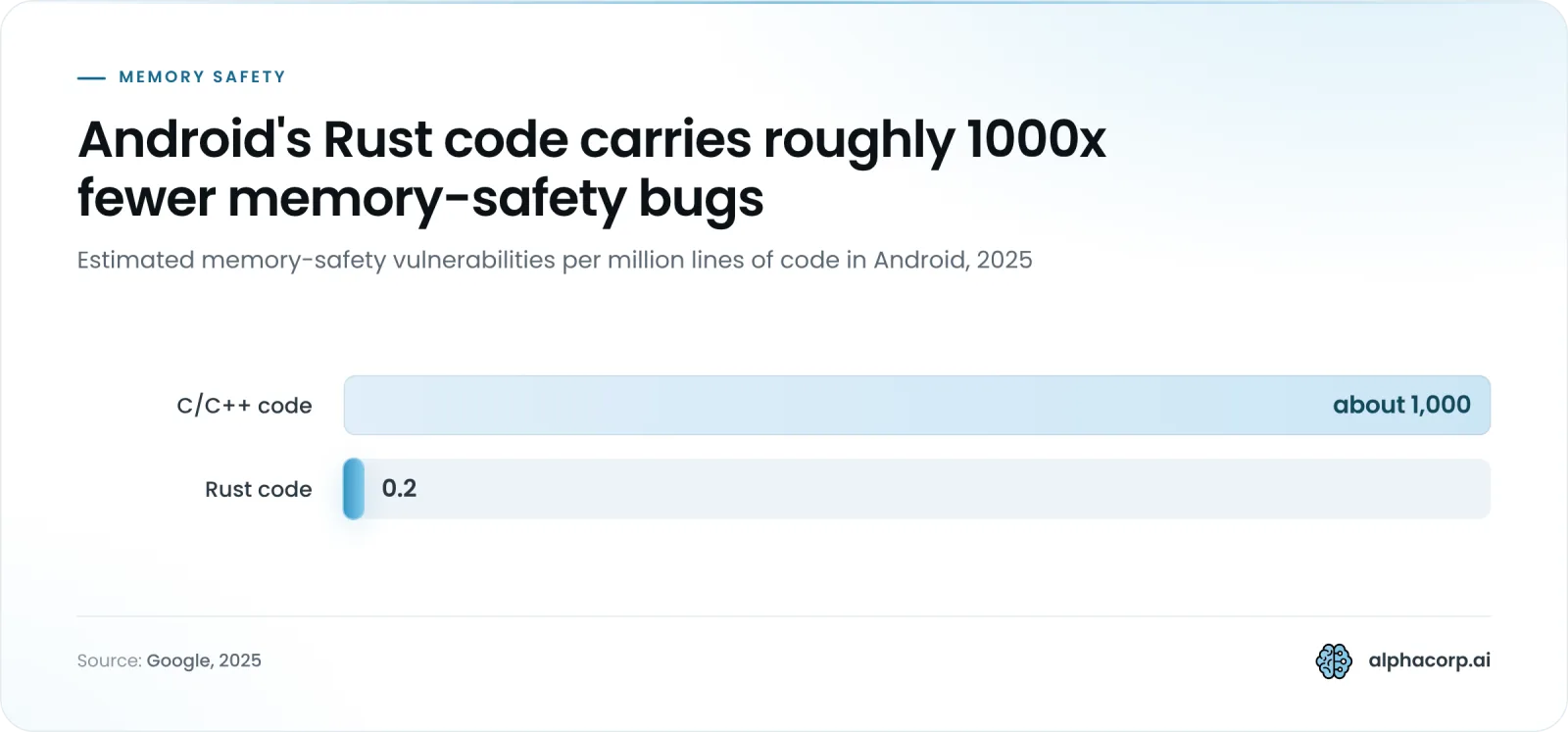
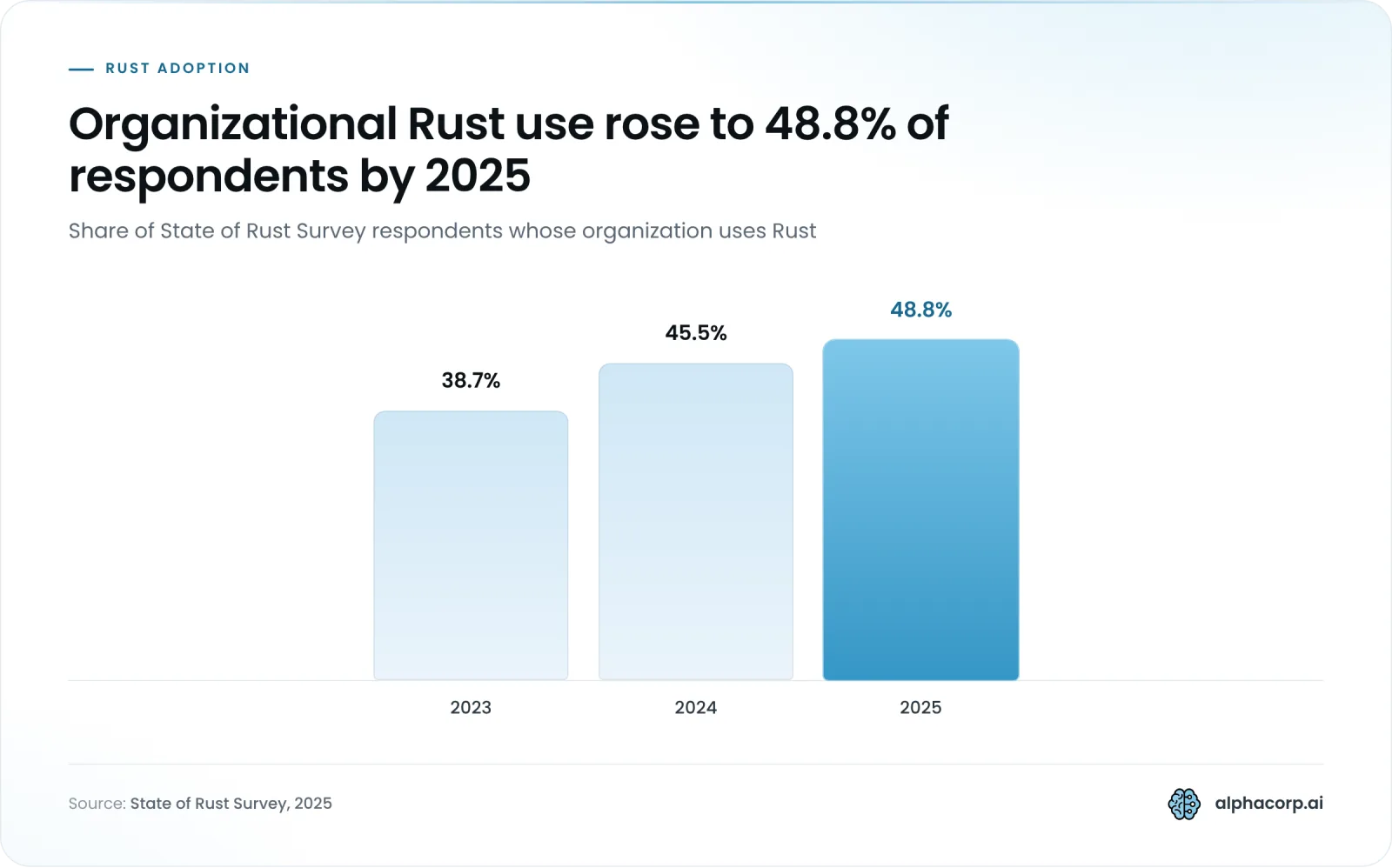
The case for Rust rests on published production numbers and on a regulatory clock that has already started.
What our Rust development services build
AlphaCorp AI builds six kinds of Rust work, and each one targets a specific place where C/C++ risk or garbage-collector latency is costing you.
The Stack We Ship On
We pick the best tool for each job, not the trendiest. This is what runs behind the agents, retrieval pipelines and automation we put into production.
 AWS
AWS Azure
AzureHow an AlphaCorp AI Rust development services engagement runs
An engagement runs in five sequential steps, from a ranked risk map to a handover your own engineers can maintain.
Why invest in Rust development services now
The case for Rust rests on published production numbers from 2025 and 2026, plus a regulatory clock that started in 2024.
Rust development services in action across industries
Rust has already proven itself in six production patterns, and those patterns are the shapes of work AlphaCorp AI takes on.
Why AlphaCorp AI for Rust development services
AlphaCorp AI is the engineering studio behind RustyRAG, an open-source retrieval-augmented generation engine with sub-200ms retrieval, written in Rust. The team is remote-first, based in Rio de Janeiro, works US Eastern hours, and operates in English, Portuguese, and Spanish. We are the right partner when the blocker is hiring and the risk is concentrated in code you can name.
We solve the hiring problem you have already hit. A 2021 University of Maryland study presented at USENIX SOUPS found that difficulty recruiting developers already qualified in Rust was among the most-cited drawbacks of adoption, and the 2025 State of Rust Survey still lists insufficient industry usage as respondents' top concern at 42.1%. You get senior Rust engineers on day one, and pairing means the capability stays in your building.
We tell you where Rust will not save you. Rust reduces memory-safety risk without eliminating it. Recent studies put direct unsafe usage at roughly 19 to 25% of published crates, mostly for FFI and performance paths, and bugs inside those blocks mirror C/C++ logic errors. Embedded is harder still: a 2024 ACM CCS study of 6,408 embedded Rust packages found peripheral-access-crate support for only 37% of microcontroller families, unsafe code in 48.5% of embedded crates, and static-analysis false-positive rates of 40 to 90%. If your target MCU is not covered, we say so before you sign.
The tradeoff, stated up front. Rust has a steep learning curve, and a 2021 multicore N-body study found comparable performance to C alongside real differences in programming effort. A rewrite costs more than a patch. That is why step one of every engagement ranks your components by exposure, so you spend only where the risk justifies it. Where the hot path is not the problem, our Python development services are the cheaper answer.
The people you talk to are the people who build. No handoff from a sales engineer to a bench you never met. Read about how the studio works.
Security and compliance in our Rust development services
AlphaCorp AI's Rust work maps directly to the memory-safety guidance that regulators and auditors now cite. Four documents set the bar.
The White House ONCD's February 2024 report argues that manufacturers can eliminate entire vulnerability classes by moving from C and C++ to memory-safe languages. The June 2025 NSA and CISA joint guidance names Rust, Go, and Java, building on the agencies' 2023 call for vendors to publish memory-safety roadmaps by the end of 2025.
NIST's Secure Software Development Framework, SP 800-218, which federal agencies have attested against since 2022, situates memory-safe language adoption inside a documented development process. The EU Cyber Resilience Act imposes security-by-design obligations on products sold in the EU, with reporting duties from 11 September 2026.
In practice, engagements run inside your repositories, your CI, and your review process. Every unsafe block ships with a written justification, which is the artifact an auditor asks for first.