

On this page(18)
- Gemini 4 Argon vs GPT-6 Astra: the verdict at a glance
- Coding and agentic benchmarks: where each model wins
- Knowledge work, science and computer-use benchmarks
- Long context and output limits: 1M output tokens vs 1.05M context
- Pricing: Argon costs a fifth of Astra per token
- Availability: GPT-6 Astra is live, Gemini 4 Argon is gated
- Cybersecurity capabilities: CWE-bench tie and vulnerability discovery
- Safety and risk classification: Critical tier vs Frontier Safety Framework
- How much to trust these numbers: self-reported benchmarks and missing head-to-heads
- Frequently asked questions about Gemini 4 Argon vs GPT-6 Astra
- Is Gemini 4 Argon better than GPT-6 Astra for coding?
- How much cheaper is Gemini 4 Argon than GPT-6 Astra?
- When will Gemini 4 Argon be available to the public?
- What is the context window of Gemini 4 Argon?
- Why is GPT-6 Astra classified as Critical?
- Which model is safer against prompt injection?
- Can a small team use either model today without an enterprise contract?
- Which model to choose for your workload
Google published its Gemini 4 Argon benchmark table on September 30, 2026, and it scores GPT-6 Astra on all 19 rows. Head to head, Argon wins 14, Astra wins 4 and one is a tie. In the Gemini 4 Argon vs GPT-6 Astra decision, that lead plus a rate card at a fifth of Astra’s price makes Argon the stronger model on paper, while Astra is the stronger model to buy this quarter because it is the only one a paying customer can call. What follows is every published score, both rate cards and the rollout gates, so you can choose by score, price or access.
The numbers that decide it, as of September 30, 2026:
- DeepSWE v1.1 (2026): Gemini 4 Argon 77.9%, GPT-6 Astra 74.1%, per Google’s Gemini 4 Argon announcement.
- List price per million tokens (2026): Argon $2 in and $10 out at the introductory rate, Astra $10 in and $50 out, per Google’s announcement and OpenAI’s API pricing page.
- Maximum output (2026): Argon 1,000,000 tokens, Astra 128,000 tokens, per Google’s announcement and OpenAI’s model documentation.
- Gray Swan indirect prompt injection (2026): Argon 0.7% attack success, Astra 8.5%, as reported by Google.
- Availability (2026): Astra rolling out to ChatGPT and API customers since September 3, 2026. Argon limited to Fairwind Program cyber defenders with no public date.
Curious what AI could do for your business?
No jargon and no hard sell. Just a friendly look at where AI fits, and where it doesn't.
Gemini 4 Argon vs GPT-6 Astra: the verdict at a glance
Gemini 4 Argon beats GPT-6 Astra on 14 of the 19 benchmarks in Google’s September 30, 2026 comparison table and lists at a fifth of Astra’s per-token price, but GPT-6 Astra is the only one of the two a paying customer can actually use today. So the answer splits by axis. If you need a frontier model in production this quarter, pick Astra. If you can wait, and you care about cost, long outputs or agentic coding scores, Argon is the model to plan around.
As of September 30, 2026, that is the whole verdict. The rest is how each side earns it.
| Gemini 4 Argon | GPT-6 Astra | |
|---|---|---|
| Launch date | September 30, 2026 | September 3, 2026 |
| Input price per 1M tokens (2026) | $2 introductory, $4 standard | $10 (up to 272K input) |
| Output price per 1M tokens (2026) | $10 introductory, $20 standard | $50 (up to 272K input) |
| Cached input per 1M tokens (2026) | $0.10 | $1 |
| Maximum output | 1,000,000 tokens | 128,000 tokens |
| Context window | Not published by Google | 1,050,000 tokens |
| Who can use it on Sep 30, 2026 | Fairwind Program cyber defenders, Google internal teams | ChatGPT Pro, Enterprise, Business, Plus, API, Codex |
| Rows led on Google’s 19-row table | 13 outright, 1 tie | 3 outright, 1 tie |
| Vendor’s own risk posture | Phased release under Frontier Safety Framework | “Critical” cybersecurity tier under Preparedness Framework |
The cleanest way to hold this in your head is the three-axis read we use at AlphaCorp AI when a client asks which frontier model to standardise on: score, price, access.
- Score: head to head, Argon beats Astra on 14 rows, Astra beats Argon on 4 (FrontierSWE v2, Terminal-bench 4.0, Terminal-Bench Science 0.1 and OSWorld-2.0), and CWE-bench v1 is a tie. Across all four models in the table, Argon leads 13 rows outright.
- Price: Argon’s 2026 introductory rate is $2 in and $10 out per million tokens, against Astra’s $10 and $50 on OpenAI’s 2026 rate card.
- Access: Astra has been rolling out to ChatGPT and API customers since September 3, 2026. Argon is limited to vetted cyber-defense partners, with no public date for wider release.
One thing to keep in mind before the numbers start piling up. A benchmark lead on a table the winning vendor assembled is a weaker signal than a rate card or a rollout date. Weight it that way.
Coding and agentic benchmarks: where each model wins
On agentic coding, Gemini 4 Argon takes three of the five head-to-head rows against GPT-6 Astra (DeepSWE v1.1, Vibe Code Bench and PostTrainBench), while Astra wins FrontierSWE v2 by 10.5 points and edges Terminal-bench 4.0, which makes coding the closest category in the whole comparison.
Here are the five rows as Google published them on September 30, 2026, with the two Claude models Google included for context:
| Benchmark (2026) | Gemini 4 Argon | GPT-6 Astra | Claude Fable 5.1 | Claude Opus 5.5 |
|---|---|---|---|---|
| DeepSWE v1.1 | 77.9% | 74.1% | 67.4% | 74.2% |
| FrontierSWE v2 | 55.0% | 65.5% | 56.3% | 62.3% |
| Vibe Code Bench | 91.9% | 89.6% | 90.3% | 90.3% |
| Terminal-bench 4.0 | 57.4% | 58.2% | 57.9% | 66.4% |
| PostTrainBench | 45.3% | 44.3% | 40.2% | 49.3% |
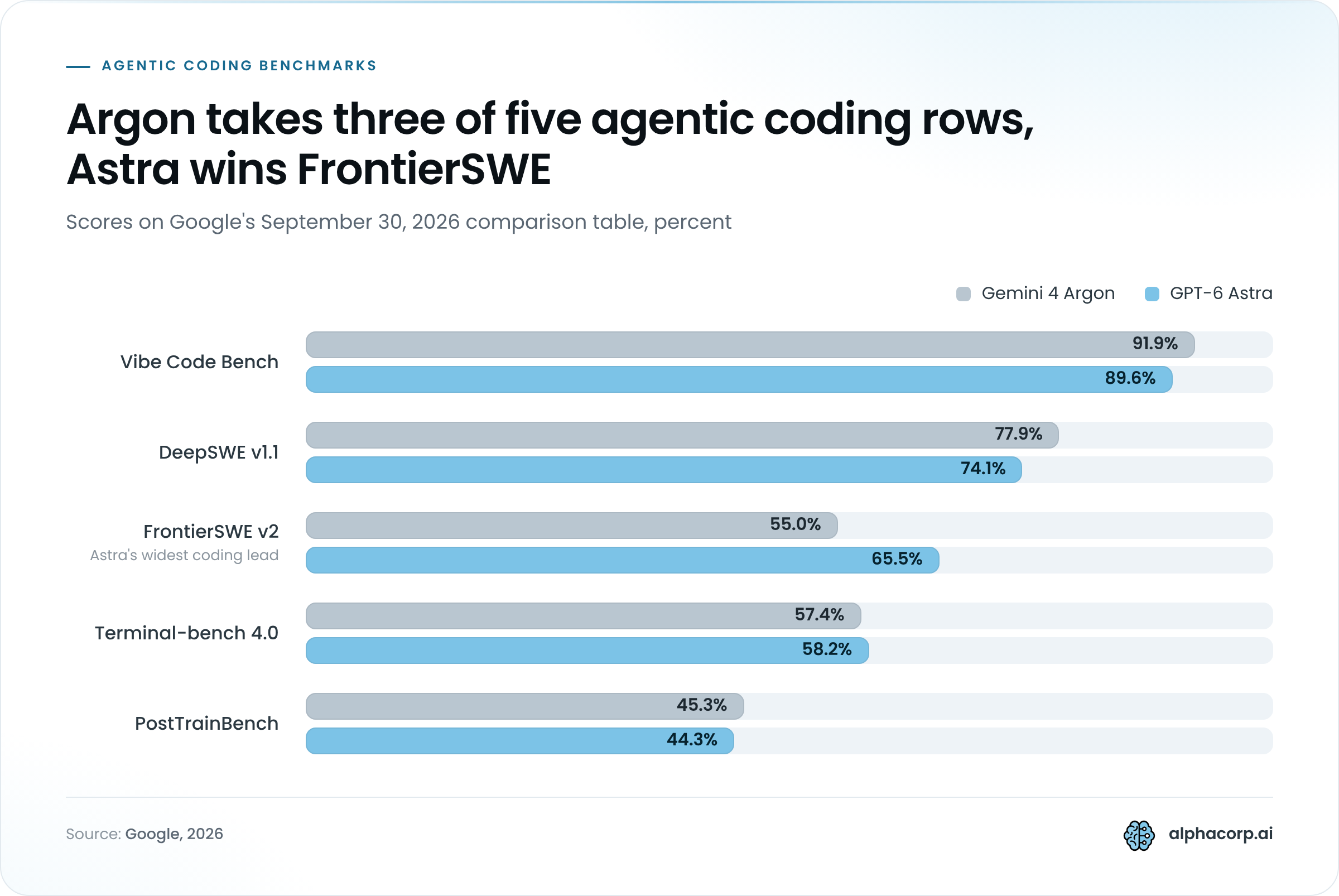
DeepSWE is the number Google leads with. Argon scored 77.9% on DeepSWE v1.1 in 2026, which Google’s Gemini 4 Argon announcement calls a new state of the art for long-horizon, real-world engineering tasks. Astra sits at 74.1% and Claude Opus 5.5 at 74.2%. A 3.8-point gap. Real, and echoed on the Vibe Code Bench row (91.9% to 89.6%), but hardly a rout.
FrontierSWE v2 flips it. Astra’s 65.5% beats Argon’s 55.0% by more than all four other coding gaps on the table added together. Google describes DeepSWE as a test of long, real-world engineering work and gives no matching description of FrontierSWE, so the safe reading is that the two suites reward different behaviours and Astra does better at whatever FrontierSWE asks for. Anyone who has run their own SWE-style eval knows a 10-point swing between two suites is normal. It’s also why the only score that settles this is the one from your own repo.
Argon is “built to sustain deep reasoning across complex, long-horizon workflows.” Koray Kavukcuoglu, SVP at Google DeepMind, September 30, 2026.
Terminal-bench 4.0 and PostTrainBench belong to neither model. Claude Opus 5.5 posts 66.4% on Terminal-bench 4.0 against Astra’s 58.2% and Argon’s 57.4%, and 49.3% on PostTrainBench against Argon’s 45.3% and Astra’s 44.3%. Google left those grey cells in its own table, which earns it some credit. If your workload is terminal-driven agent loops or post-training pipelines, neither headline model is the 2026 leader.
My lean: Argon for long-running repository tasks, Astra when FrontierSWE-shaped work is your daily bread. Close call.
Knowledge work, science and computer-use benchmarks
Across the eleven knowledge-work, science, computer-use and multimodal rows in Google’s September 30, 2026 table, Gemini 4 Argon leads nine and GPT-6 Astra leads two: Terminal-Bench Science 0.1 (68.1% to 57.6%) and OSWorld-2.0 (72.6% to 69.2%).
| Benchmark (2026) | Gemini 4 Argon | GPT-6 Astra | Leader |
|---|---|---|---|
| Vals Index | 68.9% | 63.1% | Argon |
| AutomationBench | 51.3% | 41.4% | Argon |
| Vals Finance Agent v2 | 65.4% | 53.5% | Argon |
| Harvey’s Legal Agent Benchmark | 19.6% | 5.4% | Argon |
| Terminal-Bench Science 0.1 | 57.6% | 68.1% | Astra |
| LABBench 2 | 88.8% | 85.4% | Argon |
| RiemannBench | 76.0% | 72.0% | Argon |
| Agent’s Last Exam (pass rate) | 39.5% | 34.2% | Argon |
| OSWorld-2.0 (offline subset, partial score) | 69.2% | 72.6% | Astra |
| Chartography | 71.6% | 71.0% | Argon |
| LVBench | 91.7% | 87.5% | Argon |
Knowledge work is Argon’s strongest category. The Vals Index, which weights finance, coding, legal and tax tasks by each sector’s share of U.S. GDP, puts Argon at 68.9% against Astra’s 63.1% in 2026. AutomationBench, Zapier’s end-to-end business-workflow test, is a 10-point gap at 51.3% to 41.4%. Vals Finance Agent v2 runs 65.4% to 53.5%.
Harvey’s Legal Agent Benchmark is the row to read twice. Argon’s 19.6% is more than triple Astra’s 5.4%, and it is still under 20%. Every model on the table fails roughly four times in five at legal research and drafting. A law firm should read that row as “nobody can do this reliably yet, and Argon fails least” rather than as a green light.
The rest of the rows sort into three shapes:
- Split science: Astra wins Terminal-Bench Science 0.1 by 10.5 points. Argon wins LABBench 2 (88.8% to 85.4%) and RiemannBench (76.0% to 72.0%).
- Split computer use: Argon leads Agent’s Last Exam 39.5% to 34.2%. Astra leads OSWorld-2.0 72.6% to 69.2%, on an offline subset with a partial score.
- Multimodal: Chartography is a coin flip at 71.6% to 71.0%. LVBench, the long-video test, is a real lead at 91.7% to 87.5%.
OpenAI tells a different story about some of the same rows. The GPT-6 Astra launch on September 3, 2026 claims state-of-the-art results on Agents’ Last Exam and AutomationBench, plus ScreenSpot Pro, FrontierMath Tier 4 and ARC-AGI-3. Both claims can be true. OpenAI’s was made 27 days before Google’s table existed. ScreenSpot Pro, FrontierMath Tier 4 and ARC-AGI-3 don’t appear in Google’s table at all, so there is no Argon score to set against them.
The ARC-AGI-3 figure deserves its own asterisk. Under OpenAI’s own agentic harness, Astra reportedly reaches the high 90s, while a plain stateless API call scores far lower. ARC Prize’s leaderboard only counts runs it verifies itself on its semi-private test sets, so treat the vendor number as harness-dependent until ARC Prize posts one.
Long context and output limits: 1M output tokens vs 1.05M context
On long context, Gemini 4 Argon beats GPT-6 Astra on both GraphWalks rows and on the output ceiling (1,000,000 tokens against 128,000), while Astra is the only one of the two with a published input window, at 1,050,000 tokens on OpenAI’s 2026 model documentation.
| Limit (2026) | Gemini 4 Argon | GPT-6 Astra |
|---|---|---|
| Maximum output per response | 1,000,000 tokens | 128,000 tokens |
| Input context window | Not published | 1,050,000 tokens |
| GraphWalks BFS, up to 128K (F1) | 99.7% | 98.7% |
| GraphWalks BFS, 256K to 1M (F1) | 84.2% | 71.8% |
| Knowledge cutoff | Not published | April 30, 2026 |
The output number is the one Google is proudest of. Argon’s cap rose from 64,000 tokens on the prior generation to 1,000,000 in September 2026, and Google’s stated reason is that the model can think and generate through an entire multi-step task in a single trajectory instead of being cut off and resumed. Astra’s 128,000-token output cap is roughly an eighth of that.
The input side is murkier. Google has not printed an input window for Argon. Third-party estimates run anywhere from 1.5 million to 10 million tokens, and none of them trace back to a Google document, so treat every one of them as a rumour. What Google did publish is a GraphWalks result on inputs between 256K and 1M tokens, which tells you Argon accepts at least a million tokens of input. The ceiling above that is unknown.
GraphWalks is where the gap opens. Both models are near-perfect up to 128K (99.7% versus 98.7%), so for a typical retrieval-augmented pipeline that feeds 30K to 100K tokens per call the difference is noise. Between 256K and 1M tokens, Argon holds 84.2% while Astra drops to 71.8%. That 12.4-point spread is the largest long-context gap on Google’s table.
Here’s the practical read. If you’re stuffing an entire codebase or a quarter’s worth of contracts into one prompt, Argon degrades more gracefully. If you’ve built a proper RAG pipeline that keeps each call well under 128K, either model handles it, and you should be choosing on price instead.
Pricing: Argon costs a fifth of Astra per token
On price, Gemini 4 Argon beats GPT-6 Astra by a wide margin: $2 per million input tokens and $10 per million output at Google’s 2026 introductory rate, against $10 and $50 on OpenAI’s 2026 rate card for requests up to 272K input tokens.
| Per 1M tokens (2026) | Argon introductory | Argon standard | Astra up to 272K input | Astra over 272K input |
|---|---|---|---|---|
| Input | $2.00 | $4.00 | $10.00 | $20.00 |
| Cached input | $0.10 | Not published | $1.00 | $2.00 |
| Cache write | Not published | Not published | $12.50 | $25.00 |
| Output | $10.00 | $20.00 | $50.00 | $75.00 |
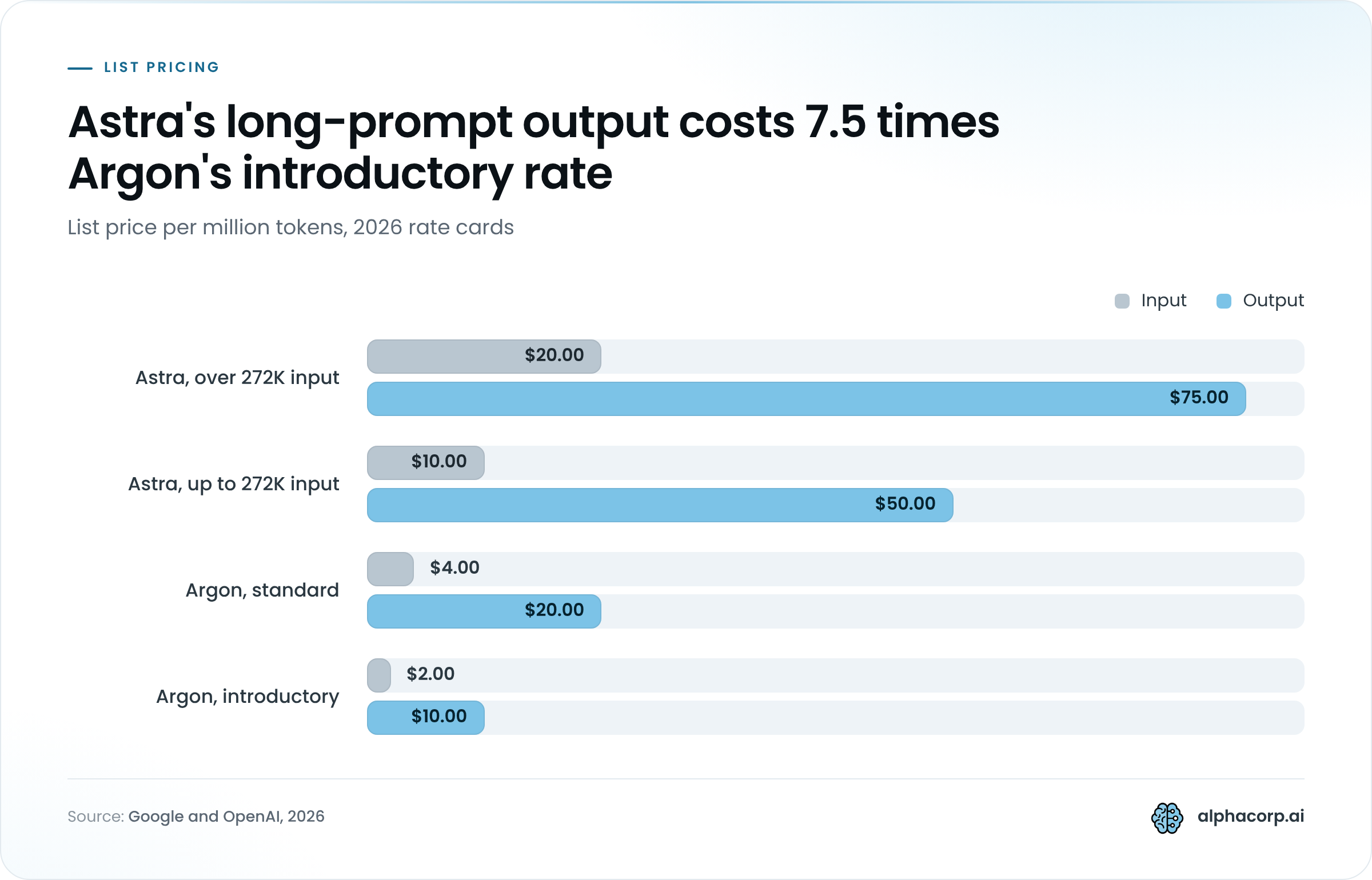
Astra’s card has more moving parts. OpenAI’s 2026 API pricing page doubles the input rate and lifts output to $75 once a request passes 272K input tokens. Batch mode runs at about half the standard rate. Fast and Ultrafast tiers cost 2 to 4 times more. Regional or FedRAMP processing adds a 10% surcharge on models released after March 5, 2026, which includes Astra.
Two example workloads make the gap concrete:
- Short agent run, 200K input and 50K output: Argon introductory $0.90, Argon standard $1.80, Astra $4.50. That is a 5x gap today and 2.5x after Argon’s promo ends.
- Long-document run, 500K input and 100K output: Argon introductory $2.00, Argon standard $4.00, Astra $17.50, because the whole request lands in the over-272K tier. Nearly 9x at the introductory rate.
Now the fine print. Argon’s $2 and $10 is an introductory price for a model almost nobody outside Google can call yet, set against a rate card Astra customers have been paying since September 3, 2026. The standard $4 and $20 still leaves Argon at 40% of Astra’s short-context price, so the lead survives the promo. It just shrinks.
Reasoning tokens bill as output on both platforms. That matters more than it sounds, because a model with a 1M-token output cap can spend a lot of tokens thinking before it answers. Honestly, this is the line I’d watch hardest once Argon’s API opens: a single deep trajectory at $10 per million output could cost more than the same task on Astra if Argon reasons five times longer to get there. Nobody outside Google has that data yet.
Availability: GPT-6 Astra is live, Gemini 4 Argon is gated
On availability, GPT-6 Astra wins outright: it has been rolling out to ChatGPT Pro, Enterprise, Business and Plus subscribers plus API and Codex users since September 3, 2026, while Gemini 4 Argon on September 30, 2026 is limited to vetted cyber defenders in Google’s Fairwind Program and Google’s own internal teams.
That is the single biggest practical difference between these two models. Every benchmark row in this comparison is something Astra customers can test against their own workload this afternoon. Argon’s rows are numbers you have to take on faith until Google opens the door.
Google’s rollout order is stated, but undated:
- Trusted cyber defenders through the Fairwind Program, plus Google internal teams (live now).
- Paid API customers and Google AI Ultra subscribers (next, no date given).
- Developers, enterprises and consumers more broadly (“as soon as possible,” in Google’s words).
Getting into Fairwind is deliberately hard. Google DeepMind’s Fairwind Program requires phishing-resistant multi-factor authentication, background checks on the applying organisation, and use restricted to authorised defensive work such as threat simulation, reverse engineering and malware analysis. Partners in that cohort receive Argon without cyber guardrails, which is the version Google wants tested before anything reaches the general public.
“We’ll continue to gather feedback from early testers as we iterate on guardrails before making Argon available to developers, enterprises, and consumers as soon as possible.” Koray Kavukcuoglu, Google DeepMind, September 30, 2026.
Astra’s rollout was phased too, but across paying tiers rather than vetted organisations, and it was broad within days of launch. Astra is the only model here you can benchmark on your own repo today. Argon is the one you plan around.
Fair enough on Google’s caution. It’s still frustrating.
Cybersecurity capabilities: CWE-bench tie and vulnerability discovery
On cybersecurity, Gemini 4 Argon and GPT-6 Astra tie at 68% on CWE-bench v1 in 2026, and Argon is the only one of the two with published vulnerability-discovery scores: 85.8% on real-world source-code discovery and 70.9% on Wiz’s penetration-test benchmark.
The CWE-bench tie is a three-way one. Google’s leaderboard, scored Pass@1 with Pass@4 as the tiebreak, reads:
- Grok 4.7 (opencode harness): 68%
- Gemini 4 Argon (Antigravity harness): 68%
- GPT-6 Astra (Codex harness): 68%
- Claude Opus 5.5 (Claude Code): 67%
- Claude Fable 5.1 (Claude Code): 58%
- Grok 4.6 (opencode): 57%
- GPT-6 Sol (Codex): 52%
Every model ran inside a different agent scaffold, so each row measures model plus tooling. Three models within a point of each other on three different harnesses is a dead heat. Patching a known flaw has become a task the whole frontier does about equally well.
Discovery is where Argon separates. Google published two discovery scores for Argon in 2026, each measured against its own prior cyber model, Gemini 3.8 Flash Cyber, instead of against Astra:
- Real-world Vulnerability Discovery (source code across 20 languages): 85.8% versus 71.0%
- Wiz Penetration Test Benchmark (live web systems, no source code): 70.9% versus 58.2%
What could a custom AI agent take off your plate?
We build production-grade AI systems that quietly handle the busywork, so your team can focus on the work that actually matters.
OpenAI has published no matching discovery figure for Astra, so the only security head-to-head between the two is the patching test.
The most concrete evidence is a single find. Wiz, running Argon through its Scan for Good programme, which scans public infrastructure for free, turned up a critical flaw exposing personal data in healthcare software used by hospitals worldwide. Google says earlier frontier models had missed it. One anecdote is one anecdote. It’s still the kind of result a hospital CISO remembers longer than any percentage.
Google’s internal engineering numbers point the same way. In 2026, Argon agents replaced 32,000 lines of SIMD code in libgav1, Google’s open-source video decoder, with safe Rust the compiler vectorises on its own, and the result runs 2.7x faster than the earlier Rust port with identical video output. Rust migrations now range from small libraries such as re2 up to the 800,000-plus-line Zircon kernel in Fuchsia OS. A team of Argon agents also freed over 300 TiB of memory across Google’s data centres, with Google estimating 500 TiB to 1 PiB in total savings.
Those are Google’s numbers about Google’s code, checked by Google. Weight them as such. Memory-safe rewrites at kernel scale are still exactly the defensive work Fairwind partners exist to test, and nothing comparable has been published for Astra.
Safety and risk classification: Critical tier vs Frontier Safety Framework
On safety, Gemini 4 Argon posts the better measured result, a 0.7% attack success rate on Gray Swan’s 2026 indirect-prompt-injection benchmark against GPT-6 Astra’s 8.5%, and the two vendors made opposite release calls for models both of them treat as dangerous.
Start with OpenAI’s call, because it is the more unusual one. OpenAI’s GPT-6 Astra system card places the model at the “Critical” cybersecurity level under the Preparedness Framework, the first time OpenAI has put any model at that tier. The framework defines Critical as a capability that “could introduce unprecedented new pathways to severe harm,” and requires safeguards during development as well as at deployment. Astra shipped broadly anyway on September 3, 2026, with the safeguards OpenAI lists:
- Strengthened jailbreak resistance
- Model isolation and encrypted checkpoints
- Misalignment monitoring on tool-using inference
- 99.79% resistance on indirect prompt-injection attacks and 99.99% on instruction-hierarchy tests, both from OpenAI’s own evaluations
Google made the opposite call. Argon’s release is phased under the Frontier Safety Framework, and the model is trained to refuse cyber and CBRN requests while allowing dual-use science. Google says it monitors the model’s internal activations for misuse, ran internal and external red teams with manual and automated attacks, and watches Argon’s chain of thought and actions mid-task with the authority to halt execution. One detail stuck with me: Google ran that same monitor over training and deliberately kept its findings out of the training signal, so the model would never learn to hide its reasoning from the monitor.
Now the one number both sides can be measured on. Gray Swan’s Indirect Prompt Injection benchmark, as reported by Google on September 30, 2026, scores attack success at 15 attempts, lower is better:
| Model (2026) | Attack success rate |
|---|---|
| Gemini 4 Argon | 0.7% |
| Claude Opus 5.5 | 1.0% |
| Claude Fable 5.1 | 1.0% |
| Claude Opus 5 | 4.6% |
| Gemini 3.8 Flash | 5.5% |
| Gemini 3.8 Flash Cyber | 6.0% |
| GPT-6 Astra | 8.5% |
| GPT-6 Sol | 10.1% |
| Muse Spark 1.3 | 15.9% |
| GPT-5.6 Sol | 27.0% |
| GLM 5.3 | 31.5% |
| Grok 4.6 | 51.8% |
| Kimi K3 | 52.7% |
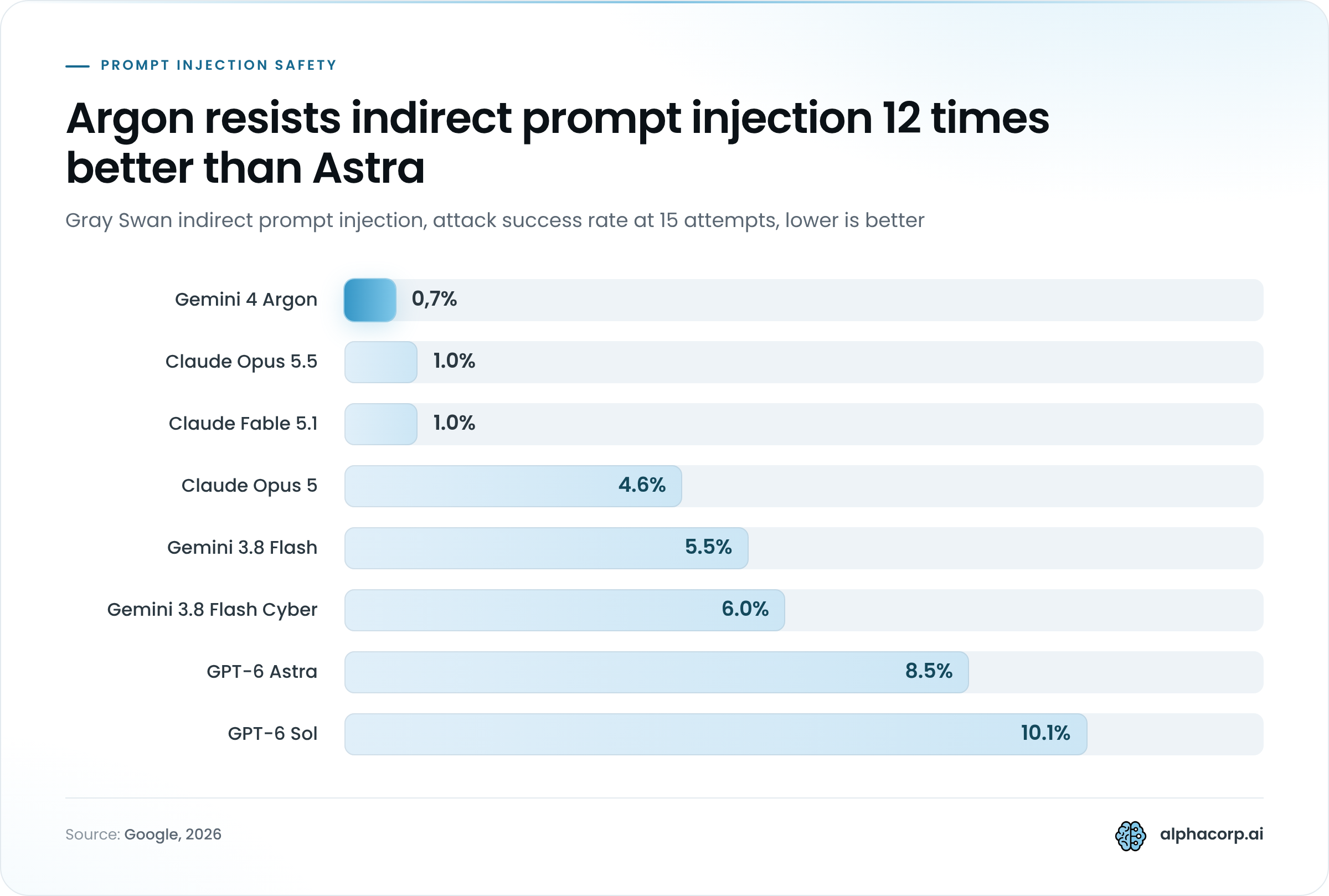
Astra’s 8.5% and OpenAI’s 99.79% answer different questions. Gray Swan gives an attacker 15 tries. OpenAI’s figure comes from its own attack set with its own attempt budget. Read Argon’s 0.7% as a 12x edge on the one shared test, and Astra’s 99.79% as a claim waiting for an outside run.
Both models pass through the same U.S. government check. NIST’s Center for AI Standards and Innovation, the renamed U.S. AI Safety Institute, holds voluntary pre-release access agreements with Google DeepMind and with OpenAI (which first signed in 2024) to probe cyber, bio and chemical capabilities before launch. A 2026 external review of DeepMind’s “scheming inability” safety case, published on arXiv, found gaps in how such cases get built across the industry. Apply that scepticism evenly. Neither lab’s safety claim carries an independent stamp yet.
How much to trust these numbers: self-reported benchmarks and missing head-to-heads
Trust every score in this comparison as a vendor claim, because as of September 30, 2026 neither Google nor OpenAI has published an independently audited head-to-head of Gemini 4 Argon and GPT-6 Astra scored under identical conditions.
That cuts both ways. Google chose the 19 rows on its table, ran Astra itself, and hosts the methodology on its own site. OpenAI’s Astra claims come from OpenAI’s evaluations, made 27 days earlier, on suites Google left out. Four things bend a score without anyone cheating:
- Harness: CWE-bench lists each model with its agent scaffold (Antigravity, Codex, opencode, Claude Code). Swap the scaffold and the score moves.
- Problem-set revisions: Epoch AI, which maintains FrontierMath, corrected errors in 42% of the original problem set in mid-2026, so Tier 4 scores taken before and after the fix come from different tests.
- Verification policy: ARC Prize counts only runs it executes on its semi-private sets, which is why a vendor’s ARC-AGI-3 number can sit far above the leaderboard’s.
- Row selection: a lab publishes the suites where it looks best. Google’s grey cells (Claude Opus 5.5 on two rows, Astra on three) show it did not scrub every loss, which is more than most vendor tables offer.
A 2026 arXiv paper on benchmark risk management, BenchRisk, catalogues these exact failure modes and treats capability misrepresentation as a predictable side effect of self-reporting instead of a rare exception.
So here’s how I read Google’s table. Gaps under 2 points (Chartography, Terminal-bench 4.0, Vibe Code Bench) are noise. Gaps over 8 points on a named third-party suite (AutomationBench, FrontierSWE v2, GraphWalks at 256K to 1M) will probably survive a rerun. Everything in between is a hypothesis. Test it on your own workload before you sign anything.
Frequently asked questions about Gemini 4 Argon vs GPT-6 Astra
The short answers, as of September 30, 2026: Gemini 4 Argon leads on most published benchmarks and on price, GPT-6 Astra leads on availability, and no independent lab has yet scored the two side by side.
Is Gemini 4 Argon better than GPT-6 Astra for coding?
On Google’s 2026 table, yes, by a narrow margin. Argon scores 77.9% on DeepSWE v1.1 against Astra’s 74.1%, and 91.9% on Vibe Code Bench against 89.6%. Astra wins FrontierSWE v2 at 65.5% to 55.0%, the widest coding gap in either direction. If your daily work looks like FrontierSWE, treat Astra as the stronger coder.
How much cheaper is Gemini 4 Argon than GPT-6 Astra?
Five times cheaper at Google’s 2026 introductory rate, and 2.5 times cheaper once standard pricing kicks in. Argon lists at $2 per million input tokens and $10 per million output. Astra charges $10 and $50 for requests up to 272K input tokens, then $20 and $75 above that, so the gap grows on long prompts.
When will Gemini 4 Argon be available to the public?
Google has given no date. On September 30, 2026 the model is open only to cyber defenders in the Fairwind Program and to Google’s own teams. Paid API customers and Google AI Ultra subscribers come next, with developers, enterprises and consumers after that, “as soon as possible” in Google’s words.
What is the context window of Gemini 4 Argon?
Google has not published one. The confirmed number is the 1,000,000-token output cap, and a GraphWalks score on inputs between 256K and 1M tokens shows Argon accepts at least a million tokens in. Figures between 1.5 million and 10 million circulate online with no Google document behind them. GPT-6 Astra’s window is a confirmed 1,050,000 tokens on OpenAI’s 2026 documentation.
Why is GPT-6 Astra classified as Critical?
Because OpenAI’s own testing found cybersecurity capabilities at the top tier of its Preparedness Framework, which OpenAI’s 2025 Preparedness Framework defines as capability that “could introduce unprecedented new pathways to severe harm.” Astra is the first OpenAI model to carry the label. OpenAI released it anyway on September 3, 2026, with jailbreak hardening, encrypted checkpoints and misalignment monitoring on tool use.
Which model is safer against prompt injection?
Gemini 4 Argon, on the one test both models have run. Gray Swan’s 2026 indirect-prompt-injection benchmark records a 0.7% attack success rate for Argon and 8.5% for Astra at 15 attempts. OpenAI’s 99.79% robustness claim for Astra comes from a separate attack set with its own attempt budget, so it can’t be laid directly against the Gray Swan number.
Can a small team use either model today without an enterprise contract?
Only Astra. It sits in ChatGPT Plus, Pro, Business and Enterprise, plus the API and Codex, all since September 3, 2026. Argon needs Fairwind vetting, which means phishing-resistant MFA, a background-checked organisation and a defensive-security use case.
Which model to choose for your workload
Choose GPT-6 Astra if you need a frontier model in production before Gemini 4 Argon opens its API, and plan around Argon if price, output length or long-context handling matters more to you than shipping this quarter.
- Pick GPT-6 Astra if: you are deploying in Q4 2026, your repository work resembles FrontierSWE v2 (Astra leads by 10.5 points), you run desktop computer-use agents (OSWorld-2.0), or your contract needs a published context window.
- Wait for Gemini 4 Argon if: the token bill is your binding constraint, your agents write very long outputs, you build legal or finance agents, you process long video, or your prompts regularly pass 256K tokens.
- Apply for both if you run a security team: the CWE-bench tie means either patches known flaws about as well. Argon’s discovery scores and its guardrail-free Fairwind build make it the one worth the application.
- Look at Claude Opus 5.5 instead if: your workload is terminal-driven agent loops or post-training pipelines, the two rows it leads on Google’s 2026 table.
Concrete next step: run Astra against your own eval set through the API this week, and keep a paid Google API account or AI Ultra subscription ready, since Google says those tiers get Argon first. Then the decision becomes a diff on your data.
If you’d rather have the engineers who build these pipelines run that head-to-head on your real workload, talk to AlphaCorp AI about a model bake-off.