


On this page(36)
- Claude Sonnet 5.5 vs GPT-6 Sol: The Short Verdict
- Head-to-Head Benchmarks: The Four Tests Both Models Share
- Knowledge work: the gap is wide
- Coding: a narrow lead with a catch
- Pricing: Identical Token Rates, Different Cost per Task
- How each vendor reached $2 and $10
- Why the token rate is the wrong number to budget on
- Benchmarks Only One Vendor Reported
- What Anthropic published for Sonnet 5.5
- What OpenAI published for GPT-6 Sol
- Context Window, Output Limits and Knowledge Cutoff Compared
- Which spec differences change a build
- Built-in tools on each model
- Effort Levels, Speed and Efficiency
- The default depends on where you call it
- Low effort is where the savings are
- What OpenAI shows for GPT-6 Sol
- How Reliable These Benchmark Comparisons Are
- Four caveats on the published 2026 scores
- What each benchmark measures
- Safety Safeguards and Platform Availability
- Who feels these safeguards
- Migration steps that catch teams out
- GPT-6 Sol availability
- Which Model to Choose for Your Workload
- Choose Claude Sonnet 5.5 if
- Choose GPT-6 Sol if
- Consider something else if
- Frequently Asked Questions
- Is Claude Sonnet 5.5 better than GPT-6 Sol?
- Is Claude Sonnet 5.5 cheaper than GPT-6 Sol?
- Which is better for coding, Claude Sonnet 5.5 or GPT-6 Sol?
- What is the context window of each model?
- Is Claude Sonnet 5.5 as good as Claude Opus 5.5?
- When were Claude Sonnet 5.5 and GPT-6 Sol released?
- Test Both Models on Your Own Tasks
Claude Sonnet 5.5 is the better pick for most teams, because it costs the same as GPT-6 Sol and leads on every benchmark the two models share. As of September 28, 2026, both charge $2 per million input tokens and $10 per million output tokens. GPT-6 Sol still earns a place for business-workflow automation and for teams that rely on OpenAI's built-in search and file tools. This Claude Sonnet 5.5 vs GPT-6 Sol comparison gives you the scores, the real cost drivers and a pick for each workload.
Five numbers frame the decision:
- Price, 2026: $2 input and $10 output per million tokens on both models, per each vendor's pricing documentation.
- Shared benchmarks, 2026: Sonnet 5.5 leads 4 of 4 in Anthropic's September 28 launch table.
- Knowledge work, 2026: 1,844 for Sonnet 5.5 against 1,487 for GPT-6 Sol on GDPval-AA v2.1, run by Artificial Analysis.
- Coding, 2026: 52.1% for Sonnet 5.5 at Xhigh effort against 49.3% for GPT-6 Sol on FrontierCode 1.1, per Anthropic.
- Automation, 2026: 33.2% for GPT-6 Sol on AutomationBench 1.0.6, per OpenAI's September 22 launch post, with no Sonnet 5.5 score published.
One limit applies to all of it. The models shipped six days apart, and every score so far comes from vendor launch material.
Claude Sonnet 5.5 vs GPT-6 Sol: The Short Verdict
Claude Sonnet 5.5 beats GPT-6 Sol for most teams: same price, and it leads on all four benchmarks both models share. As of September 28, 2026, each costs $2 per million input tokens and $10 per million output tokens. With list price out of the picture, the Claude Sonnet 5.5 vs GPT-6 Sol decision turns on what each model does with those tokens.
The numbers that carry the verdict:
- List price, 2026: $2 input and $10 output per million tokens for both models.
- Shared benchmarks, 2026: Sonnet 5.5 leads 4 of 4 in Anthropic's September 28, 2026 launch table.
- Widest gap: 1,844 against 1,487 on GDPval-AA v2.1, a test of real professional work.
- Narrowest gap: 52.1% against 49.3% on FrontierCode 1.1, a test of merge-ready code.
GPT-6 Sol is no pushover. In OpenAI's September 22, 2026 announcement of Sol and Luna, it posts 68.8% on DeepSWE v1.1 and 33.2% on AutomationBench 1.0.6. Anthropic has published no Sonnet 5.5 score on either test, so those results stand unopposed.
Here's the candid part. The two models shipped six days apart, and no neutral lab has yet run both on one test rig at matched settings. The four-for-four lead comes from a table Anthropic published, so read it as a strong lean and hold off on calling it a settled ranking.
At AlphaCorp AI, we would start a new build on Sonnet 5.5 if the work is documents, slides, spreadsheets, chart reading or everyday bug fixes. We would keep GPT-6 Sol on the shortlist for business-workflow automation and for teams already built on OpenAI's tooling.
Head-to-Head Benchmarks: The Four Tests Both Models Share
Claude Sonnet 5.5 beats GPT-6 Sol on all four benchmarks where both have a published 2026 score: FrontierCode 1.1, GDPval-AA v2.1, AA-Briefcase v1.1 and Chartography. Every figure below comes from the comparison table in Anthropic's September 28, 2026 launch post. That table is the only place the two models appear side by side.
| Benchmark (2026) | What it tests | Claude Sonnet 5.5 | GPT-6 Sol | Gap |
|---|---|---|---|---|
| FrontierCode 1.1 (Main) | Code changes that merge without human edits | 52.1% (Xhigh) | 49.3% | 2.8 points |
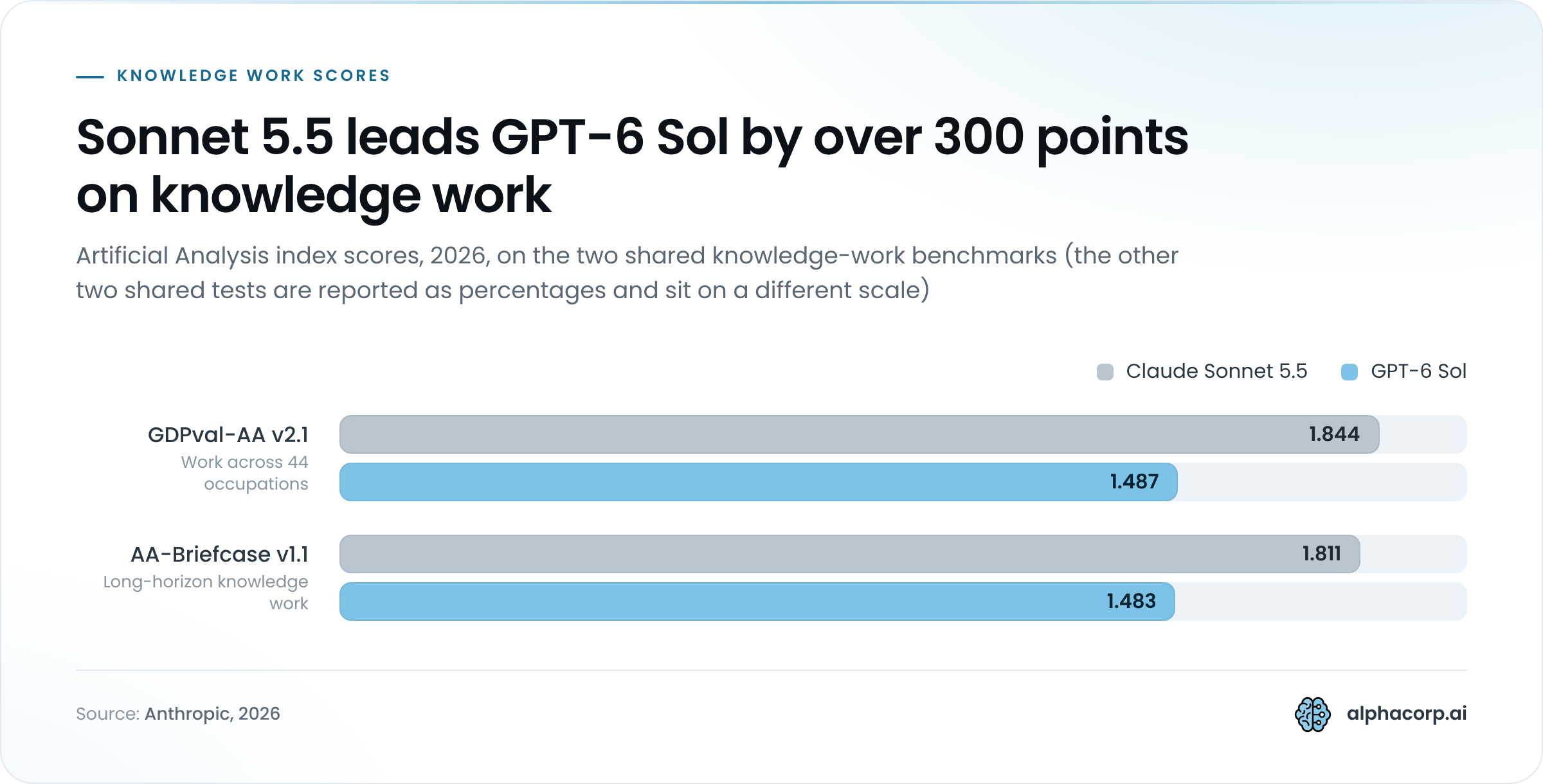
| GDPval-AA v2.1 | Real work across 44 occupations | 1,844 | 1,487 | 357 points |
| AA-Briefcase v1.1 | Long-horizon knowledge work | 1,811 | 1,483 | 328 points |
| Chartography (no tools) | Reading charts from images | 61.6% | 53.6% | 8.0 points |
Knowledge work: the gap is wide
The two knowledge-work tests are where the models separate. GDPval-AA covers tasks from 44 occupations across nine major industries, and Sonnet 5.5 scores 1,844 to GPT-6 Sol's 1,487. AA-Briefcase tells the same story at 1,811 to 1,483.
For scale, Claude Opus 5.5 scores 1,846 on GDPval-AA v2.1. Anthropic's mid-tier model sits two points behind its own flagship and 357 ahead of GPT-6 Sol. That is a big spread for two models at one price.
Chart reading follows the pattern with a smaller margin. Sonnet 5.5 scores 61.6% on Chartography without tools, eight points clear of GPT-6 Sol's 53.6%.
Coding: a narrow lead with a catch
FrontierCode is close, and the effort setting decides the winner. Sonnet 5.5 has two scores on this test:
- Xhigh effort: 52.1%, its best result and 2.8 points ahead of GPT-6 Sol.
- Max effort: 46.2%, which falls 3.1 points behind GPT-6 Sol's 49.3%.
More effort producing a worse score looks odd until you see what the test rewards. FrontierCode checks whether a change could merge with no human edits, and it marks down work that strays outside the task, even useful work. Anthropic's footnote says Sonnet 5.5 at Max ran Claude Code's code-review skill more often, which splits the review across many subagents. In two cases that Cognition examined, that led to a timeout or to edits beyond the task's scope.
The practical lesson: don't assume the top effort setting is the best one. For tightly scoped tickets, Xhigh gave the better result here.
Pricing: Identical Token Rates, Different Cost per Task
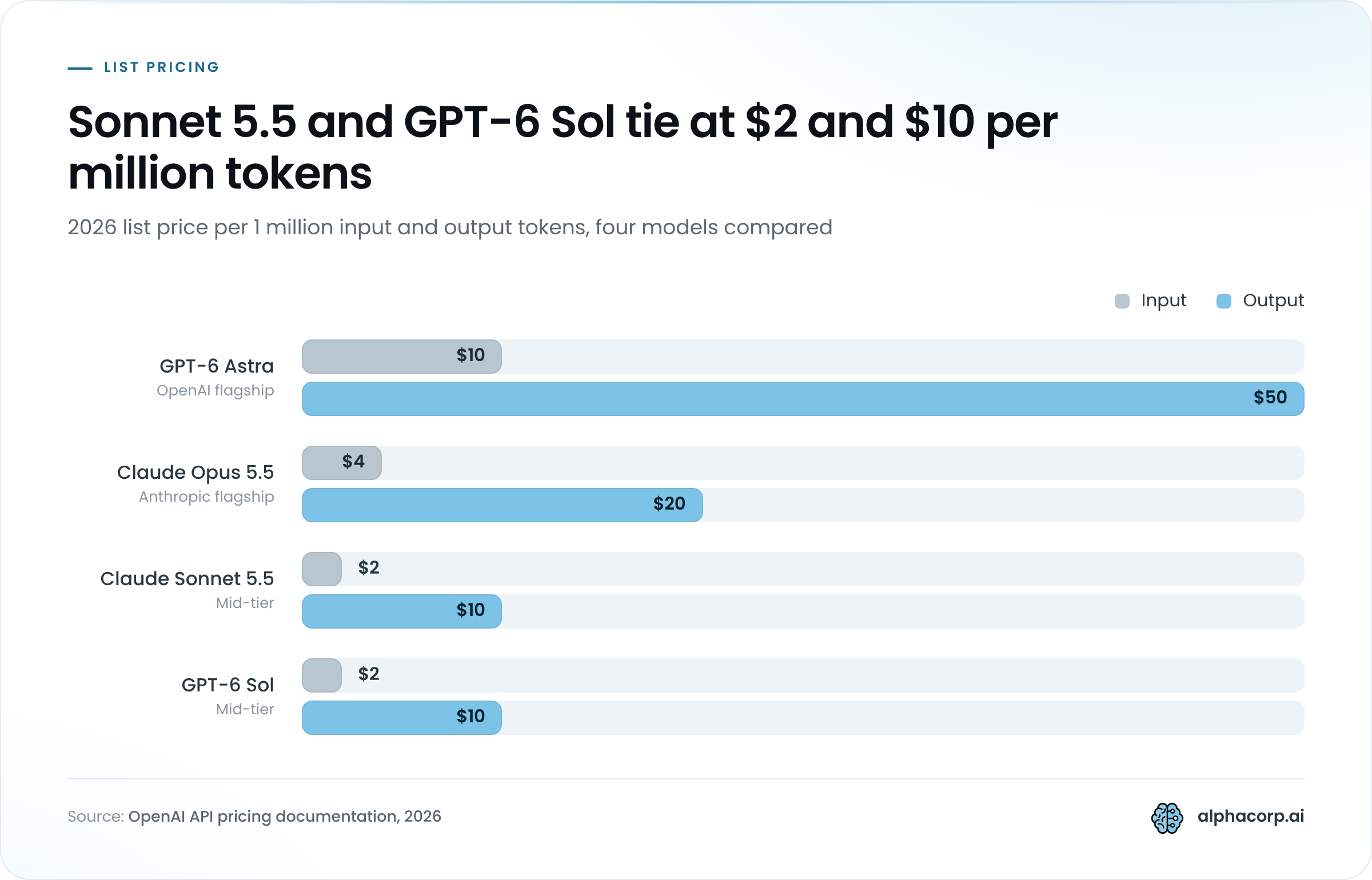
Claude Sonnet 5.5 and GPT-6 Sol tie on list price in 2026, so the cost winner is whichever model finishes your task in fewer tokens. Both charge $2 per million input tokens and $10 per million output tokens as of September 28, 2026. Cache reads cost $0.20 per million tokens on both, and standard cache writes cost $2.50.
| Model (2026 list price) | Input per 1M tokens | Output per 1M tokens |
|---|---|---|
| Claude Sonnet 5.5 | $2 | $10 |
| GPT-6 Sol | $2 | $10 |
| Claude Opus 5.5 | $4 | $20 |
| GPT-6 Astra | $10 | $50 |
One small difference sits in the caching tiers. Anthropic prices a 1-hour cache write at $4 per million tokens alongside the $2.50 five-minute write.
How each vendor reached $2 and $10
The two companies took different roads to the same number. OpenAI's 2026 API pricing page shows GPT-6 Sol at half the $4 and $20 that GPT-5.6 Sol charged. Anthropic left the Sonnet rate where Sonnet 5 had it and cut the token count instead.
Anthropic's 2026 testing puts Sonnet 5.5 at up to 30% cheaper per task than Sonnet 5, because it batches tool calls and takes fewer steps. One early customer measured the effect on its own evals:
"in fewer steps and with about 14% fewer output tokens"
Curtis Allen, Principal Engineer at Slack, on Sonnet 5.5 against Sonnet 5 in Anthropic's 2026 launch post
Both claims compare a model to its own predecessor. Neither vendor has published a cost-per-task figure that puts Sonnet 5.5 against GPT-6 Sol directly.
Why the token rate is the wrong number to budget on
On agent builds, the bill follows the count of tool calls and retries far more than the rate card. A model that needs 12 steps to close a ticket costs more than one that needs eight, even when both charge $10 per million output tokens.
The flagship gap matters too. GPT-6 Astra costs five times GPT-6 Sol on both input and output, while Claude Opus 5.5 costs twice Sonnet 5.5. Stepping up is a far cheaper move on the Anthropic side.
Benchmarks Only One Vendor Reported
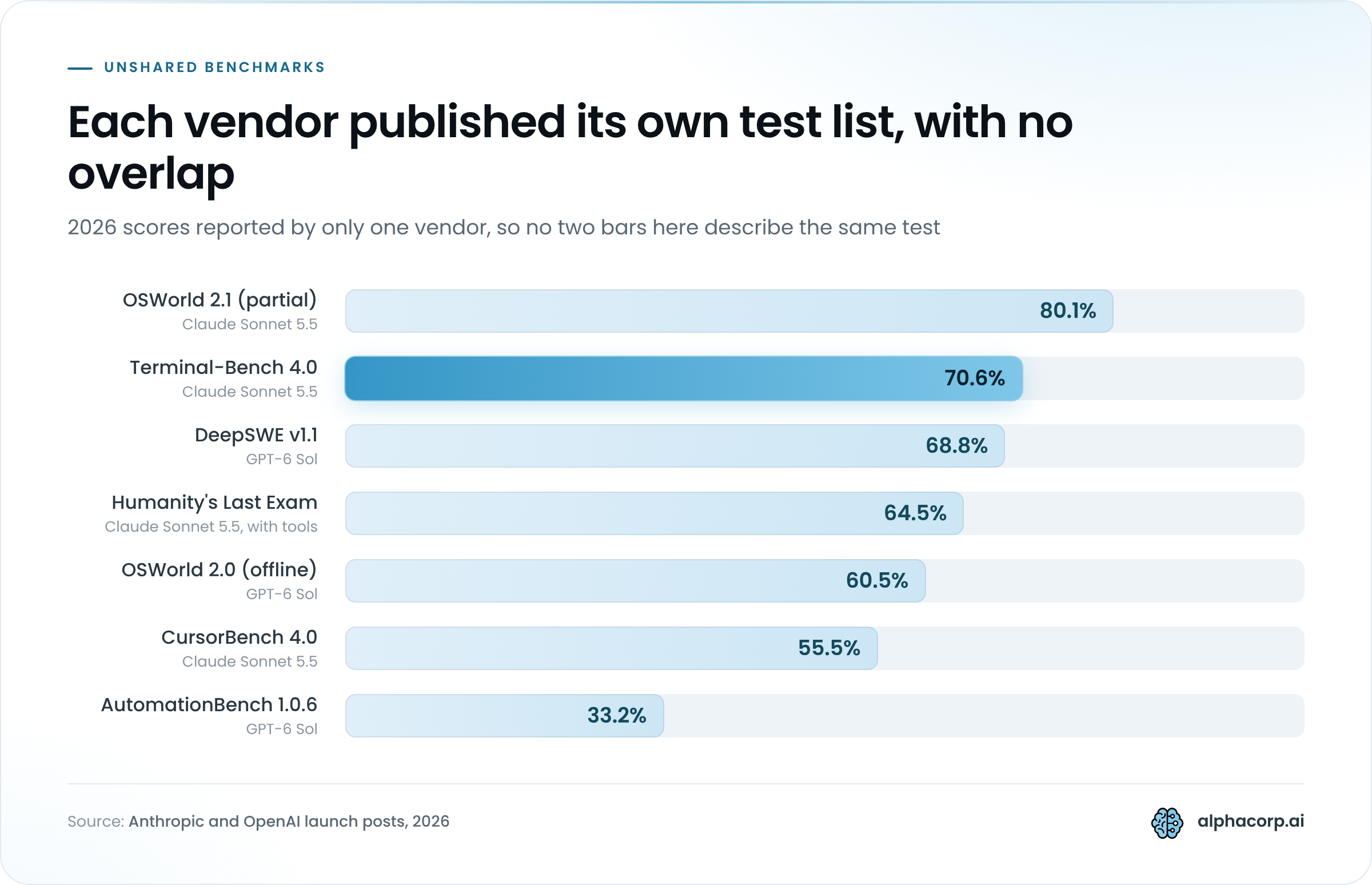
Neither Claude Sonnet 5.5 nor GPT-6 Sol wins the seven 2026 benchmarks that only one vendor reported, because no test in this group carries a score for both models. Each company published results on its own test list. Sonnet 5.5 has four such scores and GPT-6 Sol has three, plus one factuality claim.
| Benchmark (2026) | Model | Score | Vendor's own comparison point |
|---|---|---|---|
| Terminal-Bench 4.0 | Claude Sonnet 5.5 | 70.6% | Sonnet 5 at 10.3%, Opus 5.5 at 66.4% |
| CursorBench 4.0 | Claude Sonnet 5.5 | 55.5% | Sonnet 5 at 34.1%, Opus 5.5 at 57.8% |
| Humanity's Last Exam (with tools) | Claude Sonnet 5.5 | 64.5% | Sonnet 5 at 54.9%, Opus 5.5 at 67.7% |
| OSWorld 2.1 (partial) | Claude Sonnet 5.5 | 80.1% | Sonnet 5 at 57.0%, Opus 5.5 at 81.8% |
| DeepSWE v1.1 | GPT-6 Sol | 68.8% | Claude Fable at 69.9% |
| AutomationBench 1.0.6 | GPT-6 Sol | 33.2% | Claude Opus 5 at 26.9% |
| OSWorld 2.0 (offline) | GPT-6 Sol | 60.5% | Claude Opus 5 at 60.3% |
What Anthropic published for Sonnet 5.5
The Terminal-Bench result is the one that stands out. Sonnet 5.5 scores 70.6% on Terminal-Bench 4.0 in 2026, up from Sonnet 5's 10.3% and ahead of Opus 5.5's 66.4% at Xhigh effort. A mid-tier model beating its own flagship on a command-line test is rare.
The other three scores sit just under Opus 5.5. CursorBench 4.0, built from real Cursor coding sessions, puts Sonnet 5.5 at 55.5% to the flagship's 57.8%. On OSWorld 2.1 the margin is 1.7 points.
What OpenAI published for GPT-6 Sol
OpenAI's numbers lean on cost as much as score. Its September 22, 2026 launch post makes three claims:
- DeepSWE v1.1: 68.8% at max effort, about one-fifth the cost of Claude Fable's 69.9%.
- AutomationBench 1.0.6: 33.2% across 47 business tools, at about 9% of Claude Opus 5's per-task cost.
- OSWorld 2.0 offline: 60.5%, at roughly 80% lower cost per task than Claude Opus 5.
On factuality, the GitHub changelog entry from September 22, 2026 reports that GPT-6 Sol makes about half as many mistakes as GPT-5.6 Sol on OpenAI's internal evaluation. Anthropic has published no matching single figure for Sonnet 5.5.

What could a custom AI agent take off your plate?
We build production-grade AI systems that quietly handle the busywork, so your team can focus on the work that actually matters.
Look closely at the two OSWorld rows. Sonnet 5.5's 80.1% is on a partial run of version 2.1, and GPT-6 Sol's 60.5% is on the offline set of version 2.0. Those are different tests, so the 19.6-point spread tells you nothing about which model drives a desktop better.
Context Window, Output Limits and Knowledge Cutoff Compared
GPT-6 Sol has the larger context window in 2026, at 1,050,000 tokens against Claude Sonnet 5.5's 1,000,000, while Sonnet 5.5 has the newer knowledge cutoff. The two models tie on standard output length. On paper these are the closest specs in the whole comparison.
| Specification (2026) | Claude Sonnet 5.5 | GPT-6 Sol |
|---|---|---|
| Context window | 1,000,000 tokens | 1,050,000 tokens |
| Max output | 128,000 tokens | 128,000 tokens |
| Max output, batch | 300,000 tokens (beta) | 128,000 tokens |
| Knowledge cutoff | June 2026 | April 20, 2026 |
| Release date | September 28, 2026 | September 22, 2026 |
| Reasoning control | Adaptive thinking, effort levels | Effort ladder |
The Sonnet figures come from Anthropic's Sonnet 5.5 model overview, and the Sol figures from OpenAI's 2026 developer documentation.
Which spec differences change a build
The 50,000-token context gap is 5%. Few workloads fill a million tokens, so I wouldn't pick a model on it.
The cutoff gap matters more than it looks. Sonnet 5.5 knows about roughly two more months of the world, which covers any library release or API change that landed between late April and June 2026. If your agent writes code against fast-moving SDKs with no search tool attached, that window saves you from stale answers.
Batch output is the other real difference. Sonnet 5.5's beta allows 300,000 output tokens on batch jobs, more than double the 128,000 standard cap on both models. That helps with long report generation and large file rewrites that run overnight.
Built-in tools on each model
Both models support the same base features in 2026:
- Streaming responses
- Structured outputs
- Function and tool calling
- Image input
- Prompt caching
GPT-6 Sol goes further at the API level, with native web search, file search and computer use built in. Sonnet 5.5 supports Anthropic's newer browser-use and computer-use tool versions. Teams that want search and file retrieval without wiring up their own tools will get there faster on OpenAI's side.
Effort Levels, Speed and Efficiency
Claude Sonnet 5.5 wins on effort and speed evidence in 2026, because Anthropic published a speed figure and cost-per-task data at every effort level, while OpenAI reported GPT-6 Sol only at its two highest settings. Sonnet 5.5 generates output more than 30% faster than Sonnet 5, which makes it Anthropic's fastest Sonnet model to date. OpenAI's launch materials give no equivalent speed number for Sol.
Sonnet 5.5 has five effort levels: Low, Medium, High, Xhigh and Max. Lower settings answer faster and use fewer tokens. Higher settings reason for longer and check their work more.
The default depends on where you call it
Defaults catch teams out. The same model behaves differently across Anthropic's own products:
| Where you run Sonnet 5.5 (2026) | Default effort |
|---|---|
| Claude Code | Medium |
| Claude apps | Medium |
| Claude Platform (API) | High |
A prompt you tested in the Claude app runs at Medium. Ship that prompt through the API without setting effort and it runs at High, with a bigger bill and slower replies. Set the level in code every time.
Low effort is where the savings are
Anthropic's 2026 data shows Sonnet 5.5 at Low or Medium beating Sonnet 5's best score on several benchmarks for about a tenth of the cost per task. At High effort on FrontierCode, it scores 10 points above Sonnet 5 at the same setting, at about one fifteenth of the cost per task.
Epic Games reported the speed holding up on long jobs:
"kept responses snappy, handled multi-hour tasks, and delivered with less prescriptive prompting"
Daniel Vogel, Chief Operating Officer at Epic Games, in Anthropic's 2026 launch post
What OpenAI shows for GPT-6 Sol
OpenAI reports Sol's DeepSWE result at max effort and its AutomationBench and OSWorld results at xhigh. Those are best-case settings. They say little about how Sol performs at the cheaper levels most production traffic runs on.
That leaves a gap for buyers. When we scope AI agent development work, routine tickets run at the lowest effort level that passes our checks, and only the hard cases get escalated. You can plan that split for Sonnet 5.5 from published data. For GPT-6 Sol you have to measure it yourself.
How Reliable These Benchmark Comparisons Are
The Claude Sonnet 5.5 vs GPT-6 Sol benchmark comparisons are solid enough to build a shortlist on in 2026 and too thin to settle a ranking, because every published score comes from a vendor's own launch material. No neutral lab has run both models on one harness at matched effort. Anthropic makes the point about its own table:
"benchmark scores capture only one facet of a model's capabilities"
Anthropic, Claude Sonnet 5.5 launch post, September 28, 2026
Four caveats on the published 2026 scores
- Vendor selection: each company chose the tests, the effort levels and the rival models shown.
- Sonnet 5.5 bug: Artificial Analysis ran GDPval-AA and AA-Briefcase on a pre-release deployment with a structured-outputs bug, since fixed. Anthropic expects any effect to be small and to understate the model.
- GPT-6 Sol bug: OpenAI fixed a fault that degraded image understanding, and the scores from Artificial Analysis and Surge AI may predate that fix.
- Stand-in model: Anthropic's Terminal-Bench cost chart plots GPT-5.6 Sol, because no public GPT-6 Sol score exists on that test.
The two bugs pull in opposite directions. Artificial Analysis expects no major change to Sol's knowledge-work scores, and Anthropic's internal testing suggests Sol's Chartography score was unaffected. The gaps may shift a little. A 357-point lead is unlikely to vanish.
Agent benchmarks also swing with the harness. Timeouts, tool access and effort settings all change the result, so two scores under one benchmark name can describe different tests.
What each benchmark measures
| Benchmark | Built by | What it tests |
|---|---|---|
| Terminal-Bench | Stanford and the Laude Institute | Human-verified command-line tasks |
| GDPval | OpenAI | 1,320 tasks across 44 occupations, graded by human experts |
| OSWorld 2.0 | Academic team, 2026 paper | Desktop workflows that take people a median of 1.6 hours |
| Humanity's Last Exam | Center for AI Safety and Scale AI | About 2,500 expert-written questions |
| FrontierCode | Examined by Cognition | Code that merges with no human edits |
One detail stands out. GDPval is OpenAI's own design, and GPT-6 Sol trails on the Artificial Analysis version of it.
The Terminal-Bench paper describes tasks built to resist saturation, and that matters in 2026. Stanford HAI's 2026 AI Index reports SWE-bench Verified scores climbing from roughly 60% to near 100% within a single year. Once a test tops out, it stops separating models. Newer tests carry more signal.
Safety Safeguards and Platform Availability
Claude Sonnet 5.5 has the broader documented cloud reach at launch in 2026, and it ships with three safeguards that change behavior for a narrow set of requests. It runs on the Claude Platform, Amazon Web Services, Google Cloud and Microsoft Azure, with zero data retention available. The API model name is claude-sonnet-5-5.
Sonnet 5.5 is the first Sonnet model to launch with cyber safeguards like those on Anthropic's top models. Anthropic's 2026 automated audit, run across roughly 1,850 scenarios, found it improves on or matches Sonnet 5 on most alignment measures.
| Safeguard on Sonnet 5.5 (2026) | What triggers it | What you see |
|---|---|---|
| Cybersecurity | Higher-risk security tasks | A visible fallback to Sonnet 5 |
| Biology | Harmful biology requests | Some microbiology and virology work flagged in error |
| Distillation | Attempts to extract reasoning | Thinking stays tied to the account that created it |
Who feels these safeguards
Most teams won't. Routine bug fixing and most clinical, research and education work pass through untouched.
Two groups should test before they commit. Security teams doing offensive research will get Sonnet 5 answers on the riskiest tasks until Anthropic's expanded Cyber Verification Program opens. Life sciences teams working in virology may hit false flags, and Anthropic's Life Sciences Verification Program is the route around them.
Curious what AI could do for your business?
No jargon and no hard sell. Just a friendly look at where AI fits, and where it doesn't.
Migration steps that catch teams out
- If you run Sonnet with thinking off, switch to the new between_tools setting before you move to Sonnet 5.5.
- If you move conversations between accounts, including mid-session in Claude Code, read Anthropic's note on preserved thinking first.
- If you handle regulated data, turn on zero data retention at setup.
GPT-6 Sol availability
GPT-6 Sol has been available through OpenAI's API since September 22, 2026, and GitHub announced support for Sol and Luna the same day. Teams with strict data rules should confirm retention terms and cloud options with OpenAI before signing. Do it early.
Which Model to Choose for Your Workload
Claude Sonnet 5.5 is the better default for most workloads in 2026, and GPT-6 Sol is the better pick for business-workflow automation and for teams built on OpenAI's native tools. Price can't break the tie, since both charge $2 and $10 per million tokens. The workload decides.
| Workload (2026) | Pick | Deciding evidence |
|---|---|---|
| Documents, slides, spreadsheets | Claude Sonnet 5.5 | Lead on GDPval-AA and AA-Briefcase |
| Chart and image reading | Claude Sonnet 5.5 | Lead on Chartography |
| Command-line agents | Claude Sonnet 5.5 | 70.6% on Terminal-Bench 4.0 |
| Scoped, merge-ready tickets | Claude Sonnet 5.5 at Xhigh | Narrow FrontierCode lead |
| Automation across many business tools | GPT-6 Sol | 33.2% on AutomationBench 1.0.6 |
| Built-in search and file retrieval | GPT-6 Sol | Native API tools |
Choose Claude Sonnet 5.5 if
Your team produces knowledge work at volume: operating reviews, client decks, financial models, support replies. In one Anthropic test from 2026, two experts judged a 10-slide operating review ready to send on the first draft.
It also fits engineering teams that run agents in a terminal or close well-scoped tickets. Set effort to Xhigh for merge-ready work and drop to Low or Medium for routine jobs.
Choose GPT-6 Sol if
Your agents chain actions across CRMs, ticketing systems and internal apps. AutomationBench covers 47 tools, and Sol's score there has no Sonnet 5.5 rival.
Sol also suits teams already running on OpenAI's stack. Native web search, file search and computer use mean less tooling to build and maintain. Switching vendors to chase a 2.8-point coding lead would be a poor trade.
Consider something else if
- The work is complex and open-ended: step up to Claude Opus 5.5 at $4 and $20 per million tokens. Anthropic says it remains clearly stronger where sustained judgment is needed.
- You need OpenAI's top tier: GPT-6 Astra costs $10 and $50 per million tokens, five times Sol's rate.
- You run high-volume, cost-sensitive traffic: Anthropic says Claude Haiku 5.5 arrives in the coming weeks.
Honestly, neither model has proven itself on desktop computer use against the other. The two vendors tested different OSWorld versions, so run your own trial before you put either one in charge of a browser. Test before you buy.
Frequently Asked Questions
Claude Sonnet 5.5 is the stronger pick on the published 2026 evidence, and the six answers below cover the questions buyers ask most about Claude Sonnet 5.5 vs GPT-6 Sol. Each answer stands alone.
Is Claude Sonnet 5.5 better than GPT-6 Sol?
Yes, on the evidence published so far. Sonnet 5.5 leads GPT-6 Sol on all four 2026 benchmarks where both have a score: FrontierCode 1.1, GDPval-AA v2.1, AA-Briefcase v1.1 and Chartography. Those figures come from Anthropic's launch table of September 28, 2026. No neutral lab has yet run both models on one harness.
Is Claude Sonnet 5.5 cheaper than GPT-6 Sol?
No. As of September 28, 2026, both models cost $2 per million input tokens and $10 per million output tokens, with cache reads at $0.20. Your real bill depends on how many tokens each model uses per finished task, and neither vendor has published that figure for the two models side by side.
Which is better for coding, Claude Sonnet 5.5 or GPT-6 Sol?
Sonnet 5.5 has the edge, though it's narrow. It scores 52.1% on FrontierCode 1.1 at Xhigh effort against GPT-6 Sol's 49.3% in 2026. At Max effort Sonnet 5.5 drops to 46.2%, below Sol.
Each model also holds coding scores the other lacks:
- Claude Sonnet 5.5: 70.6% on Terminal-Bench 4.0 and 55.5% on CursorBench 4.0.
- GPT-6 Sol: 68.8% on DeepSWE v1.1 at max effort.
- Shared coding tests: one, FrontierCode 1.1.
What is the context window of each model?
GPT-6 Sol accepts 1,050,000 tokens and Claude Sonnet 5.5 accepts 1,000,000 tokens, per each vendor's 2026 documentation. Both cap standard output at 128,000 tokens. Sonnet 5.5 allows 300,000 output tokens on Anthropic's batch beta.
Is Claude Sonnet 5.5 as good as Claude Opus 5.5?
Close on scores, but Anthropic says no for hard work. The 2026 launch table shows how tight the numbers are:
| Benchmark (2026) | Claude Sonnet 5.5 | Claude Opus 5.5 |
|---|---|---|
| Terminal-Bench 4.0 | 70.6% | 66.4% |
| FrontierCode 1.1 (Main) | 52.1% | 54.4% |
| GDPval-AA v2.1 | 1,844 | 1,846 |
| Chartography (no tools) | 61.6% | 64.4% |
Sonnet 5.5 wins one of those four and costs half as much per token. Anthropic still rates Opus 5.5 as clearly stronger on complex, open-ended work that needs sustained judgment. I'd take that at face value, since a vendor has little reason to talk down its cheaper model.
When were Claude Sonnet 5.5 and GPT-6 Sol released?
OpenAI released GPT-6 Sol on September 22, 2026, alongside GPT-6 Luna. Anthropic released Claude Sonnet 5.5 six days later, on September 28, 2026. Claude Opus 5.5 shipped the same day as Sol, and GPT-6 Astra came earlier, on September 3, 2026.
Test Both Models on Your Own Tasks
The fastest way to settle Claude Sonnet 5.5 vs GPT-6 Sol for your team is a small trial on your own work at matched effort levels. Published scores tell you where to look. Your tasks tell you what to buy.
- Pull 30 to 50 real tasks from your backlog, with known good answers.
- Run both models at two effort levels each, one low and one high.
- Count cost per completed task, including retries and tool calls.
- Log failures by type, so you see where each model breaks.
- Recheck the vendor tables once post-fix scores appear.
Keep the task set. New models ship every few weeks in 2026, and a saved evaluation turns the next comparison into an afternoon's work. One thing teams miss: fix the effort level in code before you compare, or the defaults will skew the result.
If you want a second pair of hands on that evaluation, talk to the AlphaCorp AI team about running it against your production workload.