

On this page(17)
- Gemini 4 Argon vs Claude Fable 5.1 at a glance: the verdict in brief
- Benchmark comparison: where Gemini 4 Argon leads and where Claude Fable 5.1 holds up
- Pricing: Argon’s introductory rate versus Fable 5.1’s list price
- Context window, output limits and model specs compared
- Coding and agentic engineering: what each model does in practice
- Cybersecurity and safety: Fairwind, Mythos and prompt-injection robustness
- Availability and rollout: which model you can actually use today
- Claude vs Gemini: which is better for your use case
- Frequently asked questions about Gemini 4 Argon and Claude Fable 5.1
- Is Gemini 4 Argon available yet?
- How much does Gemini 4 Argon cost?
- Is Claude Fable 5.1 better than Gemini 4 Argon at coding?
- What is the difference between Claude Fable 5.1 and Claude Mythos 5.1?
- Does Gemini 4 Argon have a 1M context window?
- Which model is safer against prompt injection?
- Can I run Claude Fable 5.1 on Google Cloud?
- How to evaluate both models when Argon reaches general availability
Claude Fable 5.1 is the better choice for anyone building in 2026, because you can actually call it. Gemini 4 Argon posts higher scores and a far lower price. It is also, as of September 30, 2026, open only to vetted cyber defenders. This Gemini 4 Argon vs Claude Fable 5.1 comparison walks through every benchmark row Google published, both companies’ per-token prices, the context and output specs, and who should pick which once Argon’s API finally arrives.
Four numbers frame the whole decision:
- Gemini 4 Argon leads 13 of the 19 rows on Google DeepMind’s September 30, 2026 launch benchmark table, and Claude Fable 5.1 leads none.
- Argon’s 2026 introductory price is $2 per million input tokens and $10 per million output, per Google’s launch post, against Fable 5.1’s $10 and $50 on the Claude platform pricing page.
- Fable 5.1 carries a 1,000,000-token context window and a 128,000-token output cap, per Anthropic’s 2026 models overview.
- Argon’s output limit is 1,000,000 tokens in 2026, up from 64,000 on earlier Gemini models, according to Google DeepMind.
Gemini 4 Argon vs Claude Fable 5.1 at a glance: the verdict in brief
Claude Fable 5.1 is the better pick for any team that needs to ship this quarter, because as of September 30, 2026 it is the only one of the two with a public API and a live price list. Gemini 4 Argon wins on paper: it leads 13 of the 19 rows on Google’s own launch benchmark table and costs roughly one-fifth as much per token at its introductory rate. Paper is all you get right now. Argon is limited to vetted cyber defenders in Google’s Fairwind Program, and every score on its sheet came from Google.
That is the whole Gemini 4 Argon vs Claude Fable 5.1 argument in miniature. One model you can point at your own workload tonight. One model that looks stronger and cheaper but that almost nobody outside a security program can call.
AlphaCorp AI reads this matchup on three axes, and the split is unusually clean:
- Benchmarks: Argon leads most of the rows Google published on September 30, 2026. Fable 5.1 leads none of them, and where a Claude model does take a row, it is Opus 5.5.
- Price: Argon’s introductory rate is $2 per million input tokens and $10 per million output. Fable 5.1 lists at $10 and $50.
- Availability: Fable 5.1 shipped on September 1, 2026 with the model ID
claude-fable-5-1. Argon has no general API and no date for one.
| Gemini 4 Argon | Claude Fable 5.1 | |
|---|---|---|
| Announced | September 30, 2026 | September 1, 2026 |
| Who can use it today | Fairwind Program cyber defenders and Google internal teams | Anyone, via Claude API, AWS, Google Cloud and Azure |
| Price per 1M tokens (input / output) | $2 / $10 introductory, rising to $4 / $20 | $10 / $50 |
| Rows led on Google’s 19-benchmark table | 13 outright, 1 tie | 0 |
| Output limit | 1M tokens | 128K (300K via Batch API) |
| Context window | Not disclosed | 1M tokens |
| Independent benchmark reproduction | None yet | Possible, live API |
Honestly, I’d rather build on a slightly weaker model I can bill against than a stronger one I can’t reach. That opinion holds until Google’s Argon announcement turns into a pricing page and a model ID. When it does, the verdict gets a lot closer.
Benchmark comparison: where Gemini 4 Argon leads and where Claude Fable 5.1 holds up
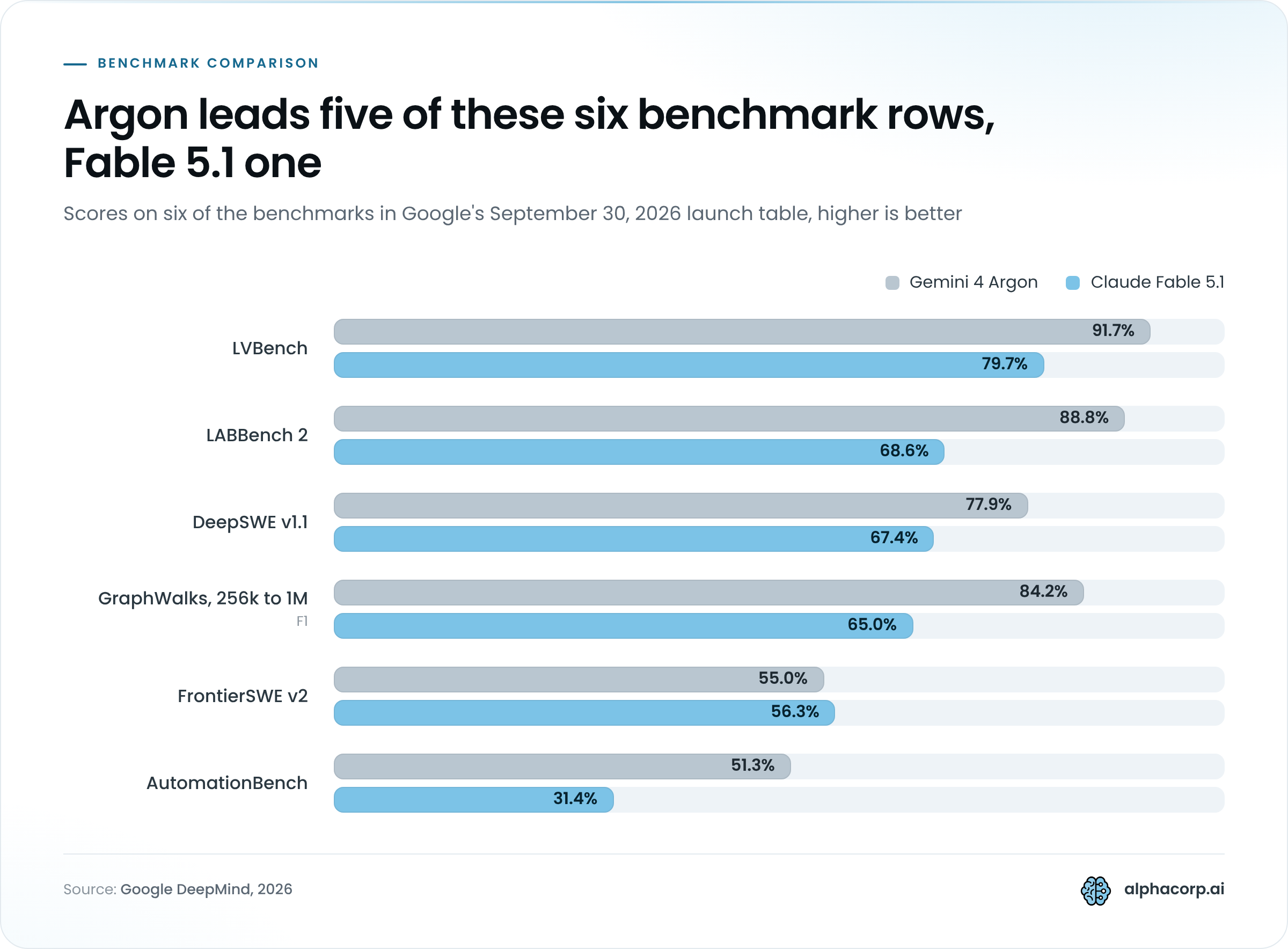
On benchmarks, Gemini 4 Argon beats Claude Fable 5.1 on 15 of the 17 rows where Google reported both models in its September 30, 2026 comparison table, and Fable 5.1 leads no row outright. The two exceptions are thin: Fable 5.1 edges Argon on FrontierSWE v2 (56.3% vs 55.0%) and on Terminal-bench 4.0 (57.9% vs 57.4%), and on both of those rows a third model takes first place anyway.
The gap is widest in knowledge work. Argon scores 68.9% on the Vals Index against Fable 5.1’s 65.8%, 51.3% on Zapier’s AutomationBench against 31.4%, and 65.4% on Vals Finance Agent v2 against 58.9%. Harvey’s Legal Agent Benchmark is the strange one. Every model scores badly, but Argon’s 19.6% is nearly triple Fable 5.1’s 6.7%.
“Argon is the leading model on the Vals Index, which measures economic impact across finance, coding, legal, and tax work, with every sector weighted by its contribution to U.S. GDP.” Koray Kavukcuoglu, Google DeepMind, September 30, 2026
| Benchmark (Google’s table, Sep 30, 2026) | Gemini 4 Argon | Claude Fable 5.1 | Row leader |
|---|---|---|---|
| Vals Index | 68.9% | 65.8% | Argon |
| AutomationBench | 51.3% | 31.4% | Argon |
| Harvey’s Legal Agent Benchmark | 19.6% | 6.7% | Argon |
| DeepSWE v1.1 | 77.9% | 67.4% | Argon |
| FrontierSWE v2 | 55.0% | 56.3% | GPT-6 Astra, 65.5% |
| Terminal-bench 4.0 | 57.4% | 57.9% | Claude Opus 5.5, 66.4% |
| PostTrainBench | 45.3% | 40.2% | Claude Opus 5.5, 49.3% |
| Terminal-Bench Science 0.1 | 57.6% | 52.6% | GPT-6 Astra, 68.1% |
| LABBench 2 | 88.8% | 68.6% | Argon |
| GraphWalks, 256k to 1M (F1) | 84.2% | 65.0% | Argon |
| Chartography | 71.6% | 46.2% | Argon |
| LVBench | 91.7% | 79.7% | Argon |
Coding is where Fable 5.1 holds up best, and where the table gets interesting. Argon’s headline is DeepSWE v1.1, a long-horizon software engineering benchmark, at 77.9% against Fable 5.1’s 67.4%. Flip to FrontierSWE v2 and Terminal-bench 4.0, and the two models sit within a point of each other while GPT-6 Astra and Claude Opus 5.5 run away with the rows. Vibe Code Bench is a near wash: 91.9% vs 90.3%.
Long context and multimodal work are lopsided. On GraphWalks at 256k to 1M tokens, Argon posts an F1 of 84.2% to Fable 5.1’s 65.0%, and even at up to 128k it leads 99.7% to 91.4%. Chartography (chart reading) is 71.6% to 46.2%. Science splits: Argon leads LABBench 2 by 20 points and RiemannBench 76.0% to 65.6%, but GPT-6 Astra owns Terminal-Bench Science 0.1 at 68.1%. Computer use has no Fable 5.1 entry at all in Google’s table.
Now the caveats, because they matter. Google chose every benchmark on this sheet, ran every competitor, and released nothing an outside lab can rerun. The numbers even disagree with Anthropic’s own: Google lists Fable 5.1 at 57.9% on Terminal-bench 4.0, while Anthropic’s September 1, 2026 launch post reports 55.8%, a gap that likely comes down to harness and settings. Anthropic also leads with tests Google skipped: 60.9% without tools and 65.0% with tools on Humanity’s Last Exam, 1,853 on GDPval-AA v2, and 41.7% strict / 77.9% partial on OSWorld 2.0. Google’s OSWorld-2.0 figure for Argon (69.2%) is an offline-subset partial score, so the two OSWorld numbers do not line up. Argon has no published Humanity’s Last Exam score.
Read it this way: Argon leads on the sheet its maker printed. Fable 5.1 leads on a different sheet. Neither has been checked by anyone else.
Pricing: Argon’s introductory rate versus Fable 5.1’s list price
On price, Gemini 4 Argon beats Claude Fable 5.1 by a factor of five at Google’s September 2026 introductory rate: $2 per million input tokens and $10 per million output, against Fable 5.1’s $10 and $50. Even after the promotion ends, Google has said Argon moves to $4 input and $20 output, which is still exactly half of Fable 5.1’s list price on both sides.
| Per 1M tokens (2026) | Gemini 4 Argon (introductory) | Gemini 4 Argon (post-introductory) | Claude Fable 5.1 |
|---|---|---|---|
| Input | $2 | $4 | $10 |
| Output | $10 | $20 | $50 |
| Cached input read | $0.10 (95% off input) | Not published | $0.25 |
| Cache write | Not published | Not published | $12.50 (5-minute) / $20 (1-hour) |
| Batch input / output | Not published | Not published | $5 / $25 |
| On a live billing page today | No | No | Yes |
Anthropic’s move on September 1, 2026 was on caching rather than the sticker. The Claude platform pricing page shows Fable 5.1’s list price unchanged from Fable 5, but cache-hit reads dropped from $1 to $0.25 per million tokens, a 75% cut. Anthropic puts the effect at roughly 25% lower cost on typical workloads and up to about 45% on agentic ones that hit the cache constantly. Batch runs at half list: $5 in, $25 out.
Here’s a worked example. Take a monthly agentic workload of 100M input tokens and 10M output tokens, uncached:
- Fable 5.1: $1,000 input + $500 output = $1,500
- Argon, introductory: $200 + $100 = $300
- Argon, post-introductory: $400 + $200 = $600
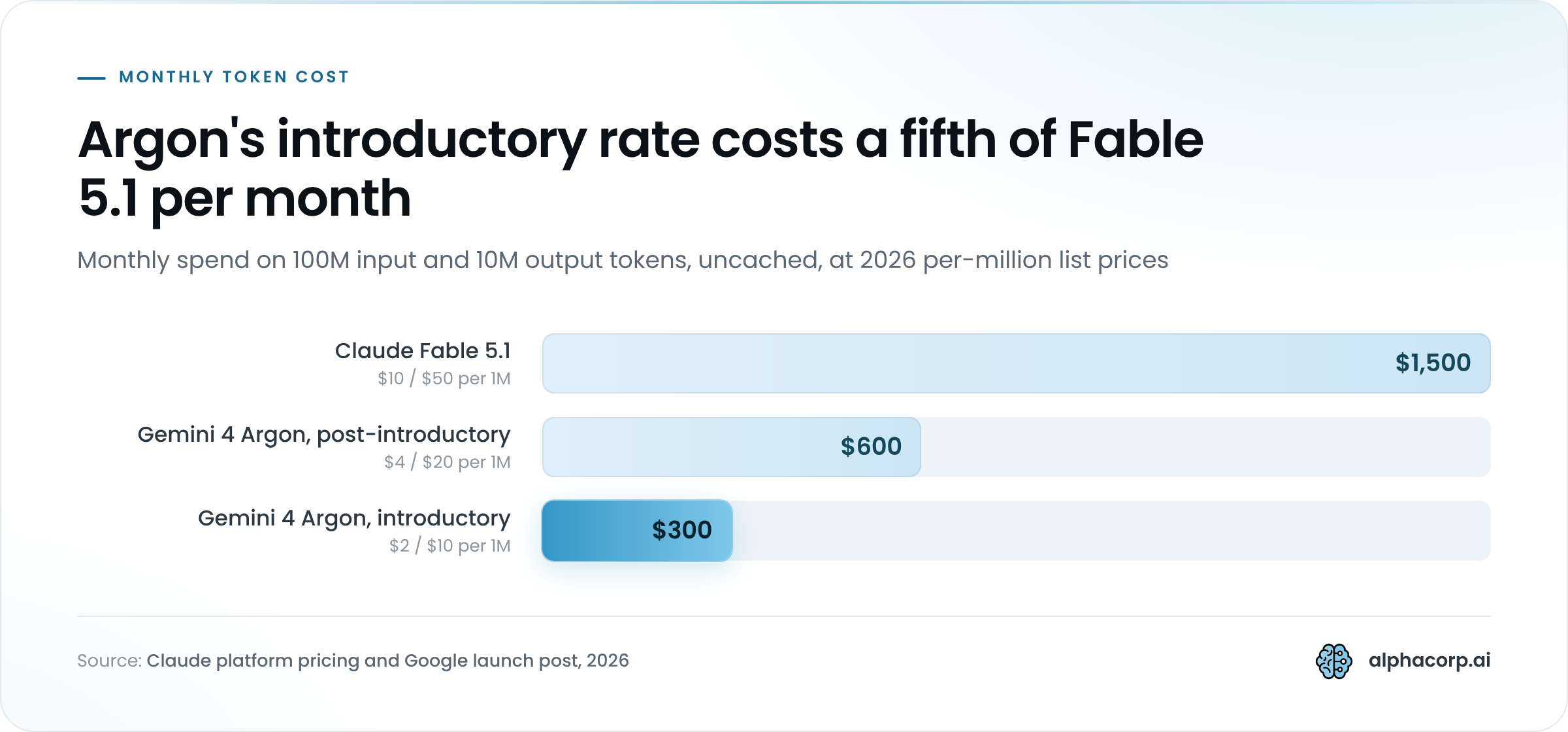
Caching narrows the gap without closing it. If 80M of those input tokens come from cache, Fable 5.1 drops to about $720 (80M at $0.25, 20M at $10, 10M output at $50) before any cache-write charges. Argon at introductory rates lands near $148. The cache-write line is the trap on the Claude side: every 5-minute cache refresh costs $12.50 per million tokens, so a workload that churns its context can give back a chunk of that 75% saving.
One thing worth stating plainly. Argon’s prices exist only in Google’s launch post. The Gemini API pricing page lists nothing above Gemini 3.1 Pro Preview, which bills $2 to $4 per million input and $12 to $18 output depending on prompt length. Until Argon appears there, its $2 / $10 rate is a promise with no invoice behind it.
Context window, output limits and model specs compared
On specs, Claude Fable 5.1 wins on input and on documentation, with a published 1M-token context window and a June 2026 knowledge cutoff, while Gemini 4 Argon wins on output with a 1M-token ceiling and publishes almost nothing else. The two companies made opposite bets. Which one you need depends on which direction most of your tokens flow.
Anthropic’s bet is ingestion. Anthropic’s models overview lists Fable 5.1 at 1,000,000 tokens of context, 128,000 output tokens in a synchronous call, and up to 300,000 through the Batch API beta, with reasoning that is adaptive and always on. The same 1M window applies to Opus 5.5 and Sonnet 5.5, so a prompt built for one Claude model drops into the others without re-chunking. Small thing. Saves real hours.
Google’s bet is generation. Argon’s output limit rises to 1M tokens from 64K on earlier Gemini models, and Google’s framing is that a model with room to write hundreds of thousands of tokens in a single trajectory can reason its way through a hard problem in one go. Input is where the sheet goes quiet. Google’s GraphWalks row runs to 1M tokens, so the model handles inputs at that scale under test, but there is no published context figure, no knowledge cutoff and no thinking-token spec to plan a budget around.
| Spec (September 2026) | Gemini 4 Argon | Claude Fable 5.1 |
|---|---|---|
| Context window | Not disclosed | 1,000,000 tokens |
| Max output | 1,000,000 tokens (up from 64K) | 128,000 sync / 300,000 via Batch API beta |
| Reasoning | Long-horizon emphasis, no token spec | Adaptive, always on |
| Knowledge cutoff | Not disclosed | June 2026 |
| API model ID | None issued yet | claude-fable-5-1 |
The workload split follows from the numbers. A large-input, modest-output profile like Fable 5.1’s suits codebase analysis, contract review and retrieval over long records, where the model reads a great deal and answers briefly. A large-output profile like Argon’s suits emitting a whole migrated module or a full legal brief in one pass. A 128K cap sounds generous until an agent tries to write a full test suite plus the code it covers in a single turn, and then you’re stitching outputs together yourself.
What could a custom AI agent take off your plate?
We build production-grade AI systems that quietly handle the busywork, so your team can focus on the work that actually matters.
Coding and agentic engineering: what each model does in practice
In practice, Gemini 4 Argon has the stronger engineering evidence, because Google has shown it doing production-scale work inside Google, while Claude Fable 5.1’s coding case rests on Anthropic’s published scores plus whatever you run through its live API yourself. That is a real edge for Argon, with one asterisk. Every Argon example comes from Google’s own buildings.
Google’s September 30, 2026 examples are specific enough to be worth listing:
- Rust migrations: Argon agents are rewriting C/C++ codebases in Rust, from tens of thousands of lines in re2 and libgav1 up to 800K+ lines for the Fuchsia OS Zircon kernel. Google says these rewrites are still going through automated and manual audit, emulation testing and review before production.
- libgav1 SIMD rewrite: agents replaced 32K lines of SIMD code with safe Rust the compiler vectorizes on its own, after many rounds of profile-guided experiments. The decoder runs 2.7x faster than the earlier Rust port with identical video output.
- Data-center memory: a team of Argon agents read fleet-wide profiling telemetry and applied optimizations that freed over 300 TiB once rolled out, with 500 TiB to 1 PiB expected in total.
- Quantum subroutines: Argon beat a published baseline for a subroutine’s qubits-times-gates cost by 40% in minutes.
Note the verb tense on the kernel. It’s in review.
Anthropic’s evidence is narrower and more testable. Its September 1, 2026 launch post reports Fable 5.1 at 55.8% on Terminal-Bench 4.0 and 73.4% on CursorBench 3.2.0, with the gated Mythos 5.1 at 60.9% on Terminal-Bench, and says Fable 5.1 beats Fable 5, Opus 5 and GPT-5.6 Sol across coding work. That Terminal-Bench figure carries weight because the benchmark is independent: the 2026 Terminal-Bench paper describes hard, realistic command-line tasks on which frontier agents scored under 65% even on the 2.0 revision.
Here’s the pattern I’d actually act on. Argon’s ten-point lead sits on DeepSWE, a long-horizon benchmark. On FrontierSWE v2 and Terminal-bench 4.0, which reward shorter, bounded agentic work, Argon and Fable 5.1 land within a point of each other and Claude Opus 5.5 is the model to beat. So Argon’s advantage shows up when the trajectory runs long, which fits its 1M output ceiling. For a bounded ticket, the two are interchangeable.
Most of the agents AlphaCorp AI ships for clients are bounded tickets, and on rewrites at Google’s scale the queue that stalls is human review, which Google’s own description of the Zircon work confirms.
Cybersecurity and safety: Fairwind, Mythos and prompt-injection robustness
On cybersecurity, Gemini 4 Argon beats Claude Fable 5.1 on both measures Google published on September 30, 2026: 68% against 58% on CWE-bench v1 for patching vulnerabilities, and a 0.7% against 1.0% attack-success rate on Gray Swan’s indirect prompt injection benchmark. The first gap is wide. The second is a rounding error.
The CWE-bench v1 leaderboard is a three-way tie at the top: Grok 4.7, Argon and GPT-6 Astra all score 68% Pass@1, with Claude Opus 5.5 at 67%. Fable 5.1 sits at 58%, ten points back, running in Claude Code while Argon ran in Antigravity, so harness is a variable here too. On vulnerability discovery, Google compares Argon only with its own Gemini 3.8 Flash Cyber: 85.8% against 71.0% scanning source across 20 languages, and 70.9% against 58.2% on Wiz’s black-box penetration test with no source code. Through Wiz’s Scan for Good program, Argon found a critical flaw exposing personal data in hospital software used worldwide that earlier frontier models had missed.
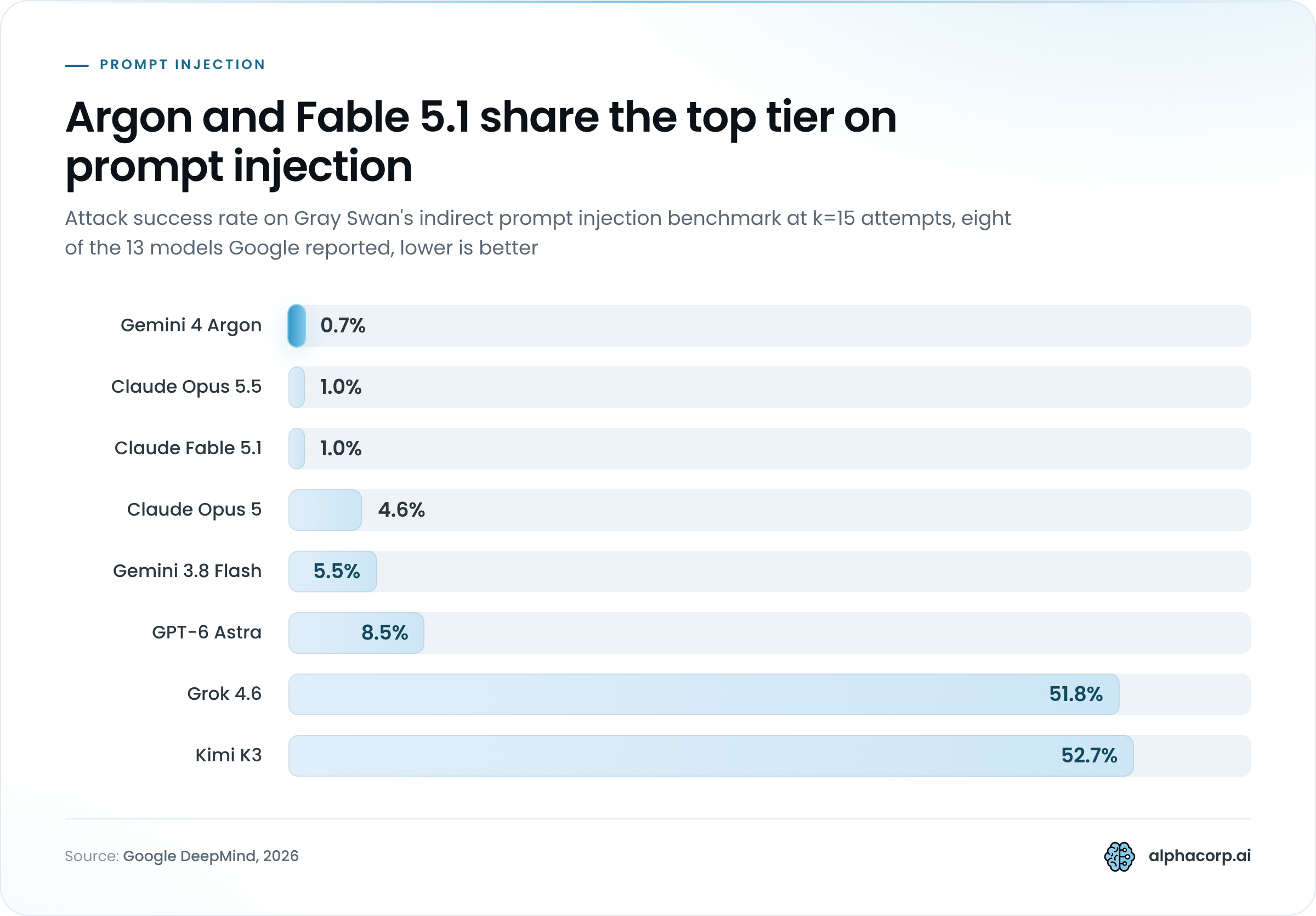
The prompt-injection numbers tell a tiering story. Argon at 0.7%, Opus 5.5 at 1.0% and Fable 5.1 at 1.0% form one group. Then a cliff: Claude Opus 5 at 4.6%, Gemini 3.8 Flash at 5.5%, GPT-6 Astra at 8.5%, and down at the bottom Grok 4.6 at 51.8% and Kimi K3 at 52.7%. For an agent that reads untrusted email or web pages, either Argon or Fable 5.1 is fine. The choice that matters is staying out of the lower tiers.
Both vendors gate their sharpest cyber capability. Google’s Fairwind Program gives background-checked defenders (governments, healthcare providers, telecoms) access to Argon and pairs it with CodeMender, Google’s automated patching agent.
“For trusted defenders and our own internal teams at Google, we’ll be releasing Argon without cyber guardrails so they can leverage its full frontier-level cybersecurity defense capabilities.” Koray Kavukcuoglu, Google DeepMind, September 30, 2026
Anthropic runs the same logic with a different split. Mythos 5.1 goes only to vetted U.S. cyber defenders and life scientists through its Cyber Verification and Life Sciences Verification programs, at the same list price as Fable 5.1. The generally available Fable 5.1 can now find software vulnerabilities for defensive work, though it will still refuse to build exploits, and Anthropic says cyber-related false-positive safeguard interventions fell roughly 60% per session compared with Fable 5’s launch. That last figure is the one working security teams will feel day to day.
Both companies also sit inside the same government process. NIST’s Center for AI Standards and Innovation runs voluntary pre-release testing of frontier models for cyber and bio risk, adding Google DeepMind, Microsoft and xAI under agreements announced in May 2026, while Anthropic’s models went through the earlier 2024 version of that arrangement. Google adds its own layers on top: monitoring of internal activations to catch misuse, chain-of-thought monitoring that halts execution when the model strays from the user’s intent, and sealed sandboxes for high-risk evaluation. Anthropic publishes fewer mechanics. Same destination, different amount of shown work.
Availability and rollout: which model you can actually use today
On availability, Claude Fable 5.1 is the only one of the two you can use today: as of September 30, 2026 it is generally available through the Claude API, AWS, Google Cloud and Microsoft Azure under the model ID claude-fable-5-1, while Gemini 4 Argon is limited to Fairwind Program cyber defenders and Google’s own internal teams. There is no Argon model ID, no SDK entry and no date.
Google has described the order of its rollout without attaching a calendar to any step:
- Now (September 30, 2026): trusted cyber defenders in the Fairwind Program, plus Google internal teams, with cyber guardrails removed for the defenders.
- Next: paid API customers and Google AI Ultra subscribers, once Google has gathered tester feedback and finished tuning its guardrails.
- Later: developers, enterprises and consumers broadly, “as soon as possible” in Google’s own words.
Note the odd shape of the market this creates. You can buy Anthropic’s flagship on Google Cloud this afternoon. You cannot buy Google’s.
For a team evaluating models this quarter, a phased rollout means more than waiting. Enterprise procurement usually starts with a vendor security review that takes weeks, and that review needs terms of service, a data-processing agreement and rate-limit documentation to chew on. Argon has none of those yet, so it cannot even enter the queue. Fable 5.1 has all of them, on four clouds, with an invoice at the end.
The honest read is that Argon’s timeline is in Google’s hands and Google has chosen to say nothing about it. Plan around that. If a board deck depends on a Gemini 4 Argon vs Claude Fable 5.1 bake-off, the Argon column stays empty until a model ID exists.
Claude vs Gemini: which is better for your use case
For most production use cases in 2026, Claude Fable 5.1 is the better choice by default because it is the one you can deploy, and Gemini 4 Argon takes the call in three specific scenarios (very long single-pass output, price-sensitive volume, and gated security work) once you can actually reach it. Confidence varies a lot by scenario, so here is each one with its evidence and how much weight it can bear.
| Scenario | Pick | Confidence |
|---|---|---|
| Production app that needs a billable model now | Fable 5.1 | High |
| Cost-sensitive, high-volume workloads | Argon, when available | High on price, conditional on access |
| Very long single-pass output (full briefs, whole modules) | Argon | High |
| Large-codebase or document ingestion | Fable 5.1 today | Medium |
| Defensive security tooling | Argon if you qualify for Fairwind, otherwise Fable 5.1 | Medium |
| Enterprise legal and finance research | Argon on Google’s numbers | Low to medium |
Choose Claude Fable 5.1 if you are shipping a customer-facing agent, a RAG pipeline or an internal copilot in the next 90 days, or if your workload reads far more than it writes. A published 1M-token context window, a 128K output cap and a $0.25 cache-hit price you can model in a spreadsheet make it the safe bet for contract review, codebase Q&A and retrieval over long records.
Choose Gemini 4 Argon if your tokens flow outward: generating a migrated module, a full test suite or a long legal draft in one trajectory, where a 1M output ceiling changes what a single call can do. Choose it too if token spend is your dominant line item and you can wait, since $2 / $10 introductory and $4 / $20 after that undercuts Fable 5.1 at every tier. And if you are a government, hospital or telecom security team, apply to Fairwind. The 68% CWE-bench score and the guardrail-free release exist for you.
Consider neither if your work is bounded agentic coding. Claude Opus 5.5 tops Terminal-bench 4.0 at 66.4% and PostTrainBench at 49.3% on Google’s own September 2026 table, and GPT-6 Astra leads FrontierSWE v2 at 65.5%. For a ticket-sized task, both headline models here are runners-up.
The legal and finance call is the one I’d trust least. Argon’s 19.6% on Harvey’s Legal Agent Benchmark against Fable 5.1’s 6.7% looks decisive, but a single-vendor sheet with no outside rerun is thin ground for a procurement decision.
Frequently asked questions about Gemini 4 Argon and Claude Fable 5.1
Is Gemini 4 Argon available yet?
No. As of September 30, 2026, Gemini 4 Argon is accessible only to vetted cyber defenders in Google’s Fairwind Program and to Google’s internal teams. Google says broader release will start with paid API customers and Google AI Ultra subscribers, then extend to developers, enterprises and consumers, but it has given no date for any stage.
How much does Gemini 4 Argon cost?
Google’s September 30, 2026 launch set an introductory price of $2 per million input tokens and $10 per million output tokens, with cached input at 95% off, or $0.10 per million. After the introductory period the rate rises to $4 input and $20 output. None of this appears yet on the Gemini API pricing page, where the top listed model is still Gemini 3.1 Pro Preview. Claude Fable 5.1, for comparison, bills $10 input and $50 output.
Is Claude Fable 5.1 better than Gemini 4 Argon at coding?
Not on Google’s numbers. Argon scores 77.9% on DeepSWE v1.1 against Fable 5.1’s 67.4%, a ten-point gap on long-horizon engineering. On shorter agentic work the two are level: 56.3% vs 55.0% on FrontierSWE v2 and 57.9% vs 57.4% on Terminal-bench 4.0, both in Fable 5.1’s favor by less than a point. Claude Opus 5.5 beats both on Terminal-bench 4.0 at 66.4%. Every one of these figures is Google’s, so treat the gap as provisional.
What is the difference between Claude Fable 5.1 and Claude Mythos 5.1?
Access. Both launched on September 1, 2026 at the same list price, but Fable 5.1 is generally available while Mythos 5.1 goes only to vetted U.S. cyber defenders and life scientists through Anthropic’s Cyber Verification and Life Sciences Verification programs. Mythos 5.1 also scores higher where Anthropic has reported both, at 60.9% on Terminal-Bench 4.0 against Fable 5.1’s 55.8%.
Does Gemini 4 Argon have a 1M context window?
Google has not published an input context figure for Argon. What it has published is a 1M-token output limit, up from 64K on earlier Gemini models, and a GraphWalks result of 84.2% F1 on inputs between 256K and 1M tokens, so the model was tested at that input scale. Claude Fable 5.1 is the one with a documented 1,000,000-token context window.
Which model is safer against prompt injection?
Gemini 4 Argon, by a hair. On Gray Swan’s indirect prompt injection benchmark at k=15 attempts, Argon posts a 0.7% attack success rate and Claude Fable 5.1 posts 1.0%, with Claude Opus 5.5 also at 1.0%. The next model down, Claude Opus 5, sits at 4.6%, and GPT-6 Astra at 8.5%. In practice the two models here share the top tier and the three-tenths-of-a-point gap will not change an architecture decision.
Can I run Claude Fable 5.1 on Google Cloud?
Yes. Fable 5.1 is available on Google Cloud alongside the Claude API, AWS and Microsoft Azure, so a team already standardized on Google’s cloud can bill Anthropic’s model today and swap in Argon later without leaving the platform.
How to evaluate both models when Argon reaches general availability
The way to evaluate Gemini 4 Argon against Claude Fable 5.1 is to build the test harness on Fable 5.1 now, so the day Argon gets a model ID you swap one string and rerun. Vendor tables settle nothing about your workload. Your own tasks do.
Curious what AI could do for your business?
No jargon and no hard sell. Just a friendly look at where AI fits, and where it doesn't.
Four steps, in order:
- Freeze a task set from real traffic. Pull 50 to 100 prompts your agents actually handle, with the context sizes and output lengths they really use, and score Fable 5.1 on them this week.
- Budget both Argon prices. Model your monthly token spend at $2 / $10 and again at $4 / $20, because the introductory rate expires and Google has not said when.
- Watch for reruns. Treat the first outside reproduction of DeepSWE v1.1 or Terminal-bench 4.0 as the moment Argon’s column becomes trustworthy.
- Apply early if you qualify. Government, hospital and telecom security teams can request Fairwind access now. Everyone else should get on the Google AI Ultra or paid API list.
Keep the harness cheap to rerun. Most of the evaluation cost sits in building it once.
If you’d like a second pair of hands designing that harness or pricing the two models against your own traffic, talk to AlphaCorp AI and we’ll scope the bake-off with you.