

On this page(16)
- What Is Predictive AI and What Makes It Different From Other AI?
- How Predictive AI Works, From Historical Data to a Forecast
- Predictive AI vs Generative AI: Which Problems Each One Solves
- The Most Common Business Uses of Predictive AI Today
- What Does It Actually Cost to Build and Run a Predictive AI Model?
- Where Predictive AI Fails and Why Its Forecasts Go Wrong
- Which Companies and Teams Benefit Most From Predictive AI
- How Predictive AI Changed in the Past Year
- Frequently Asked Questions About Predictive AI
- Is ChatGPT predictive AI?
- What is an example of predictive AI?
- Is predictive AI the same as predictive analytics or machine learning?
- How accurate is predictive AI?
- Is predictive AI regulated?
- Does predictive AI replace human judgment?
- Where to Start With Predictive AI in Your Organization
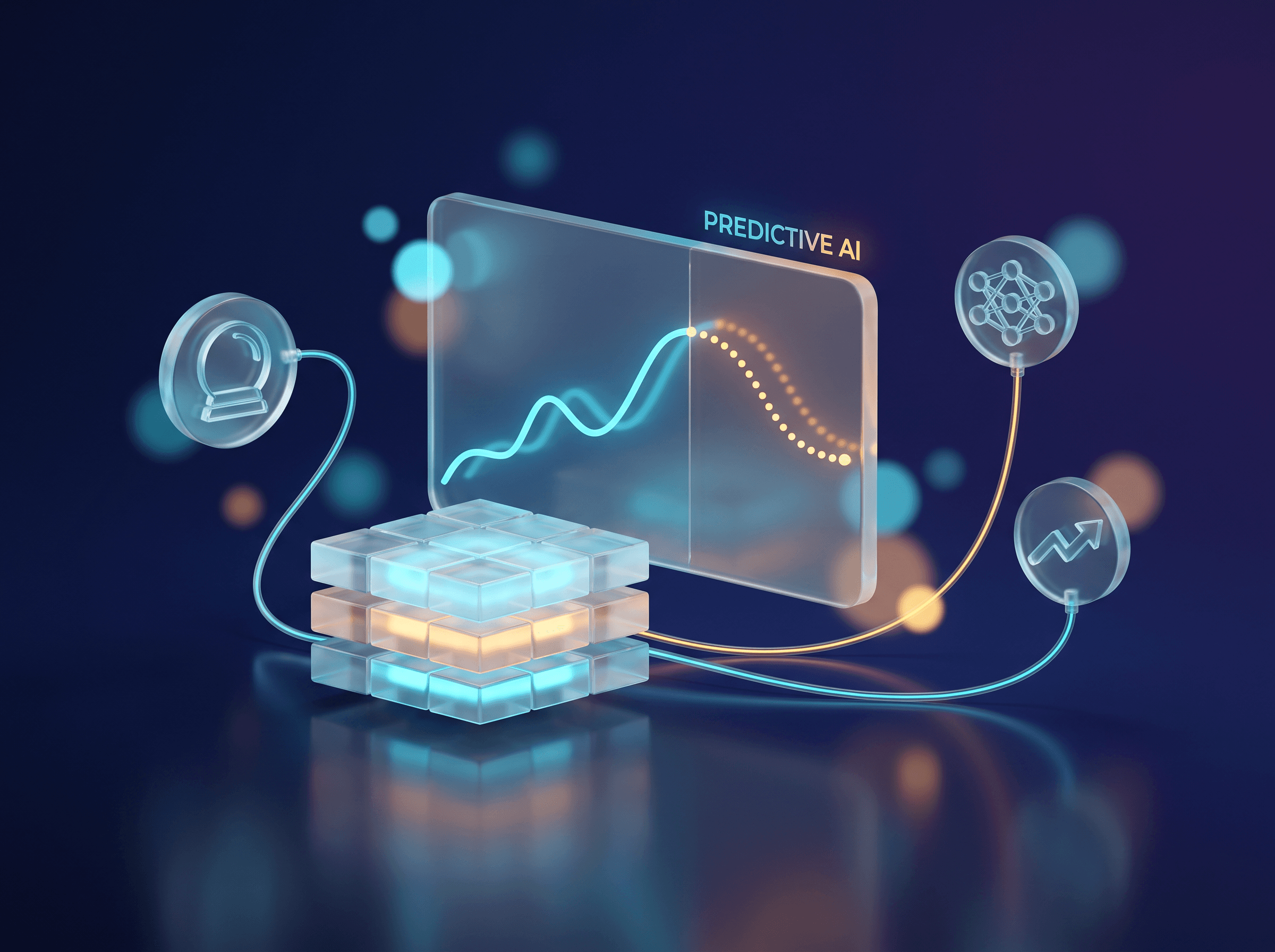
Predictive AI is machine learning that learns patterns from past data and estimates what hasn’t happened yet: a probability, score, label or forecast. It flags fraud, scores credit, plans demand and, since July 2025, runs daily inside ECMWF’s operational weather forecasts. This guide covers how an AI prediction gets made, where the published evidence says it works, where it falls flat (forecasting individual people, mostly), what it costs, and how the EU began regulating it. As of November 2026, the models have changed less than the rules around them.
- GraphCast beat ECMWF’s deterministic HRES system on about 90% of 2,760 verification targets in its 2023 evaluation (DeepMind, published in Science, 2023).
- The FDA authorized 258 AI medical devices in 2025, taking the cumulative total to 1,357 by December 2025 (Stanford AI Index 2026, medicine chapter).
- Version 1 of the Epic Sepsis Model missed 67% of sepsis cases and scored an AUC of 0.63 in a 2021 external validation at Michigan Medicine (Wong et al., JAMA Internal Medicine, 2021).
- COMPAS predicted reoffending with about 65% accuracy, while untrained volunteers scored 63 to 67% (Dressel and Farid, Science Advances, 2018).
- The EU AI Act’s ban on profiling-only crime prediction has applied since 2 February 2025, with fines up to €35 million or 7% of turnover (European Commission, Article 5(1)(d)).
What Is Predictive AI and What Makes It Different From Other AI?
Predictive AI is machine learning that learns patterns from historical data and outputs an estimate about something it hasn’t yet observed: a probability, a score, a class label or a numeric forecast. Generative AI, the other main branch, produces new content. Predictive systems produce a number you act on.
That number takes one of three shapes, which line up with the three classic machine learning tasks:
- Classification: a label, or the probability of one. Is this card payment fraud? Will this patient develop sepsis in the next few hours?
- Regression: a continuous value. How many units will this warehouse ship next week?
- Time-series forecasting: a run of values over future time steps. What will the temperature be at this grid point ten days out?
The everyday examples are unglamorous on purpose. Fraud flagging, credit risk, demand planning, clinical risk scores and weather forecasts all fit the pattern. None of them writes a paragraph. Each answers a narrow question with a quantity, and a downstream rule or a human turns that quantity into a decision.
The label is newer than the technique.
“Predictive AI” is mostly an industry and policy term. NIST’s AI 100-2 E2025 adversarial machine learning taxonomy from March 2025 splits the field into “PredAI” and “GenAI” and treats them as the two main system types, each with its own list of attacks. Researchers usually reach for older words: supervised machine learning, predictive modeling, or, when a forecast drives a decision about a specific person, predictive optimization. Wang, Kapoor, Barocas and Narayanan defined predictive optimization in a 2024 ACM Journal on Responsible Computing paper as decision-making algorithms that use machine learning to forecast an individual’s future outcome and then act on it. Their standing example is COMPAS, the pretrial risk tool.
There is no single official definition to lean on, so the terms overlap and people argue at the edges. The boundary with generative AI blurs further once you notice that a large language model is, at the lowest level, predicting the next token. What settles the question is the output and what you do with it. A predictive system hands you a structured estimate to plug into a decision. The math underneath can be the same deep learning either way.
How Predictive AI Works, From Historical Data to a Forecast
Predictive AI works by fitting a model to past cases where the outcome is already known, then applying that fitted model to new cases where it isn’t. A credit scorecard and a global weather model look nothing alike from the outside, yet both run the same five stages.
- Collect labelled history. Each record pairs inputs with the outcome that actually happened: a transaction tagged fraud or legitimate, a patient who did or didn’t deteriorate, a past atmospheric state paired with what the atmosphere did next.
- Build features. Raw records become signals a model can use. Spend relative to the cardholder’s usual pattern. Hours since the last login. Pressure at neighbouring grid points.
- Pick and train a model family. Logistic regression gives a transparent baseline. Tree ensembles such as random forest and XGBoost do well on tabular business data. Deep neural networks suit dense, structured inputs like the physics-based reanalysis grids that weather models such as GraphCast learn from. Diffusion models can generate a whole ensemble of plausible futures, which is how GenCast, published in Nature in December 2024, produces probabilistic forecasts.
- Validate out of sample. Hold back data the model never trained on, and score it there only.
- Emit a score and set a threshold. The model outputs a probability, a score, a label or a number. Someone then decides where the line sits. A fraud model that returns 0.82 blocks nothing until a threshold says it should.

Stage four is where real performance and flattering performance part ways. A model that has memorised its training set will look brilliant on that set and useless on next month’s data, so the only score that counts is the one measured on cases it never saw. That sounds obvious. In practice it’s the step teams rush.
The commonest way it goes wrong is quiet leakage: a feature that carries the answer into training. A “chargeback filed” flag sitting in a fraud dataset. A lab test that only gets ordered once a clinician already suspects sepsis. The model learns to read the answer key instead of the question, and the held-out score looks spectacular right up until deployment, when the answer key is no longer there.
Two habits separate credible pipelines from the rest. Split the data by time, so the model is always tested on a period later than the one it learned from. And compare every fancy architecture against the plain logistic regression you trained in an afternoon. If the ensemble can’t beat it out of sample, ship the simple one.
Predictive AI vs Generative AI: Which Problems Each One Solves
Predictive AI solves problems that need a structured estimate (a probability, a number, a category), and generative AI solves problems that need new unstructured content such as text, images or code. That one test sorts most real projects in a sentence.
The clearest version of the rule comes from MIT Sloan Management Review’s guide to choosing between generative and predictive AI. Start from the output you want. If it’s unstructured, you have a generation task. If it isn’t, you have a prediction problem, and if the inputs are tabular rows and columns, traditional machine learning is the better fit.
| Dimension | Predictive AI | Generative AI |
|---|---|---|
| Output | Probability, score, label, forecast | Text, image, code, audio |
| Typical input | Tabular records, time series, sensor grids | Prompts, documents, images |
| Core tasks | Classification, regression, forecasting | Drafting, summarising, conversing |
| Main attacks per NIST’s 2025 taxonomy | Evasion, poisoning, privacy | The same three plus prompt injection, misuse, supply chain, agent security |
| Everyday examples | Fraud flags, credit risk, weather | Chat assistants, document drafting, code generation |
The security column is telling. NIST’s March 2025 taxonomy gives predictive systems a short, mature threat list: an attacker perturbs inputs to dodge a classifier, poisons the training data, or extracts private records from the model. Generative systems inherit all of that and then pick up a second tier of problems that only exist once a model reads instructions from untrusted text and can take actions. Different threat lists are a strong hint that these are different kinds of system.
Here’s the part that trips people up. A language model is a next-token predictor. Trained on text, it estimates which token comes next, over and over, and every classifier does something structurally similar. It still counts as generative, because its output is free text and its use is composition. Classify by what comes out and what it’s for, and the overlap in the math stops mattering.
One more point from MIT Sloan’s 2025 explainer deserves emphasis: don’t swap out working machine learning systems in a hurry. I’ve sat in rooms where a churn model with years of validated performance was slated for replacement by an LLM prompt, mostly because the LLM was the thing the board had heard of. The scorecard was cheaper, auditable and more accurate on the data that mattered. Working out which of your existing systems fall into that category is exactly the question an AI integration audit exists to answer before anyone rewrites code.
The sensible framing is right tool for the job. Most enterprises end up running both, side by side, for different decisions.
The Most Common Business Uses of Predictive AI Today
The most common business uses of predictive AI in 2026 are fraud detection, credit risk scoring, demand planning, clinical risk scores, and forecasting for physical systems such as weather and floods. The strongest public evidence sits at the two ends of that list: card payments and the atmosphere.
Fraud and credit. Card fraud is the textbook case because every transaction eventually gets labelled, in volumes no other business dataset matches. Tree ensembles such as random forest and XGBoost dominate, and a 2023 systematic review in PMC of credit card fraud studies published from 2019 to 2021 found them consistently among the strongest performers. The same review adds a sobering line: a lot of fraud still slips through. Credit scoring runs on the same machinery, estimating the probability of default from repayment history. Demand planning rounds out the tabular trio, forecasting units per location per week so reorder points can follow.
Weather is the showcase. Three results explain why.
- GraphCast, DeepMind’s model published in Science in 2023, produces a 10-day global forecast in under a minute and beat ECMWF’s deterministic HRES system on about 90% of 2,760 verification targets in that 2023 evaluation.
- GenCast, published in Nature in December 2024, is a diffusion-based ensemble that reports more skill and more speed than ECMWF’s ENS, the best operational ensemble.
- ECMWF, an intergovernmental forecasting body, made its own 51-member AIFS ensemble operational on 1 July 2025, reporting gains of up to about 20% on measures such as surface temperature, at a coarser 31 km resolution versus 9 km for its physics ensemble.
One caveat travels with all three. These models train on, and start each run from, the physics-based reanalysis and analysis products that the traditional systems produce. They outperform the physics model while standing on it. The headline numbers are also largely developer-reported, with peer review in Science and Nature as the main check.
Floods followed the same path. A March 2024 Nature paper reported flood forecasts for ungauged watersheds whose reliability at a 5-day lead time matched the Copernicus GloFAS system’s same-day nowcasts, and whose accuracy on 5-year return-period events matched what had been possible for 1-year events. Google Research says that model now underpins public forecasts in more than 80 countries.
Clinical risk scores are the fastest-growing category by regulatory count. The Stanford AI Index 2026 medicine chapter reports that the FDA authorized 258 AI medical devices in 2025, bringing the cumulative total to 1,357 by December 2025, with radiology accounting for about 77% of them. Those devices span AI broadly, and the report is blunt that a clearance is a permission to sell, which is a long way from a hospital actually using the thing.

What Does It Actually Cost to Build and Run a Predictive AI Model?
A predictive AI model costs roughly what its data costs, plus a usually smaller bill for compute, validation and upkeep, and no trustworthy published benchmark exists for the total. Anyone quoting you a market-wide average is reading a vendor deck.
Curious what AI could do for your business?
No jargon and no hard sell. Just a friendly look at where AI fits, and where it doesn't.
The spend breaks into five lines, and they rarely rank the way newcomers expect:
- Data collection and labelling. Getting outcomes attached to records is the biggest line in most tabular projects. Fraud teams get labels for free from chargebacks. Clinical teams pay specialists to adjudicate charts.
- Feature engineering. Analyst and engineer time turning raw records into signals, and pipelines to compute those signals the same way in production as in training.
- Compute. Cheap for tabular models. A logistic regression or gradient-boosted tree trains on a laptop. Expensive for dense physical models, though mostly up front: GraphCast took serious training compute and then delivers a 10-day global forecast in under a minute, far cheaper per run than a physics simulation.
- Validation. Held-out testing, time-based splits, and ideally external validation on data from another site or period. Skipping this is the one saving that reliably costs more later.
- Monitoring and retraining. The permanent line. Input distributions drift, fraud patterns adapt, hospital coding practices change.
That last item is the one I’ve watched get left out of budgets most often. The model was fine. An upstream team renamed a field, a feature silently went to zero, and scores drifted for six weeks before anyone compared them to outcomes. Pipeline plumbing and alerting are unglamorous, and they are most of what keeps a deployed score honest, which is why a serious custom AI build prices the monitoring in from day one.
Market-size figures for predictive AI circulate widely. All of them come from vendors or analysts selling into that market, and none has independent verification. Treat them as advertising.
Where Predictive AI Fails and Why Its Forecasts Go Wrong
Predictive AI fails in two recurring situations: when the outcome is a human life event that the available data barely predicts, and when the reported accuracy was inflated by leakage, imbalanced metrics or testing at a single site. The evidence for both is unusually solid.
| Case | Year | What the evidence showed |
|---|---|---|
| Fragile Families Challenge (PNAS) | 2020 | 160 teams predicting six age-15 outcomes from birth-to-age-9 data; poor accuracy across every approach |
| COMPAS recidivism tool (Science Advances) | 2018, replicated 2020 | Tool about 65% accurate; untrained people 63 to 67% in 2018 and 62% in 2020; a few-feature model matched the tool |
| Leakage survey across ML-based science (Patterns) | 2023 | 294 affected papers as a lower bound; corrected civil-war models didn’t beat logistic regression |
| Credit card fraud baseline (arXiv) | 2025 | 97.9% accuracy with near-zero recall |
| Epic Sepsis Model, version 1 (JAMA Internal Medicine) | 2021 | External AUC 0.63 versus vendor-reported 0.76 to 0.83 |
Some outcomes have a low ceiling. The Fragile Families Challenge, published in PNAS in 2020, is the cleanest demonstration. Salganik and colleagues gave 160 teams rich data on thousands of children from birth to age 9 and asked them to predict six outcomes at 15. Nobody did well, and the authors concluded there are practical limits to how predictable some life outcomes are. COMPAS tells the same story from criminal justice: Dressel and Farid found in 2018 that lay volunteers matched the tool’s roughly 65% accuracy, a 2020 replication landed at 62% for people versus 65% for the tool, and COMPAS’s own developer has described about 70% as the speed limit for this kind of forecast.
Reported accuracy is routinely inflated. Kapoor and Narayanan’s 2023 survey of leakage in machine-learning-based science00159-9) found 294 papers across fields where the test data had contaminated training, and they call that a floor. In their civil-war replication, once evaluation was fixed, deep models stopped beating decades-old logistic regression. Fraud detection shows the metric version of the same problem. A 2025 arXiv re-examination of credit card fraud results described a baseline with 97.9% accuracy and almost no recall, because predicting “legitimate” for every transaction is 97.9% right.
Then there’s the gap between what a vendor reports and what a hospital measures.
In 2021, an external validation at Michigan Medicine found the Epic Sepsis Model missed 67% of sepsis cases while alerting on 18% of all hospitalized patients, with a hospitalization-level AUC of 0.63 against the 0.76 to 0.83 the vendor reported (Wong et al., JAMA Internal Medicine).
That 2021 JAMA Internal Medicine external validation covered one site, 2018 to 2019 data and version 1 of the model, and Epic disputed the methodology. A later multicenter prospective validation of the updated model in JAMA Network Open found improved discrimination but considerable variation from one institution to the next. The 2021 figures describe a past version. The lesson they teach, that a model must be validated where it will run, hasn’t aged at all.

Regulators have drawn a line at predicting people. Article 5(1)(d) of the EU AI Act prohibits assessing a person’s likelihood of committing a crime based solely on profiling or personality traits, a ban in force since 2 February 2025. Wang, Kapoor, Barocas and Narayanan go further in their 2024 ACM paper, arguing that forecasting an individual’s future and acting on it raises legitimacy problems no accuracy gain can fix. That remains an argued position within the field. The empirical record on low ceilings and inflated scores is far less contested.
Which Companies and Teams Benefit Most From Predictive AI
The teams that benefit most from predictive AI are the ones whose decisions run on dense, high-volume data about things (payments, inventory, sensor grids, the atmosphere), and the ones that gain least are those forecasting sparse outcomes in individual human lives. The published record splits almost exactly along that line.
Look at what the success stories share. Card networks label millions of transactions a week. Weather models learn from decades of gridded reanalysis covering every point on the globe. Flood models serving more than 80 countries read gauges and satellite data that refresh continuously. Physics or contract terms govern the outcome, the label arrives fast, and there’s always more data tomorrow.
Now the other column. Predicting a teenager’s life from nine years of survey data, or a defendant’s behaviour from a questionnaire, produced accuracy that trained models and untrained volunteers shared. The outcome hinges on a future the data can’t see, the label takes years to arrive, and in the EU the use itself may be banned.
Before committing budget, run your candidate decision through four questions:
- Volume: do you hold tens of thousands of labelled historical cases, or a few hundred?
- Label quality: is the outcome recorded cleanly and the same way every time (a chargeback, a shipment, a temperature), or reconstructed later from notes?
- Feedback speed: how long until you learn whether a prediction was right? Days or weeks let you retrain and catch drift. Years means you fly blind.
- Things or people: is the forecast about a transaction, a machine or a river, or about what one individual will do next?
Three or four good answers describe a decision where predictive AI has a verified track record.
Here’s the part that only shows up once you’ve run this screen a few times. Feedback speed is the question teams answer worst. Everyone knows their data volume. Almost nobody can say, without checking, how many weeks pass between a prediction and a known outcome, and that one number sets the pace of every retraining cycle that follows.
Sector by sector, that puts financial services, logistics and operational healthcare (bed demand, deterioration alerts validated at the hospital that runs them) at the front of the queue, and anything resembling individual risk profiling at the back.
How Predictive AI Changed in the Past Year
Predictive AI changed in 2025 and 2026 mostly through institutions catching up with it: a forecasting agency put an AI ensemble into daily operation, a standards body gave the category a formal name, and regulators began enforcing the first outright bans. The models moved less than the rules around them.
| Date | What happened | Why it matters |
|---|---|---|
| 2 February 2025 | EU AI Act prohibitions took effect, including Article 5(1)(d) on profiling-based crime prediction | First enforceable ban on a predictive use, with fines up to €35 million or 7% of turnover |
| March 2025 | NIST published AI 100-2 E2025, splitting systems into PredAI and GenAI | Security teams get a threat list specific to predictive models |
| 1 July 2025 | ECMWF’s 51-member AIFS ensemble became operational | An intergovernmental forecaster now runs AI ensembles in production |
| 29 July 2025 | European Commission issued guidelines on prohibited AI practices | Spells out the profiling test and the carve-out for human-supported assessment |
| December 2025 | Cumulative FDA AI device authorizations reached 1,357, with 258 added in 2025 | Clinical deployment keeps outrunning trial evidence |
The weather milestone is the biggest technical shift. ECMWF’s announcement that its ensemble AI forecasts became operational on 1 July 2025 reports gains of up to about 20% on measures such as surface temperature against its physics ensemble, on a 31 km grid versus the physics system’s 9 km. Those are the agency’s own figures. A full season of operational verification will say more than a launch note.
Regulation moved from text to enforcement. The ban under Article 5(1)(d) of the EU AI Act has applied since 2 February 2025, and the Commission’s July 2025 guidelines set out the two-part test. A system that rates someone’s likelihood of committing a crime based solely on profiling or personality traits is prohibited. A system that supports a human assessment grounded in objective, verifiable facts linked to criminal activity escapes the ban and is treated as high-risk instead. The high-risk tier is the less settled half. Legal commentary places credit scoring in it with obligations from December 2027, and a proposed “AI Omnibus” package may shift that timetable, so treat any specific high-risk deadline as provisional.
Medical adoption kept outrunning the evidence. The Stanford AI Index 2026 counts 258 FDA authorizations in 2025, yet its analysis of 1,016 authorizations through December 2024 found that only 2.4% of devices with clinical studies had randomized-trial evidence. The updated Epic Sepsis Model did receive a multicenter prospective validation in JAMA Network Open, showing better discrimination alongside wide variation between institutions. Adoption surveys blur the picture further: 88% of organizations surveyed for the AI Index 2026 used some form of AI in 2025, up from 78% in 2024, with no breakout for predictive models.
Frequently Asked Questions About Predictive AI
Is ChatGPT predictive AI?
No. ChatGPT is generative AI: its output is free text and its purpose is composition. The model underneath does predict the next token, which is why the question comes up at all. NIST’s 2025 taxonomy and MIT Sloan’s decision rule both sort systems by output and use, and on that test a chat assistant sits on the generative side.
What is an example of predictive AI?
A card fraud score is the everyday example. A model reads a transaction, returns a probability that it’s fraudulent, and a threshold decides whether to block it. At the other end of the scale, GraphCast produces a 10-day global weather forecast in under a minute, and Google’s flood model supplies public forecasts in more than 80 countries. Hospital sepsis alerts are the clinical case.
Is predictive AI the same as predictive analytics or machine learning?
Mostly, yes. “Predictive analytics” is the business-intelligence term, “supervised machine learning” is the research term, and “predictive AI” is the newer industry and policy label that NIST adopted in its March 2025 taxonomy. AI predictive analytics usually means the same tooling pointed at business data. Machine learning is the wider field, and it also covers generative models.
How accurate is predictive AI?
Anywhere from better than the best physics simulations to no better than an untrained volunteer, depending on what’s being predicted. GraphCast beat ECMWF’s deterministic system on about 90% of 2,760 targets in its 2023 evaluation. COMPAS predicted reoffending with about 65% accuracy in Dressel and Farid’s 2018 study, matching lay people. The only AI prediction accuracy worth trusting is one measured on data the model never trained on, at the site where it will run.
Is predictive AI regulated?
In parts. The EU AI Act has banned crime prediction based solely on profiling since 2 February 2025, with fines up to €35 million or 7% of turnover, and routes other high-stakes decisions about people into a high-risk tier whose dates are still being phased in. In the US, the FDA authorizes predictive models sold as medical devices, 258 of them in 2025. Demand planning and fraud scoring aren’t named in the EU prohibitions.
Does predictive AI replace human judgment?
No. A predictive model emits a score and stops. A threshold, and usually a person, turns that score into an action. The EU AI Act builds this in by permitting systems that support a human assessment grounded in verifiable facts while banning profiling-only prediction. The Epic Sepsis Model’s 2021 external validation, which found 67% of cases missed, shows why the clinician stays in the loop.
Where to Start With Predictive AI in Your Organization
Start with one decision that already produces dense data and a fast answer on whether the prediction was right, and build the smallest model that can be tested honestly against it. Everything else follows from that choice.

What could a custom AI agent take off your plate?
We build production-grade AI systems that quietly handle the busywork, so your team can focus on the work that actually matters.
Five moves, in order:
- Pick the decision, then check the data. A reorder point, a payment block, a bed-demand estimate. Thousands of labelled cases, a clean outcome field, and a feedback loop measured in weeks.
- Train logistic regression first. It takes an afternoon. Any model you ship afterwards has to beat it on held-out, time-split data, or it stays on the shelf.
- Demand validation where the model will run. A vendor’s figure from another site tells you what happened there. Ask for a trial on your own records, over a recent period, before a single score reaches a decision.
- Screen for people-decisions. If the forecast rates what an individual will do, check EU AI Act exposure first. Profiling-only crime prediction has been prohibited since 2 February 2025, and the high-risk tier carries obligations whose dates are still settling.
- Budget the monitoring before the launch. Drift alerts, score-versus-outcome checks, a retraining cadence tied to your feedback speed.
Most organizations don’t need their first predictive AI project to be ambitious. They need it to be measurable. A boring forecast with an honest baseline teaches more in a quarter than a flagship model nobody can audit.
If you’d like a second pair of eyes on which decision to start with, or on a vendor score you’re being asked to trust, the engineers at AlphaCorp AI are the same people who would build and validate it.