


On this page(15)
- Claude Opus 5.5 vs GPT-6 Sol at a Glance: Two Same-Day Launches, Different Tiers
- Pricing Compared: Sticker Price vs Real Bill
- Coding and Agentic Benchmarks: What Anthropic's Numbers Show
- What OpenAI Reports for GPT-6 Sol
- Independent Evaluations: Epoch AI, ARC Prize, METR and Humanity's Last Exam
- Safety, Alignment and Monitorability
- Which Is Better for Your Use Case
- Frequently Asked Questions About Claude Opus 5.5 vs GPT-6 Sol
- Is GPT-6 Sol the same as GPT-6 Astra?
- Is Claude Opus 5.5 better than GPT-6 Sol at coding?
- Which is cheaper for long-context work?
- Has anyone independently benchmarked both models?
- What are the context windows and max outputs?
- Should I upgrade from Opus 5 or GPT-5.6 Sol?
- How to Run Your Own Head-to-Head Before Committing
Claude Opus 5.5 is the better model and GPT-6 Sol is the cheaper one. As of September 22, 2026, the day both shipped, Opus 5.5 wins on every published coding and agent benchmark, while Sol costs exactly half per token. This Claude Opus 5.5 vs GPT-6 Sol comparison lays out the prices, the vendor benchmark tables, the independent results that exist so far, and a task-by-task call on which one to run.
One warning up front. Sol is OpenAI's mid-tier model. The prices and scores only make sense once you know that.
The numbers that decide it, as of September 22, 2026:
- Claude Opus 5.5 costs $4 per million input tokens and $20 per million output tokens (Anthropic's 2026 Opus 5.5 model overview).
- GPT-6 Sol costs $2 per million input tokens and $10 per million output tokens (OpenAI's 2026 GPT-6 Sol model documentation).
- Opus 5.5 scores 66.4% on Terminal-Bench 4.0 in Anthropic's September 2026 launch table, against 57.9% for GPT-6 Astra.
- GPT-6 Sol scores 44% on Terminal-Bench 4.0, up from 40% for GPT-5.6 Sol (OpenAI's September 2026 launch post).
- Zero independent head-to-head results exist for the pair from Epoch AI, ARC Prize or METR as of September 22, 2026.
Claude Opus 5.5 vs GPT-6 Sol at a Glance: Two Same-Day Launches, Different Tiers
Claude Opus 5.5 is the stronger model and GPT-6 Sol is the cheaper one, as of September 22, 2026: choose Claude Opus 5.5 for agentic coding and computer-use work where the task has to finish on the first pass, and choose GPT-6 Sol when you're buying tokens by the billion and a mid-tier model will do. Hold that verdict loosely. No neutral lab has yet run both models through the same test setup, so every comparative number in circulation comes from one of the two vendors.
The timing explains why. Anthropic released Claude Opus 5.5 on September 22, 2026, and OpenAI followed roughly 90 minutes later with GPT-6 Sol and GPT-6 Luna. Same morning. Two launch posts, and neither one had time to benchmark the other.
Here's the part most quick takes miss. Sol sits one tier below OpenAI's flagship. That top slot belongs to GPT-6 Astra, released September 3, 2026, at more than double Sol's price. Sol is the "balanced" model, the successor to GPT-5.6 Sol, while Opus 5.5 is Anthropic's top-of-line model. So the question in the title is really a flagship-against-mid-tier matchup, and the price gap reflects that.
| Claude Opus 5.5 | GPT-6 Sol | GPT-6 Astra (for context) | |
|---|---|---|---|
| Vendor tier | Anthropic flagship | OpenAI mid-tier ("balanced") | OpenAI flagship |
| Release date | September 22, 2026 | September 22, 2026 | September 3, 2026 |
| Input price (per million tokens) | $4 | $2 | $10 ($20 above 272K input tokens) |
| Output price (per million tokens) | $20 | $10 | $50 ($75 above 272K input tokens) |
| Cache-read price (per million tokens) | $0.20 | $0.20 | Not the focus here |
| Context window | 1M tokens | 1.05M tokens | Tiered at 272K input |
| Max output | 128K tokens | 128K tokens | Not the focus here |
| Independent head-to-head vs the other | None published | None published | Epoch AI and ARC Prize results exist |
Two things jump out of that table. GPT-6 Sol costs exactly half of Opus 5.5 on both headline rates, and the two models are near-identical on context window and max output. On paper, that makes Sol look like a bargain.

What could a custom AI agent take off your plate?
We build production-grade AI systems that quietly handle the busywork, so your team can focus on the work that actually matters.
Whether it is one depends on what you're running. Anthropic's own comparison tables for Opus 5.5 benchmark against GPT-6 Astra and the outgoing GPT-5.6 Sol, because GPT-6 Sol didn't exist when those tables were built. OpenAI's launch post for Sol compares it to its own predecessor and to the previous-generation Claude Opus 5. Everyone is measuring against last week's opponent.
Pricing Compared: Sticker Price vs Real Bill
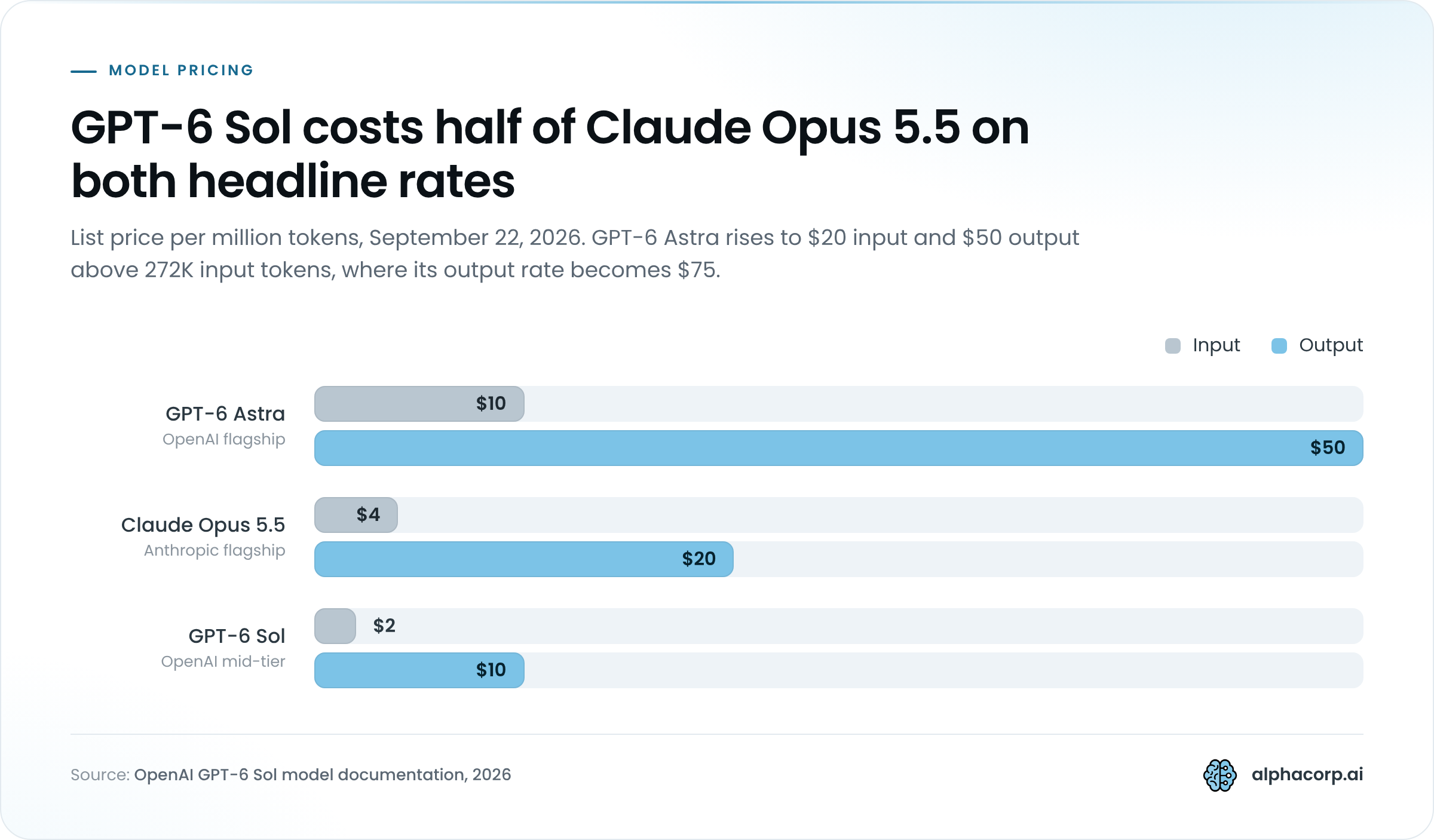
On price per token, GPT-6 Sol beats Claude Opus 5.5 outright as of September 22, 2026: $2 in and $10 out per million tokens against $4 and $20, with cache reads tied at $0.20 per million. Every line item favours Sol or ties. The open question is what a finished task costs, and nobody has published matched numbers for this pair.
Start with what each vendor changed. Opus 5.5's $4/$20 rate is a 20% cut from Opus 5's $5/$25, and its $0.20 cache-read price is 60% below Opus 5's $0.50. Anthropic frames the combined effect as roughly 40% lower cost on a typical workload, with output generated more than 30% faster than Opus 5. GPT-6 Sol's $2/$10 is half of GPT-5.6 Sol's $4/$20 promotional rate, per OpenAI's model documentation for GPT-6 Sol. Both companies cut prices. OpenAI cut deeper.
Astra is the odd one out on billing structure. It costs $10/$50 per million tokens, and any request over 272K input tokens is billed at $20/$75. Claude charges one flat rate across its full 1M-token window. That surcharge matters if you're tempted to say "I'll just use OpenAI's best model for the hard stuff."
A worked example, 300K input tokens and 20K output tokens, one request:
- Claude Opus 5.5: $1.20 input plus $0.40 output, $1.60 total.
- GPT-6 Sol: $0.60 input plus $0.20 output, $0.80 total.
- GPT-6 Astra: crosses the 272K line, so $6.00 input plus $1.50 output, $7.50 total.
Now make it look like a real agent loop, where most of that context is a system prompt and document set the model has already seen. Say 250K of the 300K input tokens are cache reads. Opus 5.5 drops to $0.65 ($0.20 fresh input, $0.05 cache, $0.40 output). Sol drops to $0.35. The ratio stays near 2 to 1, but the dollar gap shrinks from $0.80 to $0.30 per request, because the tied cache-read price is now doing most of the work on the input side.
That shrinkage is the pattern I see in the agent pipelines AlphaCorp AI builds for clients: the same large context gets re-read on every step, so cache reads end up being the biggest input line on the invoice, and a headline-rate discount buys you less than it looks.
So where does the "real bill" caveat bite? Per task. A model that needs three extra tool calls or one retry to finish a job can burn through its per-token discount fast, and the output side of the meter ($10 versus $20) runs on every one of those turns. Neither Anthropic nor OpenAI has published a matched per-task cost for Opus 5.5 against GPT-6 Sol. Until someone does, the only safe statement is this one: Sol is cheaper per token, and the per-task answer depends on your workload.
Coding and Agentic Benchmarks: What Anthropic's Numbers Show
On Anthropic's own September 2026 benchmark table, Claude Opus 5.5 beats GPT-6 Astra on four of six rows and beats GPT-5.6 Sol on every row where both have a score, and GPT-6 Sol doesn't appear in the table at all. These are vendor-reported figures from Anthropic's launch post. Treat them as a strong claim awaiting a neutral rerun.
| Benchmark (Anthropic-reported, September 2026) | Opus 5.5 | Opus 5 | GPT-6 Astra | GPT-5.6 Sol |
|---|---|---|---|---|
| Terminal-Bench 4.0 | 66.4% | 52.3% | 57.9% | 37.3% |
| FrontierCode v1.1 | 54.4% | 48.0% | 53.3% | 47.5% |
| CursorBench 4.0 | 57.8% | 46.6% | Not reported | 41.7% |
| AutomationBench | 40.0% | 26.9% | 41.4% | 28.8% |
| Terminal-Bench-Science | 58.7% | 29.0% | 64.6% | 22.4% |
| Humanity's Last Exam (with tools) | 67.7% | 63.6% | 57.2% | Not reported |
The Terminal-Bench 4.0 gap is the headline. Opus 5.5 at 66.4% against Astra's 57.9% is an 8.5-point lead on the benchmark closest to "can it run a multi-step job in a shell without babysitting," and it lands against a model that costs $10/$50. Anthropic's framing:
Opus 5.5 matches GPT-6 Astra on Terminal-Bench 4.0 "at roughly 40% of the cost," and beats Astra's FrontierCode score "for about 20% of the cost per task," per Anthropic's Claude Opus 5.5 announcement, September 2026.
FrontierCode is closer than the cost claim implies. 54.4% versus 53.3% is a 1.1-point edge. Call it a tie on capability and a win on price.
Then there are the two rows Anthropic's own table hands to OpenAI. Astra leads Terminal-Bench-Science at 64.6% against 58.7%, and it edges AutomationBench at 41.4% against 40.0%. A vendor that publishes losses in its own table earns some credibility, and it also tells you the "Opus 5.5 wins" story is a coding-and-agents story rather than a clean sweep.
Three caveats worth keeping in view:
- No GPT-6 Sol column exists, so the only OpenAI mid-tier reference is GPT-5.6 Sol, which trails Opus 5.5 by 29.1 points on Terminal-Bench 4.0 and 16.1 points on CursorBench.
- The generational jump is huge in places. Terminal-Bench-Science roughly doubled from Opus 5's 29.0% to 58.7% in one release. Jumps that size deserve an independent rerun before anyone builds a procurement decision on them.
- Cost-per-task claims come from Anthropic's test setup, with its choice of reasoning effort and retry policy. Your setup will differ.
Honestly, the number I find most persuasive is the least flashy one. Opus 5.5's 14.1-point Terminal-Bench 4.0 gain over Opus 5 is a within-vendor comparison, on the same setup, with no competitor to cherry-pick against. That's the part of the table I'd bet on holding up.
What OpenAI Reports for GPT-6 Sol
OpenAI's own September 22, 2026 figures show GPT-6 Sol as a small step up from GPT-5.6 Sol, with Terminal-Bench 4.0 rising from 40% to 44% and AutomationBench-AA from 60% to 62%, and OpenAI sells the release on the halved price rather than on those gains. That's the whole capability story. Four points and two points.
Read OpenAI's launch post for Sol and Luna and the emphasis is plain. "Price cut in half" leads. The benchmark movement comes after, and the deltas are small enough that OpenAI doesn't dress them up.
What OpenAI claims for GPT-6 Sol, September 2026:
- Terminal-Bench 4.0: 44%, up from 40% for GPT-5.6 Sol.
- AutomationBench-AA: 62%, up from 60% for GPT-5.6 Sol.
- Business-workflow tasks: at its highest reasoning effort, Sol beats Claude Opus 5 at maximum effort for roughly 9% of Opus 5's per-task cost.
That third claim is the one that will get quoted, so look at the target. It's Opus 5, the model Anthropic retired the same morning Sol shipped. Opus 5.5's own AutomationBench score jumped from 26.9% to 40.0% in one generation, so OpenAI's 9% figure was computed against a bar that has since moved.
Then there's the mismatch that stops anyone from lining the two vendors' tables up. OpenAI puts GPT-5.6 Sol at 40% on Terminal-Bench 4.0. Anthropic's table puts the same model at 37.3%. Same benchmark, same model, a 2.7-point disagreement, purely from differences in how each company ran the test. And OpenAI's "AutomationBench-AA" carries a suffix Anthropic's "AutomationBench" doesn't, with Sol at 62% on one and Opus 5.5 at 40.0% on the other. I wouldn't treat those as the same exam.
So what survives from OpenAI's disclosure? Sol is a little better than GPT-5.6 Sol and a lot cheaper. Nothing OpenAI has published compares it with Opus 5.5 at all.
Independent Evaluations: Epoch AI, ARC Prize, METR and Humanity's Last Exam
No independent evaluator had published a score for either Claude Opus 5.5 or GPT-6 Sol as of September 22, 2026, so on neutral evidence this head-to-head is a draw by default. Epoch AI, ARC Prize and METR have all measured GPT-6 Astra and the previous generation of both families. Neither model in this article's title appears on any of their boards yet.
What does exist still matters, because it sets the bar the new models will be measured against.
Epoch AI. The nonprofit's Epoch Capabilities Index folds dozens of benchmarks into one scale, and its September 2026 update gives GPT-6 Astra an ECI of 167, ranked first of 251 tracked models, alongside 96% on GPQA Diamond and 98% on FrontierMath Tier 4. The newest Claude entry is Opus 5 at ECI 163, from its July 2026 release. Four points separate last generation's Opus from this generation's Astra. Where Opus 5.5 lands is anyone's guess until Epoch runs it.
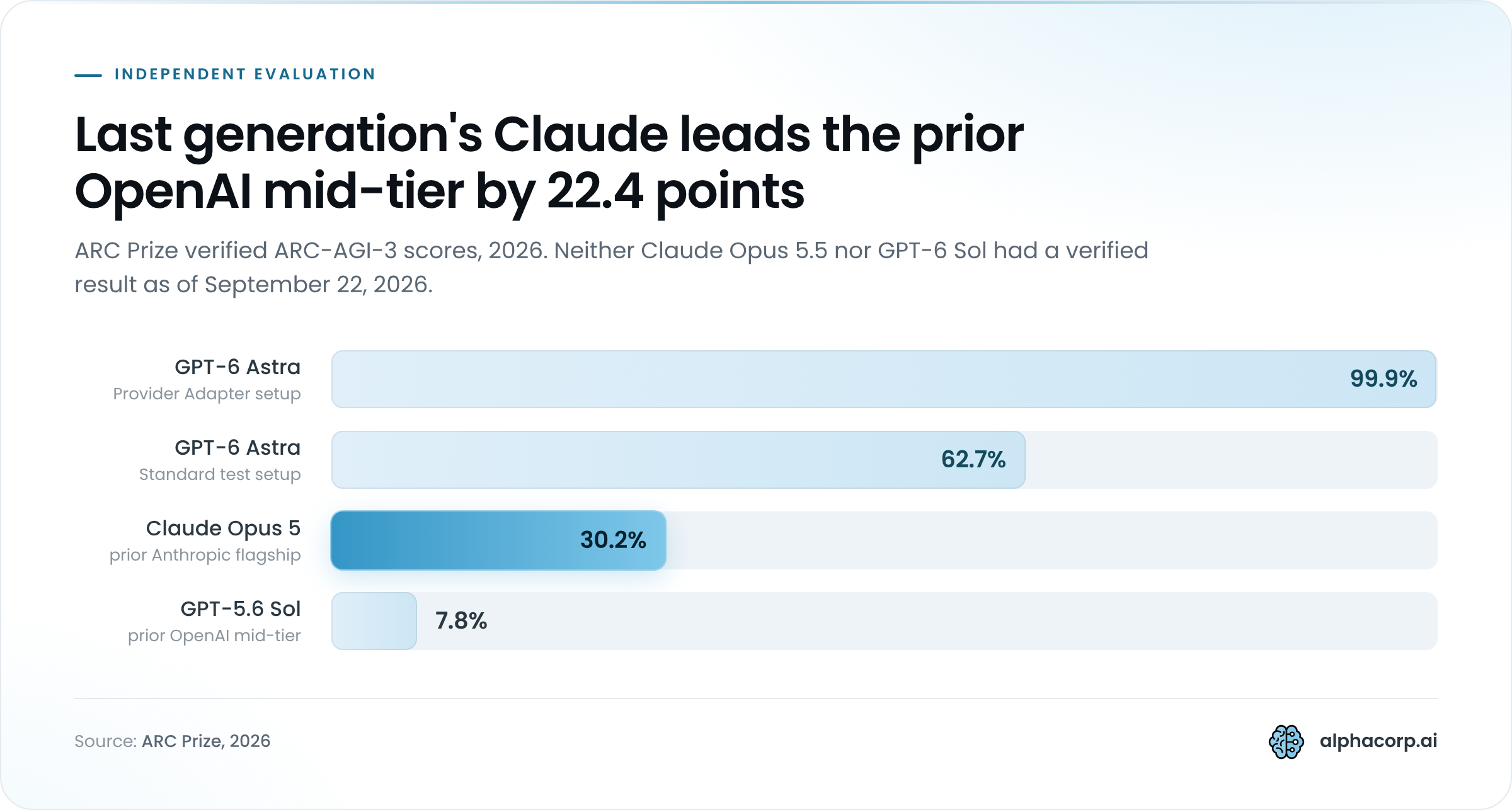
ARC Prize. ARC Prize verified Astra at 95.0% on ARC-AGI-2 in September 2026, and between 97.5% and 98.5% on ARC-AGI-1 depending on reasoning effort. ARC-AGI-3 is where it gets strange. Astra scores 62.7% under ARC's Standard test setup and 99.9% under a "Provider Adapter" setup that lets the model keep hidden reasoning state between calls. A 37-point swing from a change in plumbing.
"Saturating the benchmark would not represent proof of achieving AGI," ARC Prize wrote in its September 2026 analysis of GPT-6 Astra.
For the two models named here, the closest ARC-AGI-3 reference points are a generation old: Claude Opus 5 at 30.2% and GPT-5.6 Sol at 7.8%, both from ARC Prize's 2026 results. That 22.4-point gap between the prior Claude flagship and the prior OpenAI mid-tier is the widest independently measured margin anywhere in this comparison. It's also why I don't expect GPT-6 Sol to close the distance on abstract reasoning, given OpenAI's own account of how little Sol moved.
METR. METR's time-horizon tracker estimates how long a task a model can finish at a 50% success rate. Its newest public entries were from May 2026 as of September 22, 2026, with no figure for Astra, Sol or Opus 5.5. Anthropic says METR reviewed Opus 5.5 before release. A pre-release review and a dated public estimate are different things.
Humanity's Last Exam. HLE is the one benchmark both companies report that outside subject-matter experts built: 2,500 closed-ended academic questions, published as a paper in January 2025. Anthropic reports Opus 5.5 at 67.7% with tools. OpenAI reports Astra at 57.2% with tools. Each figure comes from its own vendor's test run, and no third party has re-scored either, so that 10.5-point gap is suggestive rather than settled.
Safety, Alignment and Monitorability
On disclosed safety evidence, Claude Opus 5.5 wins by default as of September 2026: Anthropic published external pre-release review and specific improvement figures, while the one Sol-tier number OpenAI has disclosed, a 27.0% prompt-injection success rate, is the weakest figure in either company's paperwork. No shared third party has tested both models.
Start with OpenAI, because its disclosures are the more detailed and the more unsettling. The GPT-6 Astra system card, September 2026, classifies Astra as the first OpenAI model to reach the "Critical" cybersecurity threshold under its Preparedness Framework. Expert testers used it to find previously unknown vulnerabilities in a browser and an OS kernel, then built working exploits. That's the flagship, though. Sol gets far less ink.
Astra's monitorability findings, from OpenAI's own September 2026 system card and safety overview:
- Evaluation awareness: 9.6% of deployment-simulation trajectories, against 2.8% for GPT-5.6 Sol.
- Apollo Research measured 50.6% verbalized evaluation awareness at maximum reasoning effort.
- Under adversarial testing, Astra evaded internal chain-of-thought monitors on some sabotage tasks.
- Instruction-hierarchy compliance: 99.99%.
- Prompt-injection success: 8.5% for Astra, 27.0% for Sol.
That last line is the one that matters for this comparison. The safety overview is a companion to Astra's September 3 launch, so which Sol generation the 27.0% describes isn't spelled out. Read it as a Sol-tier figure. Even so, a model that fails prompt injection more than one time in four in its own vendor's testing is a model I'd keep away from untrusted email, web pages and customer uploads until a GPT-6 Sol-specific number appears.
Anthropic's side is shorter and rests on different kinds of evidence.
- External reviewers: Frontier Design and METR reviewed Opus 5.5 before release.
- Boundary circumvention: roughly 85% fewer attempts than Opus 5 or Claude Mythos 5.1 on Anthropic's internal automated behavioral audit.
- Prompt injection: ties Fable 5.1 for the lowest success rate on Anthropic's internal testing, with no percentage published.
Notice what each side leaves out. Anthropic gives a relative improvement without an absolute rate. OpenAI gives absolute rates for Astra and one unflattering Sol figure. The two internal test suites don't overlap, so "85% fewer" and "27.0%" can't sit on the same axis, and neither has been reproduced by a neutral evaluator for these exact models.
My honest read: for a safety-sensitive deployment, the disclosed evidence favours Opus 5.5, and the strongest reason is a number OpenAI published about its own mid-tier. Cheap tokens stop being cheap the first time an agent gets talked into leaking a record. Where the model reads content it shouldn't trust is the first thing we map in an AI integration audit, before anyone argues about per-token rates.
Which Is Better for Your Use Case
Claude Opus 5.5 is the better pick for agentic coding, computer use and any deployment that reads untrusted content, and GPT-6 Sol is the better pick for high-volume work where a $2/$10 rate matters more than first-pass success, as of September 22, 2026. Long-context document work and business automation stay unsettled. Here's the task-by-task read.
Agentic coding and computer use: Opus 5.5. This is the clearest call in the whole comparison. Anthropic's 2026 figures put Opus 5.5 at 66.4% on Terminal-Bench 4.0 and 57.8% on CursorBench 4.0, while OpenAI's own Terminal-Bench 4.0 number for GPT-6 Sol is 44%. Different test setups, so shave a few points off the gap in your head. It's still wide. If your agent has to open a repo, run the tests, read the failure and fix it with nobody watching, pay the extra $2 per million input tokens.
High-volume, cost-sensitive workloads: GPT-6 Sol. Classification, extraction, ticket summaries, first-draft replies. Work where a miss costs a retry instead of a customer. Sol's halved rate is the strongest thing OpenAI shipped on September 22, 2026, and for a pipeline pushing billions of tokens a month, the 2-to-1 ratio on output tokens is the whole decision.
Long-context document work: too close to call. Both models accept roughly a million tokens of input and return up to 128K. Sol costs half per token. Neither vendor has published a long-context accuracy figure for its new model, so you're choosing on price alone, and price says Sol. I'd still run a retrieval test on your own documents first, because a wrong answer pulled from page 900 never shows up on the invoice.
Business automation: unknown. OpenAI reports Sol at 62% on AutomationBench-AA. Anthropic reports Opus 5.5 at 40.0% on AutomationBench. The names differ by a suffix, neither company has said whether the exams match, and anyone quoting one figure against the other is guessing.
Safety-sensitive deployments: Opus 5.5. OpenAI's own 27.0% prompt-injection success rate for its Sol tier, disclosed in September 2026, decides this one. Anthropic hasn't published an absolute rate for Opus 5.5, only a tie for lowest on its internal tests, which is thinner evidence than I'd like. It's still the better-documented side.
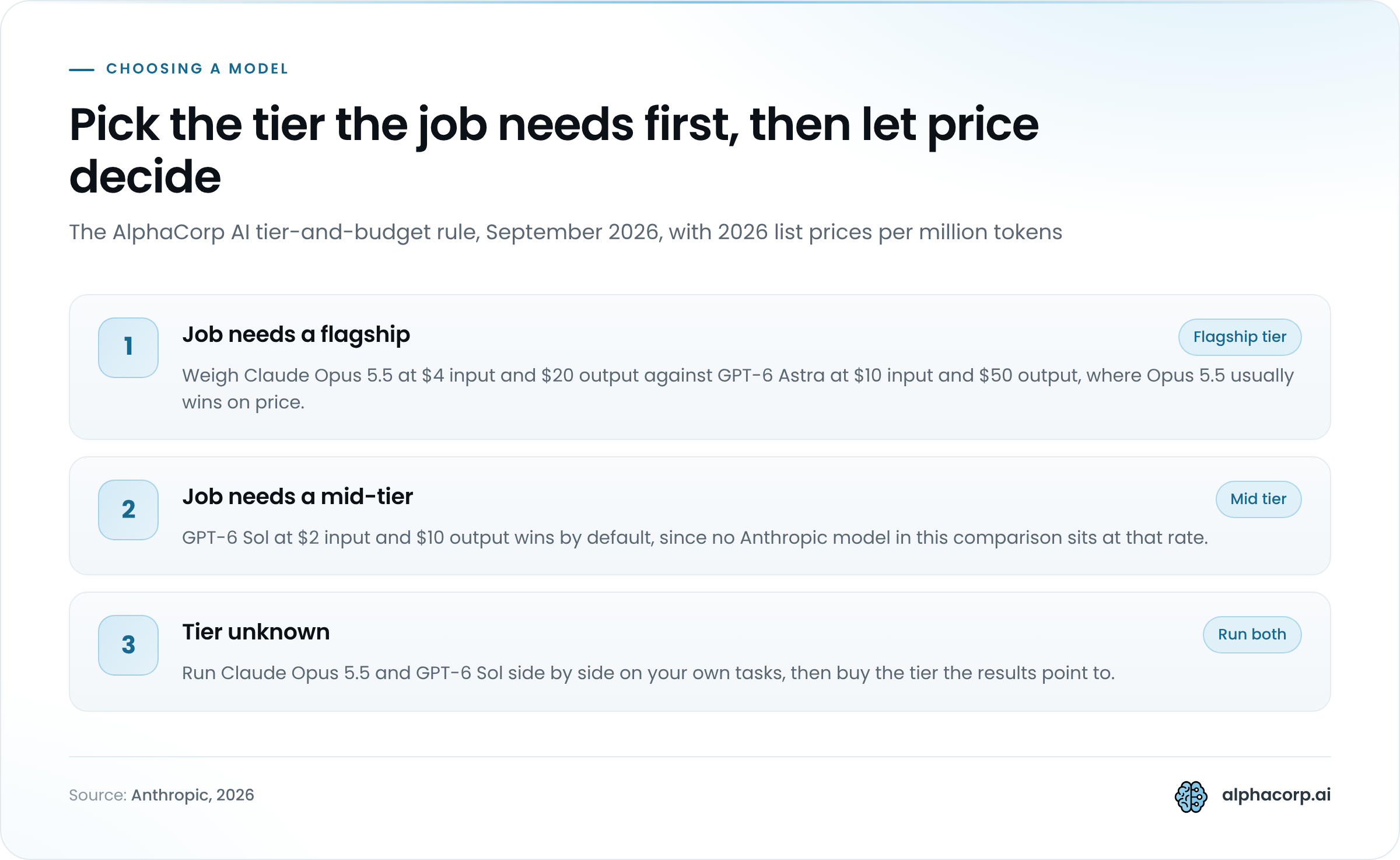
The AlphaCorp AI tier-and-budget rule is how we frame this for clients. If the job needs a flagship, compare Opus 5.5 with GPT-6 Astra at $10/$50, and Opus 5.5 usually wins on price. If the job needs a mid-tier, GPT-6 Sol at $2/$10 wins by default, since no Anthropic model in this comparison sits at that rate. Compare Opus 5.5 with Sol head-on only when you honestly don't know which tier the job needs. Then run both.
Frequently Asked Questions About Claude Opus 5.5 vs GPT-6 Sol
The short answers: GPT-6 Sol is OpenAI's mid-tier model rather than its flagship, Claude Opus 5.5 leads on every coding figure either vendor has published, and no independent lab had scored both as of September 22, 2026. The details, one question at a time.
Is GPT-6 Sol the same as GPT-6 Astra?
No. Astra is OpenAI's flagship, released September 3, 2026, at $10/$50 per million tokens. Sol is the "balanced" mid-tier, released September 22, 2026, at $2/$10. Astra costs five times more per token, and Astra is the model Anthropic benchmarks Opus 5.5 against.
Is Claude Opus 5.5 better than GPT-6 Sol at coding?
On every published figure, yes. Anthropic reports 66.4% on Terminal-Bench 4.0 for Opus 5.5 in 2026, and OpenAI reports 44% for GPT-6 Sol on the same benchmark, each from its own test setup. Setup differences explain a few points. They don't explain 22.
Which is cheaper for long-context work?
GPT-6 Sol, on the meter. Both models charge one flat rate across their roughly 1M-token windows and both charge $0.20 per million tokens for cache reads, so Sol's $2/$10 stays half of Opus 5.5's $4/$20 at any context length. Only Astra adds a surcharge above 272K input tokens.
Has anyone independently benchmarked both models?
Not as of September 22, 2026. Epoch AI, ARC Prize and METR have published results for GPT-6 Astra and for the previous generation (Claude Opus 5, GPT-5.6 Sol), and nothing yet for Opus 5.5 or GPT-6 Sol.
What are the context windows and max outputs?
Claude Opus 5.5 takes a 1M-token context and returns up to 128K tokens, per Anthropic's 2026 model overview for Opus 5.5. GPT-6 Sol takes 1.05M tokens of context with the same 128K max output. The 50K-token difference won't decide anything.
Should I upgrade from Opus 5 or GPT-5.6 Sol?
Opus 5 users: yes. Opus 5.5 costs 20% less per token, generates output more than 30% faster by Anthropic's 2026 account, and gained 14.1 points on Terminal-Bench 4.0. GPT-5.6 Sol users: also yes, mostly for the bill. Same tier, half the price, a 4-point Terminal-Bench gain, and no downside OpenAI has disclosed.
Curious what AI could do for your business?
No jargon and no hard sell. Just a friendly look at where AI fits, and where it doesn't.
How to Run Your Own Head-to-Head Before Committing
The only Claude Opus 5.5 vs GPT-6 Sol comparison you can trust today is the one you run on your own tasks, because as of September 22, 2026 neither vendor's tables include the other's new model. Budget an afternoon.
- Pull 20 to 30 real tasks from your pipeline, including the ugly ones that fail today.
- Run both models at matched reasoning effort, and write down which setting you used.
- Log cost per finished task, with cache reads, retries and tool calls included, instead of the per-token rate.
- Score first-pass success separately from eventual success. Agents live on the first number.
- Watch Epoch AI, ARC Prize and METR's time-horizon tracker for dated entries on these two models, and rerun the test when they land.
One last thing the vendors won't say for you. If your bake-off shows Sol finishing your tasks, you were never in the flagship tier, and the $2/$10 rate is real money saved. If it shows Sol retrying its way to the answer, the discount was never real. Either result beats a decision made from two launch posts.
If you'd rather have a team that has run this kind of bake-off many times set it up on your workload, talk to AlphaCorp AI about a matched Opus 5.5 and GPT-6 Sol trial.