

FastAPI Development Services
Production Python APIs for machine-learning, LLM, and data teams, designed, shipped, and patched by the engineers you actually talk to.
AlphaCorp AI's FastAPI development services design, build, and maintain production APIs on FastAPI, the Python framework that turns a single type hint into request validation, response serialization, and OpenAPI documentation in one pass. We build for engineering teams that need to put a model, a retrieval pipeline, or an agent behind an HTTP endpoint that holds up under real traffic, and we keep the dependency chain of FastAPI, Starlette, and Pydantic pinned and patched after launch. FastAPI has still never shipped a 1.0 release, and that fact is why the maintenance half of this service exists.

Creators of RustyRAG
Realtime RAG, built in Rust · Sub-200ms end-to-end 10+ years delivering AI solutionsIgnas Vaitukaitis · Founder & CEO
 VersarWashington, DC
 GynisusNew York
 CampusReelNew York
 LuniqGermany
 HospitalityFlowSingapore
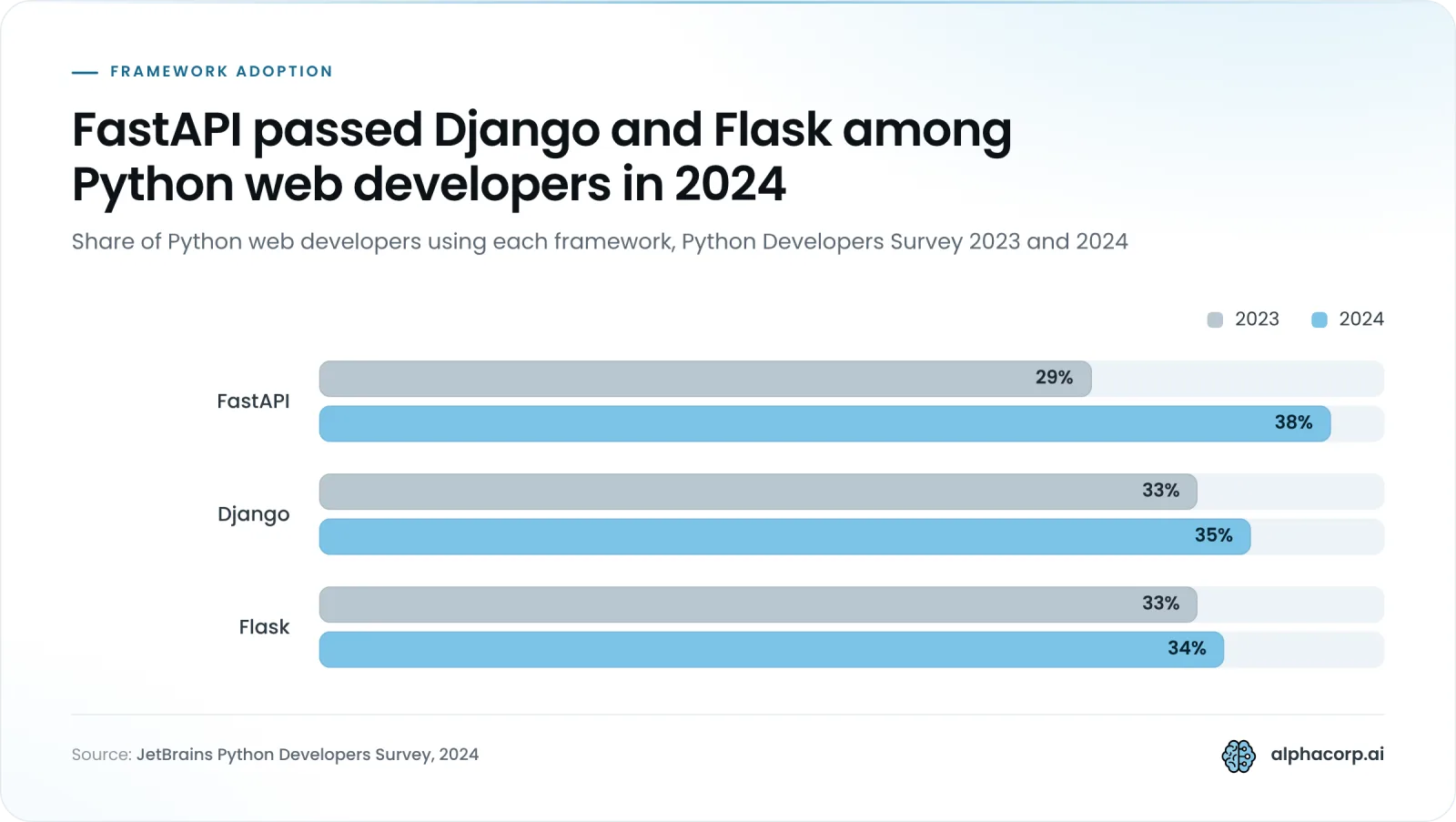
FastAPI development services by the numbers, 2024 to 2026
Two figures explain why teams put an API on FastAPI. The third explains why they keep paying someone to watch it.
What our FastAPI development services build
AlphaCorp AI's FastAPI development services cover six pieces of work, from a greenfield typed API to the rescue of an inherited codebase nobody wants to upgrade.
The Stack We Ship On
We pick the best tool for each job, not the trendiest. This is what runs behind the agents, retrieval pipelines and automation we put into production.
 AWS
AWS Azure
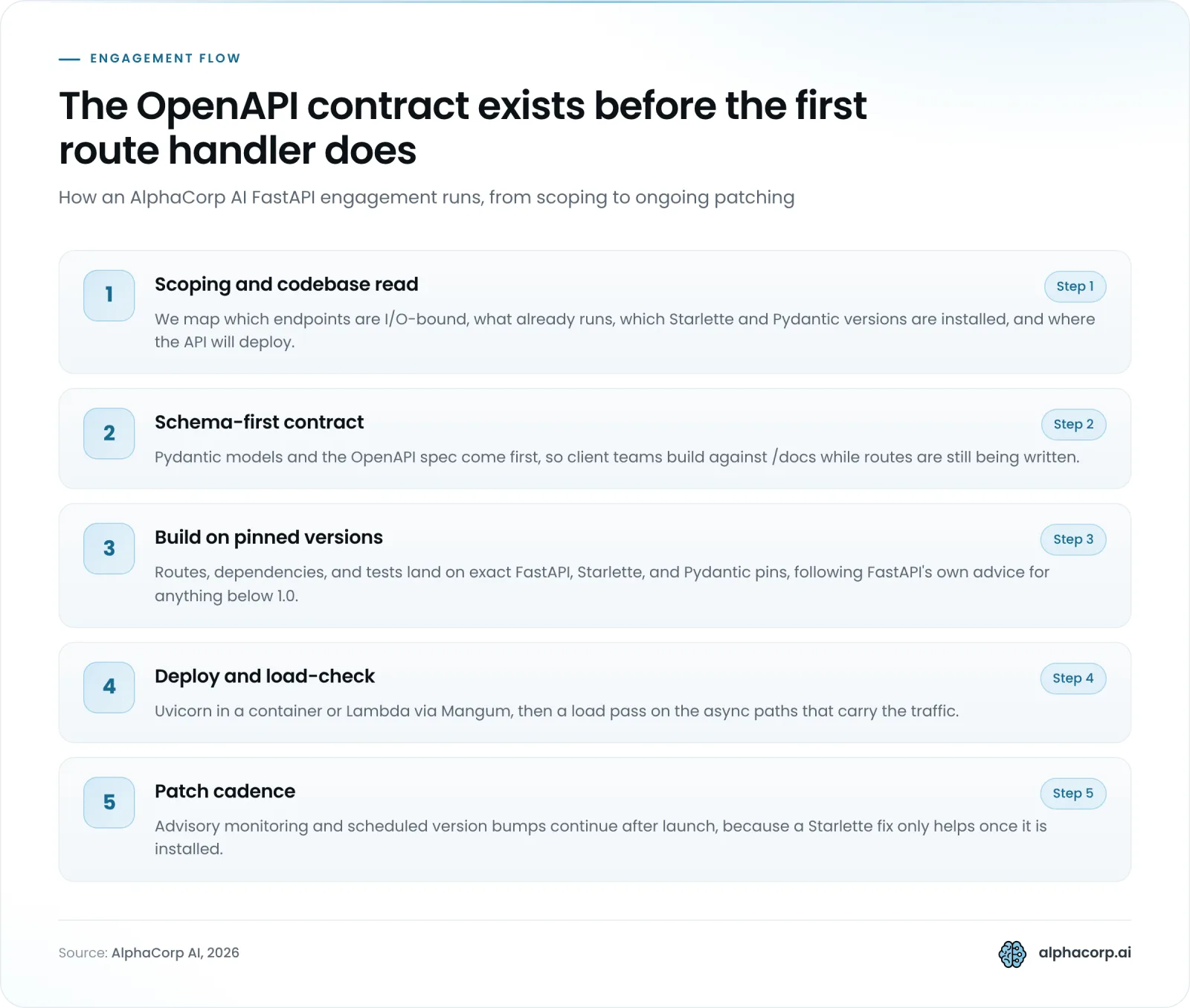
AzureHow a FastAPI development services engagement runs
An engagement runs in five steps, and the OpenAPI contract exists before the first route handler does.
Why invest in FastAPI development services
FastAPI does three jobs from one annotation and overlaps the I/O waits that dominate model-backed APIs. We build on those two mechanics on purpose.
Why Python teams pick AlphaCorp AI for FastAPI development services
AlphaCorp AI is the remote-first engineering studio behind RustyRAG, an open-source retrieval-augmented generation engine that answers in under 200ms, founded by Ignas Vaitukaitis and working US Eastern hours from Rio de Janeiro in English, Portuguese, and Spanish. The framework we build on already runs production systems at Netflix, Uber, and NASA, so the framework question is settled before the first call.
We treat sub-1.0 versioning as an operations problem. FastAPI's versioning documentation says any release below 1.0.0 could potentially add breaking changes, and recommends pinning. Eight years in, still 0.x. We pin exact versions and run the test suite against every bump before it ships.
We check the boring things first on inherited code. The first thing we grep for in a codebase we take over is StaticFiles or FileResponse running on a Starlette older than 0.49.1, because that combination is the CVE-2025-62727 denial-of-service path. The second is whether any access control keys off the request path, since the BadHost flaw splits the path routing sees from the path security middleware reads on every Starlette below 1.0.1.
We will tell you when FastAPI is the wrong layer. If an endpoint needs no validation, no serialization, and no docs, bare Starlette is lighter and we will say so. And to the objection that your team could write this themselves: true for the first endpoint, which is a short file. What you are paying for is the schema design, the async discipline, and the patch cadence over the years that follow. Where the whole service is the wrong language, our Rust development services take it from there.
The people you talk to are the people who build. The engineer who writes your version pins is the one on the scoping call.
Security and patching in our FastAPI development services
Every FastAPI deployment inherits Starlette's vulnerabilities, so AlphaCorp AI runs dependency patching as a standing part of every contract instead of a one-time setup step. Two flaws from the past year show why.
CVE-2025-62727, high, CVSS 7.5. A crafted HTTP Range header triggers quadratic processing in FileResponse's range parsing on Starlette 0.39.0 to 0.49.0, so an unauthenticated attacker can pin a CPU with one request. Patched in Starlette 0.49.1. The vLLM project had to push an urgent upgrade in October 2025 because its serving stack sits on the same layer.
CVE-2026-48710, BadHost, moderate, CVSS 6.5. Starlette 0.8.3 through 1.0.0 rebuilt request.url by concatenating the raw Host header with the path without validating it, so one malformed character desynchronizes routing from path-based security middleware. Fixed in Starlette 1.0.1, per the National Vulnerability Database record.
Our practice follows from those two records: exact pins with a tested upgrade window, advisory monitoring across FastAPI, Starlette, and Pydantic, and authentication enforced through dependency injection so a path-string check is never the only gate.