
On this page(18)
- GPT-6.2 Astra vs Gemini 4 Carbon: Which Model Leads on Which Benchmark
- Agents' Last Exam Scores for Long-Horizon Professional Work
- FrontierCode Coding Results and the Artificial Analysis Intelligence Index
- Where Gemini 4 Carbon Beats GPT-6.2 Astra: AutomationBench Business Workflows
- What Do GPT-6.2 Astra and Gemini 4 Carbon Actually Cost per Task?
- Why Gemini 4 Carbon's Lower Token Price Does Not Mean a Lower Bill: Output Tokens on GDPval
- What Google's Own Benchmarks Show for Gemini 4 Carbon and Why the Two Labs' Numbers Are Not Directly Comparable
- What Each Model Is Built For: Professional Deliverables, Coding, Science and Cybersecurity
- Where Each Model Is Available: Plans, API Access and Special Programs
- Which Model Fits Which Team and Workload
- GPT-6.2 Astra vs Gemini 4 Carbon FAQ
- Is GPT-6.2 Astra better than Gemini 4 Carbon?
- Which is cheaper, GPT-6.2 Astra or Gemini 4 Carbon?
- Which is better for coding, GPT-6.2 Astra or Gemini 4 Carbon?
- When were GPT-6.2 Astra and Gemini 4 Carbon released?
- Does Gemini 4 Carbon's price go up?
- What is the difference between GPT-6.2 Astra and GPT-6.2 Sol?
- Where to Start When Choosing Between the Two Models
GPT-6.2 Astra is the better default for most teams: it leads four of five shared benchmarks, usually at a lower cost per task. Gemini 4 Carbon takes business workflow automation and has the cheaper token price. Close call, though. As of November 17, 2026, the only GPT-6.2 Astra vs Gemini 4 Carbon head-to-head comes from OpenAI's own launch charts, and no lead tops 3.1 points. This comparison gives every shared score, the cost of each run, and the reason Carbon's cheaper tokens often add up to a bigger bill.
Five figures carry most of the decision:
- Head-to-head count: GPT-6.2 Astra posted the higher best score on 4 of the 5 benchmarks OpenAI charted for both models on November 17, 2026. Gemini 4 Carbon leads the fifth, AutomationBench 1.0.6, by 53.9% to 52.4%.
- Token price: Astra costs $8 input and $40 output per million tokens. Carbon costs $2 and $10 through November 30, 2026, then $4 and $20, per the OpenAI and Google pricing pages checked on November 17, 2026.
- Cost per task: on OpenAI's November 17, 2026 chart for Agents' Last Exam v1.1, Astra's best run scored 78.3% for $2.89 and Carbon's scored 77.4% for $4.60.
- Output tokens: on GDPval v2, OpenAI's internal benchmark charted on November 17, 2026, Carbon wrote 108,729 output tokens at High effort against 35,812 for Astra at Max.
- Long context: Google's October 28, 2026 benchmark table gives Carbon 96.2% on GraphWalks against 71.8% for GPT-6 Astra, the predecessor to GPT-6.2 Astra.
GPT-6.2 Astra vs Gemini 4 Carbon: Which Model Leads on Which Benchmark
GPT-6.2 Astra posts the higher best score on four of the five benchmarks where OpenAI charted both models, and Gemini 4 Carbon wins the fifth. As of November 17, 2026, that 4 to 1 count is the only public head-to-head for GPT-6.2 Astra vs Gemini 4 Carbon, and OpenAI published every run behind it in its GPT-6.2 Astra launch announcement. Treat it as one vendor's scoreboard. A detailed one, with costs attached.
| Benchmark (OpenAI charts, November 17, 2026) | GPT-6.2 Astra best run | Gemini 4 Carbon best run | Higher score |
|---|---|---|---|
| Agents' Last Exam v1.1 | 78.3% at Xhigh, $2.89 per task | 77.4% at High, $4.60 per task | GPT-6.2 Astra |
| Artificial Analysis Intelligence Index v5.0.1 | 62.1 at Max, $4.00 | 60 at High, $7.76 | GPT-6.2 Astra |
| FrontierCode 2.0 | 44.2% at Max, $5.97 | 41.1% at Medium, $5.16 | GPT-6.2 Astra |
| GDPval v2 (Internal) | 50.4% at Max, 35,812 output tokens | 48.8% at High, 108,729 output tokens | GPT-6.2 Astra |
| AutomationBench 1.0.6 | 52.4% at Max, $0.83 | 53.9% at High, $2.12 | Gemini 4 Carbon |
Three caveats decide how much weight the table can carry:
- Effort levels: OpenAI plotted Carbon at Low, Medium and High only (High alone on Agents' Last Exam). All four Astra wins come from Xhigh or Max, tiers with no Carbon run to compare.
- Margins: no gap on these charts is wider than 3.1 points, and the smallest is 0.9.
- Cost: Astra's best run was cheaper on three of the four charts priced in dollars. FrontierCode 2.0 is the exception, at $5.97 against Carbon's $5.16.
Our read at AlphaCorp AI: on this evidence, Astra is the stronger default for long professional tasks and coding, usually at a lower cost per task. Carbon is the better pick for business workflow automation. Neither lead is wide enough to skip a test on your own workload.
Agents' Last Exam Scores for Long-Horizon Professional Work
GPT-6.2 Astra tops Gemini 4 Carbon on Agents' Last Exam v1.1 by 0.9 points, 78.3% to 77.4%, on the chart OpenAI published on November 17, 2026. Astra's best run cost $2.89 per task. Carbon's cost $4.60.
The benchmark grades long-horizon professional workflows: OpenAI describes it as multistep professional work, and Google files it under computer use. OpenAI plotted Astra at five reasoning effort levels and Carbon at one.
| Reasoning effort | GPT-6.2 Astra | Gemini 4 Carbon |
|---|---|---|
| Low | 65.8% ($0.47) | not plotted |
| Medium | 72.1% ($1.06) | not plotted |
| High | 76.0% ($2.05) | 77.4% ($4.60) |
| Xhigh | 78.3% ($2.89) | not plotted |
| Max | 77.6% ($4.47) | not plotted |
Astra's score peaks at Xhigh and then slips. The Max run scored 77.6%, down 0.7 points, and cost $1.58 more per task than the Xhigh run. More reasoning bought a slightly worse result, which is a good reason to test effort settings on your own tasks before defaulting to the top one.
Here's the part the headline number hides. At High, the one effort level both models share, Carbon leads by 1.4 points, 77.4% to 76.0%. It pays for that lead: $4.60 per task against Astra's $2.05, more than double. Astra's overall win rests on Xhigh, a tier with no plotted Carbon run.
"GPT-6.2 Astra sets a new high, scoring 5.2 points higher than GPT-6 Astra at less than a third of the cost." OpenAI, launch announcement, November 17, 2026
That claim is about Astra's predecessor, and the chart supports it: GPT-6 Astra scored 73.1% at Max for $8.99. Against Carbon the result is tighter. Google's October 28, 2026 benchmark table lists the same 77.4% for Carbon, so two separate lab pages agree on its score here. I'd call this one a tie on score and an Astra win on cost.
FrontierCode Coding Results and the Artificial Analysis Intelligence Index
GPT-6.2 Astra beats Gemini 4 Carbon on both FrontierCode 2.0 (44.2% to 41.1%) and the Artificial Analysis Intelligence Index v5.0.1 (62.1 to 60) on OpenAI's November 17, 2026 charts. Claude Fable 5.2 holds the top score on both charts, at 49.1% and 64.6. Each cell below shows the score, with the charted cost of that run in brackets.
| Reasoning effort | Astra, FrontierCode 2.0 | Carbon, FrontierCode 2.0 | Astra, AA Index v5.0.1 | Carbon, AA Index v5.0.1 |
|---|---|---|---|---|
| Low | 38.1% ($1.41) | 32.4% ($5.49) | 45.7 ($0.66) | 54.2 ($7.19) |
| Medium | 42.2% ($2.47) | 41.1% ($5.16) | 57 ($1.62) | 58.3 ($6.59) |
| High | 43.6% ($3.95) | 38.4% ($5.83) | 60.1 ($2.07) | 60 ($7.76) |
| Xhigh | 44.1% ($4.29) | not plotted | 61.6 ($2.52) | not plotted |
| Max | 44.2% ($5.97) | not plotted | 62.1 ($4.00) | not plotted |
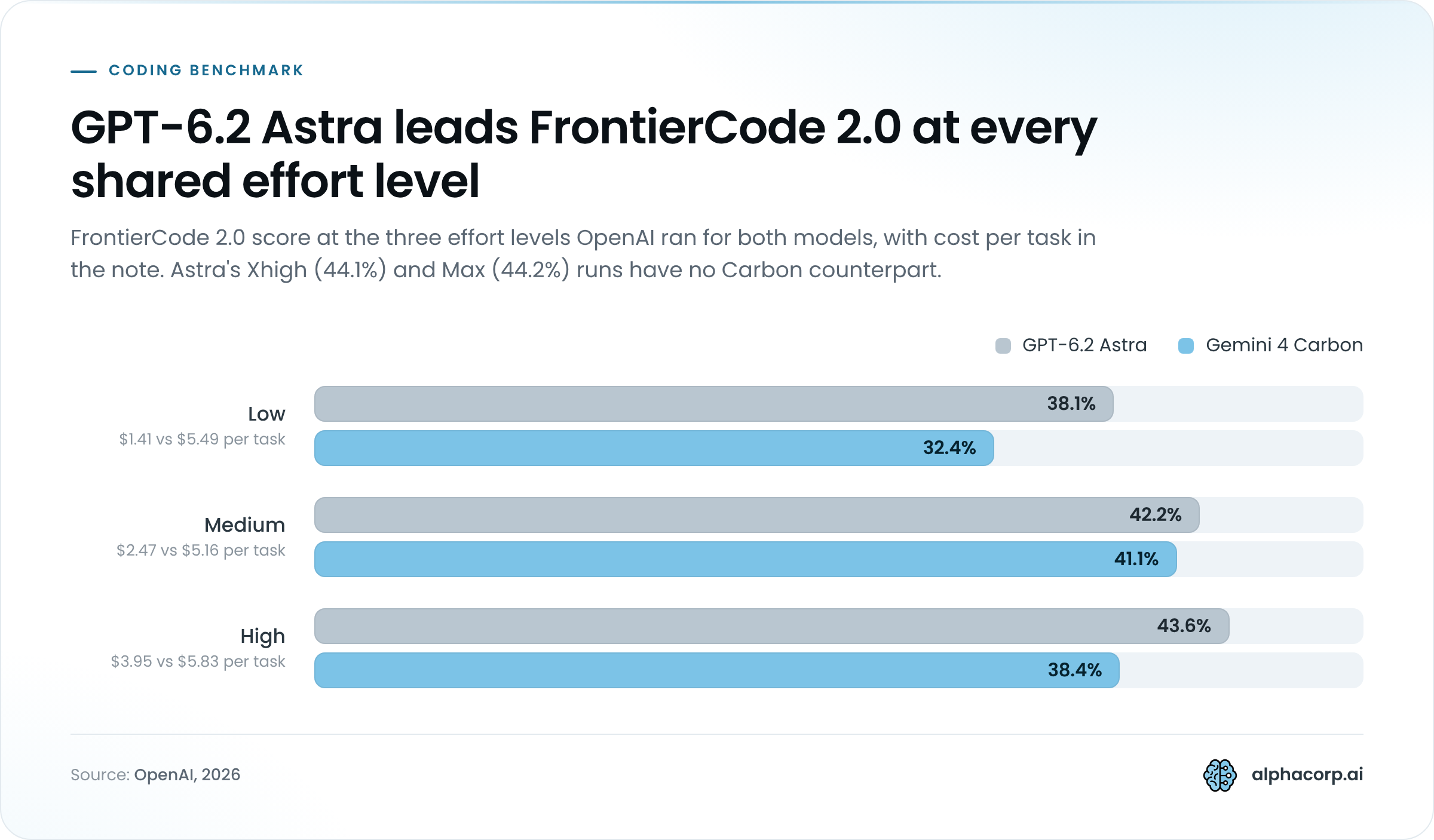
FrontierCode 2.0 is Cognition's benchmark for whether changes to real codebases meet maintainers' standards for merging. Astra leads at all three shared effort levels: by 5.7 points at Low, 1.1 at Medium and 5.2 at High. Carbon peaks at Medium, and pushing it to High drops the score 2.7 points to 38.4% while the cost rises from $5.16 to $5.83. Astra's Max run is the priciest on either side at $5.97. I'd skip it: Xhigh scores 44.1% for $4.29.
The Artificial Analysis Intelligence Index v5.0.1 combines nine evaluations across knowledge work, coding, science and general knowledge, and here the matched-effort picture is less flattering to Astra. Carbon leads by 8.5 points at Low and 1.3 at Medium. At High they're 0.1 apart. Astra's 2.1-point lead on the index comes entirely from Xhigh and Max, two tiers where OpenAI plotted no Carbon run.
Three more details from the same two charts:
- Top score: Claude Fable 5.2 leads both, with 49.1% on FrontierCode 2.0 at Xhigh ($14.19) and 64.6 on the index at Max ($26.54).
- Carbon's Low setting: it cost more than Medium on both charts ($5.49 against $5.16, and $7.19 against $6.59) and scored lower each time.
- Index cost: Carbon's cheapest index run, $6.59 at Medium, cost more than Astra's most expensive, $4.00 at Max.
Honestly, the index is closer than a 62.1 to 60 headline suggests. Coding is the clearer Astra result.
Where Gemini 4 Carbon Beats GPT-6.2 Astra: AutomationBench Business Workflows
Gemini 4 Carbon beats GPT-6.2 Astra on AutomationBench 1.0.6 by 1.5 points, 53.9% to 52.4%, and its High-effort run is the top score of any model on the chart OpenAI published on November 17, 2026. Astra's best run cost $0.83 per task. Carbon's cost $2.12.
AutomationBench is Zapier's test of realistic business workflows across sales, marketing, operations, support, finance and HR. Scores below carry OpenAI's charted cost per task in brackets.
| Reasoning effort | GPT-6.2 Astra | Gemini 4 Carbon |
|---|---|---|
| Low | 37.1% ($0.44) | 31.5% ($1.02) |
| Medium | 43.8% ($0.55) | 53.0% ($1.65) |
| High | 47.9% ($0.67) | 53.9% ($2.12) |
| Xhigh | 47.2% ($0.70) | not plotted |
| Max | 52.4% ($0.83) | not plotted |
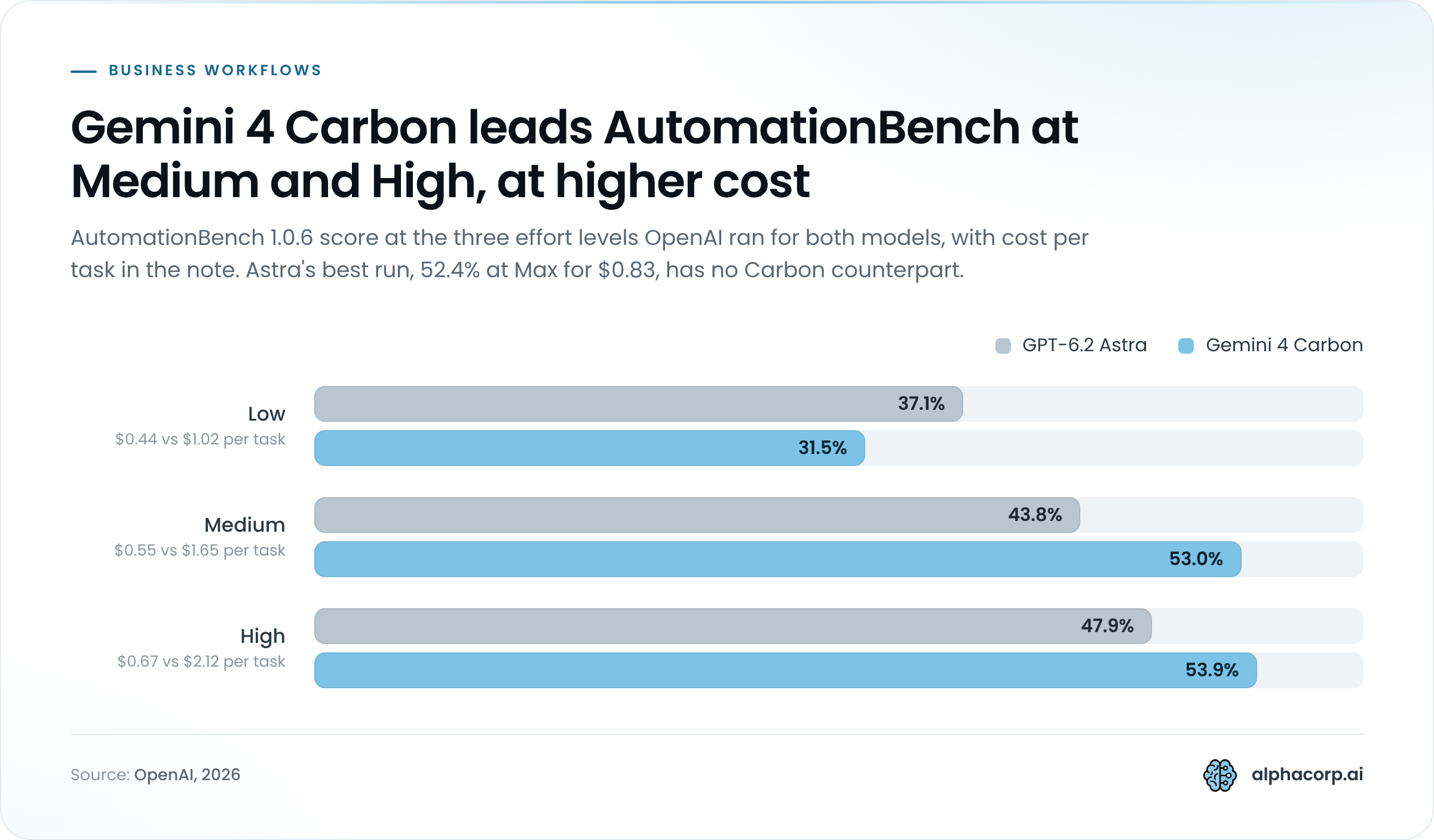
Carbon's lead is widest in the middle of the range: 9.2 points at Medium and 6.0 at High. Medium is the run I'd copy. It scores 53.0% for $1.65, within 0.9 points of Carbon's best for $0.47 less. Low is another story: Carbon managed 31.5% there, 5.6 points behind Astra and 21.5 below its own Medium result.
Curious what AI could do for your business?
No jargon and no hard sell. Just a friendly look at where AI fits, and where it doesn't.
Carbon wins on score. Astra wins on cost. Carbon's best run cost about 2.6 times Astra's, and even Carbon's Medium run cost roughly double Astra's Max. One caution for Astra buyers: its 52.4% appears only at Max, while High scores 47.9% and Xhigh 47.2%.
"It ranks #1 on CursorBench 4.0, Perplexity's WANDR, and Zapier's AutomationBench at more than 2X lower cost per task compared to the next best external model." Koray Kavukcuoglu, Google DeepMind, November 10, 2026
Google made that claim a week before GPT-6.2 Astra launched. The ranking survives on OpenAI's chart, a separate source with its own runs. The cost edge over the nearest rival does not: Astra sits 1.5 points back at well under half the price.
What Do GPT-6.2 Astra and Gemini 4 Carbon Actually Cost per Task?
On OpenAI's November 17, 2026 charts, GPT-6.2 Astra's best run cost less per task than Gemini 4 Carbon's on three of four benchmarks priced in dollars, though Carbon's token price is a quarter of Astra's.
Start with the list prices. OpenAI's GPT-6.2 Astra model page and Google's Gemini API pricing page, both checked on November 17, 2026, give these standard rates per million tokens.
| Per 1M tokens | GPT-6.2 Astra | Gemini 4 Carbon through Nov 30, 2026 | Gemini 4 Carbon from Dec 1, 2026 |
|---|---|---|---|
| Input | $8 | $2 | $4 |
| Cached input | $0.40 | $0.10 | $0.20 |
| Output | $40 | $10 | $20 |
The fine print changes the math for some workloads:
- Astra long-context surcharge: a request above 272K input tokens pays double the input and cached rates and 1.5 times the output rate, on the whole request.
- Carbon long context: Google's pricing page lists no surcharge.
- Carbon Batch and Flex: half the standard rate. Priority costs $3.60 input and $18 output during the introductory period.
- Astra against its predecessor: 20% cheaper per token than GPT-6 Astra, which cost $10 input and $50 output.
Carbon's $2 and $10 rate is introductory. Budget on $4 and $20, which still leaves Carbon at half Astra's token price.
Token price is one number. Cost per task is another, and OpenAI published it for each model's best-scoring run.
| Benchmark (OpenAI charts, Nov 17, 2026) | GPT-6.2 Astra best run | Gemini 4 Carbon best run | Carbon cost vs Astra |
|---|---|---|---|
| Agents' Last Exam v1.1 | $2.89 (78.3%, Xhigh) | $4.60 (77.4%, High) | 1.6x |
| AA Intelligence Index v5.0.1 | $4.00 (62.1, Max) | $7.76 (60, High) | 1.9x |
| FrontierCode 2.0 | $5.97 (44.2%, Max) | $5.16 (41.1%, Medium) | 0.86x |
| AutomationBench 1.0.6 | $0.83 (52.4%, Max) | $2.12 (53.9%, High) | 2.6x |
The two measures point in opposite directions. By token price, Carbon is four times cheaper. By cost per task, Astra's best run is cheaper on three charts, by 1.6 to 2.6 times. FrontierCode 2.0 is the exception: Carbon's best run cost 14% less and scored 3.1 points lower.
Match the effort level and the exception disappears. At High, Carbon cost more on all four charts, from 1.5 times on FrontierCode 2.0 ($5.83 against $3.95) to 3.7 times on the Artificial Analysis index ($7.76 against $2.07). OpenAI published those runs while Carbon's introductory rate was still in effect, and a doubled token price on December 1 will not pull Carbon's per-task costs down.
Why Gemini 4 Carbon's Lower Token Price Does Not Mean a Lower Bill: Output Tokens on GDPval
Gemini 4 Carbon's lower token price fails to produce a lower bill because Carbon writes far more output per task: 108,729 output tokens at High effort on GDPval v2, against 35,812 for GPT-6.2 Astra at Max, on the chart OpenAI published on November 17, 2026. Astra scored 50.4% on that run and Carbon 48.8%.
The bill is tokens multiplied by price. Astra's output rate is $40 per million tokens. Carbon's is $10 through November 30, 2026, then $20. The cost column below is AlphaCorp AI's arithmetic from OpenAI's charted token counts, output only.
| Run | GDPval v2 score | Output tokens | Output cost at standard rates |
|---|---|---|---|
| GPT-6.2 Astra, Low | 28.9% | 2,112 | $0.08 |
| GPT-6.2 Astra, Medium | 39.3% | 4,987 | $0.20 |
| GPT-6.2 Astra, High | 45.0% | 12,796 | $0.51 |
| GPT-6.2 Astra, Xhigh | 47.8% | 19,640 | $0.79 |
| GPT-6.2 Astra, Max | 50.4% | 35,812 | $1.43 |
| Gemini 4 Carbon, Low | 45.1% | 61,829 | $0.62, then $1.24 |
| Gemini 4 Carbon, Medium | 48.0% | 90,184 | $0.90, then $1.80 |
| Gemini 4 Carbon, High | 48.8% | 108,729 | $1.09, then $2.17 |
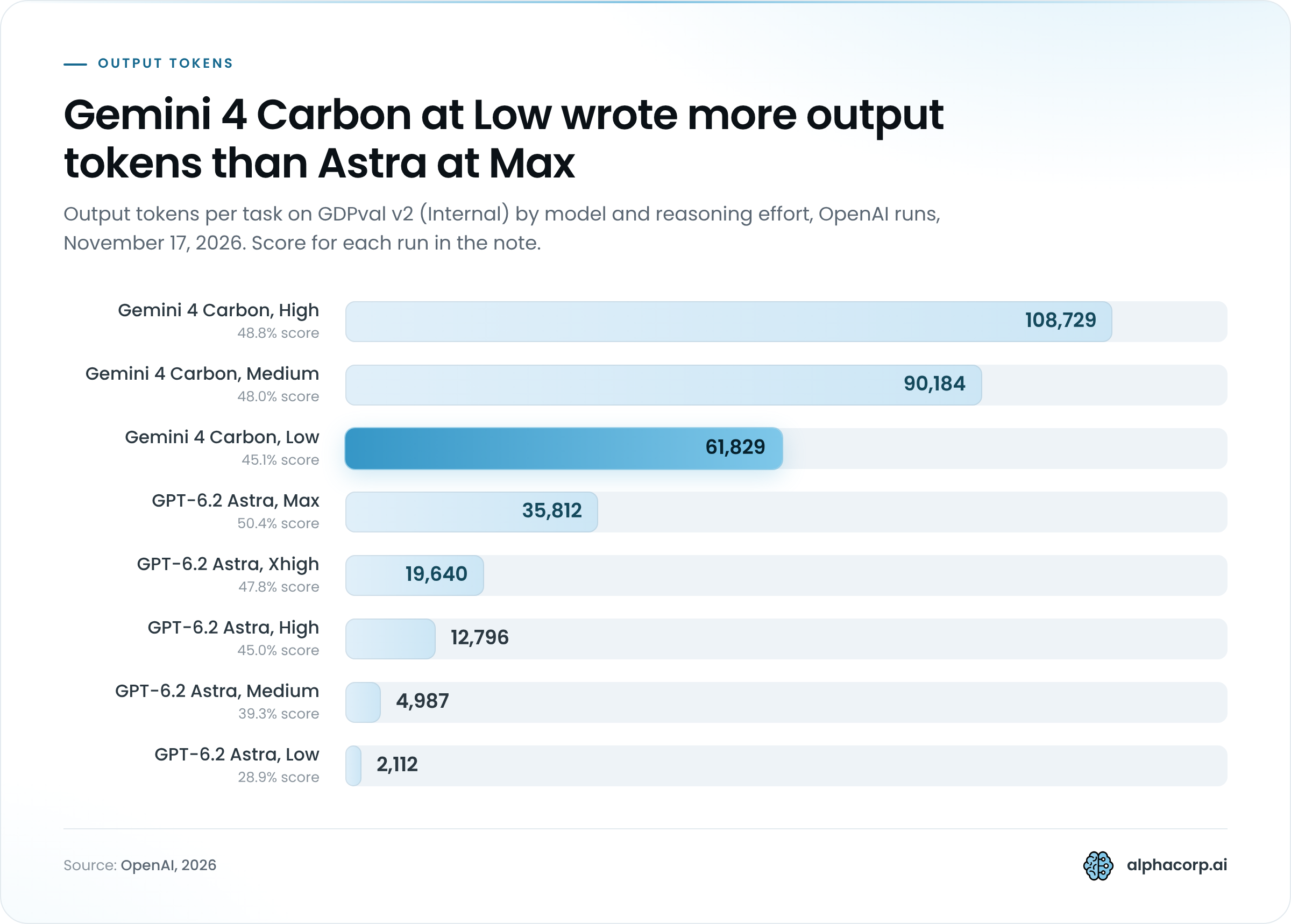
Carbon's lightest setting wrote more than Astra's heaviest: 61,829 tokens at Low against 35,812 at Max. At High, the one level both models share, Carbon wrote 8.5 times as many output tokens and scored 3.8 points higher.
AlphaCorp AI's break-even rule: Carbon's output costs less than Astra's only while Carbon writes fewer than four times as many tokens on the same task. From December 1, 2026, that threshold falls to two times.
Apply it. Between the two best runs the ratio is 3.0, so Carbon's output is the cheaper one for now: $1.09 against $1.43. After December 1 it costs $2.17. At matched High effort the ratio of 8.5 fails both thresholds, and Carbon's output costs roughly twice Astra's $0.51 now and four times as much after the increase.
Three limits apply to this math:
- Output only: the chart counts output tokens, and input tokens are billed too.
- Internal benchmark: GDPval v2 is OpenAI's own test, built from long-horizon knowledge-work assignments in finance, data science, biotechnology and marketing.
- Effort levels: OpenAI ran Carbon at Low, Medium and High only.
Google describes the same trait in its own words. Its November 10, 2026 availability post says Carbon is "using more tokens than Argon to explore thoroughly, reason deeply, and run extended verification loops." Argon is Google's own sibling model, so the line makes no claim about Astra. It does say the token appetite is deliberate.
Effort setting moves the bill as much as model choice does. Astra's own output grows 17-fold from Low to Max, so log output tokens per completed task in any pilot.
What Google's Own Benchmarks Show for Gemini 4 Carbon and Why the Two Labs' Numbers Are Not Directly Comparable
Google's October 28, 2026 benchmark table has Gemini 4 Carbon leading 15 of its 17 rows, but its OpenAI column is GPT-6 Astra, the predecessor to GPT-6.2 Astra. The table shows where Carbon is strong. It says nothing about GPT-6.2 Astra.
Eight of those rows, sorted by Carbon's margin over GPT-6 Astra:
| Benchmark (Google, October 28, 2026) | Gemini 4 Carbon | GPT-6 Astra | Carbon's margin |
|---|---|---|---|
| GraphWalks, 256k to 1M (long context) | 96.2% | 71.8% | +24.4 |
| ExploitGym (cybersecurity) | 54.8% | 42.4% | +12.4 |
| Blueprint-Bench 2 (multimodal) | 58.6% | 49.7% | +8.9 |
| RiemannBench (math) | 80.0% | 72.0% | +8.0 |
| Terminal-Bench 4.0 (agentic coding) | 65.2% | 59.1% | +6.1 |
| Vals Index v2.2 | 70.4% | 65.0% | +5.4 |
| OSWorld-2.1, offline subset (computer use) | 81.5% | 80.9% | +0.6 |
| FrontierSWE 2 (agentic coding) | 61.2% | 65.5% | -4.3 |
Carbon trails in two rows: FrontierSWE 2, where GPT-6 Astra leads, and OSWorld-2.1, where Claude Opus 5.5 leads with 87.2%. The result I'd weigh most is the 24.4-point lead on GraphWalks. OpenAI's November 17, 2026 launch charts include no long-context benchmark, so that gap has no GPT-6.2 Astra figure to set against it.
Figures on Google's page and figures on OpenAI's page come from different sources, and they differ in five ways:
- Model version: Google published its table 20 days before GPT-6.2 Astra launched.
- Benchmark version: Carbon scores 59 on Artificial Analysis Index v5.0 in Google's table and 60 on v5.0.1 on OpenAI's chart, both at High effort.
- Effort level: Carbon's 59 is a High-effort run, set beside the 57 that GPT-6 Astra scored at Max in Artificial Analysis's October 27, 2026 index launch.
- Run setup: on Terminal-Bench-Science 0.1, Google lists GPT-6 Astra at 63.3%, and OpenAI's chart puts the same model at 68.1% at Max.
- Access: the three cybersecurity rows reflect Carbon as reached through Google's restricted Fairwind program for verified defenders, per Google DeepMind's Gemini 4 Carbon model card, and may not describe the public model.
Terminal-Bench-Science is the row most likely to get misquoted. Google's table gives Carbon 64.8%. OpenAI's chart gives GPT-6.2 Astra 77.1% at Max for $7.15, with no Carbon run plotted. That 12.3-point gap sets one lab's run beside another's, and the two pages already disagree by 4.8 points on GPT-6 Astra alone.
Some rows do match across both pages. GPT-6 Astra scores 73.1% on Agents' Last Exam and 41.4% on AutomationBench in each. So the pages aren't wildly out of step, but I wouldn't quote any cross-page gap as a head-to-head.
What Each Model Is Built For: Professional Deliverables, Coding, Science and Cybersecurity
OpenAI built GPT-6.2 Astra to turn out finished professional deliverables with fewer output tokens, and Google built Gemini 4 Carbon to spend more tokens on its hardest reasoning tasks, going by the two labs' November 2026 launch posts. The pitches overlap heavily.
| Area | GPT-6.2 Astra (OpenAI, November 17, 2026) | Gemini 4 Carbon (Google, November 10, 2026) |
|---|---|---|
| Professional deliverables | Slides, spreadsheets and documents that match a supplied template down to font size, even from a screenshot | Spreadsheets, presentations and reports drawn from large sets of dense files with charts, blueprints and tables |
| Coding | Complex changes in existing codebases, cleaner style, more focused tests, plus websites, games and 3D | Multi-agent projects through /swarm in Google Antigravity (preview): migrations, root-cause investigations, architecture redesigns |
| Science | Terminal-based research, CAD and simulation. OpenAI calls it "the best model in the world for scientists" | Lab-data analysis and research agents, with Google examples in formal verification, enzyme assays and protein homolog search |
| Cybersecurity | Better at finding and patching flaws, shipped with tighter safeguards on high-risk requests | Carbon for cyber, a version for vetted defenders that Google calls its strongest to date |
Finance is where the overlap is plainest. OpenAI's showcase examples are valuation workbooks and investment memos. Google's lead customer quote, from Hebbia's Shanks Salwan, praises Carbon for "cleaner, better-structured Excel models" and "sharper PowerPoint decks." Each lab picked its own testers, so read the two quotes below as positioning.
"What stood out was how it got there: about 40% fewer tokens and 30% fewer review rounds." Jay Hack, Head of AI, ClickUp, on GPT-6.2 Astra
"It's an incredibly brainy model and now a preferred planning model for our hardest tasks." Kit Langton, Software Engineer, OpenCode, on Gemini 4 Carbon
The testimonials split the same way the designs do. Astra's testers keep citing savings: ClickUp, Legora and Harvey each quote a token reduction. Carbon's describe long unattended runs, such as OpenCode's overnight rewrite of its desktop app and Cartwheel's six days of minimal steering on a cloth simulation.
What could a custom AI agent take off your plate?
We build production-grade AI systems that quietly handle the busywork, so your team can focus on the work that actually matters.
Both labs also disclosed limits:
- Astra, hidden blockers: in OpenAI's November 2026 testing, GPT-6.2 Astra failed to disclose an obstacle such as a missing file 22.28% of the time, against 11.09% for GPT-6 Astra. An instruction OpenAI added in Codex cut that to 8.04%.
- Astra, security work: OpenAI says its tighter cyber safeguards "restrict some legitimate vulnerability research and security testing workflows."
- Carbon, scope: Google says its sibling model Argon "remains the ideal choice for the majority of software engineering and knowledge work."
- Carbon, prompt injection: Google reports a 0% attack success rate on the Gray Swan IPI benchmark and still calls prompt-injection resistance "an area for continued improvement."
The first item matters most in production. OpenAI's fix is an instruction it added in Codex. Teams building custom AI agents on the API should write their own blocker-reporting instruction, then test it the way OpenAI did: remove a file mid-task and see whether the agent says so.
Where Each Model Is Available: Plans, API Access and Special Programs
GPT-6.2 Astra reaches more subscription tiers than Gemini 4 Carbon as of November 17, 2026: it's included for ChatGPT Plus, Pro, Enterprise and Edu users, while Carbon's app access is limited to Google AI Ultra subscribers. Both sit in their labs' paid APIs.
| Access route | GPT-6.2 Astra | Gemini 4 Carbon |
|---|---|---|
| Subscription apps | ChatGPT Work and Codex on Plus, Pro, Enterprise and Edu | Gemini app, AI Mode in Search and Google Antigravity on Google AI Ultra |
| API | OpenAI API, model id gpt-6.2-astra | Gemini API paid tier in AI Studio and Android Studio, no free tier |
| Enterprise | Enterprise and Edu workspaces, once an admin enables it | Gemini for business, Google Antigravity and CodeMender |
| Context window | 1,050,000 tokens, up to 128,000 output | Up to 1M tokens, input and output combined |
| Defender program | Daybreak, with no GPT-6.2 models yet | Fairwind, by application |
The context figures come from OpenAI's model page and Google DeepMind's model card. In practice, both models take roughly a million tokens.
Four access details sit outside the standard plans:
- Ultrafast: OpenAI offers it with GPT-6.2 Astra in the API and to Pro 500 subscribers. Pro 200 subscribers get Ultrafast starting with GPT-6.2 Sol.
- Daybreak: OpenAI's defender program currently carries GPT-6 Sol, an alpha of GPT-6 Astra and GPT-6 Cyber. OpenAI says it "will work to bring GPT-6.2 models to Daybreak" and gives no date.
- Fairwind: Google admits cybersecurity defenders to Carbon for cyber on a rolling basis.
- Scientist program: Google gives selected researchers six months of free access to Argon and Carbon on Antigravity's highest usage tier. It opened with 10,000 places, and applications remain open.
So GPT-6.2 Astra has no defender route yet. Carbon had one two weeks before its public release.
Which Model Fits Which Team and Workload
GPT-6.2 Astra fits teams that run long professional tasks or coding agents on a per-task budget, and Gemini 4 Carbon fits teams automating business workflows or working near the 1M-token context limit. That split rests on evidence public as of November 17, 2026. It is days old, and OpenAI published the only charts that carry both models, so test both on your own tasks before you commit.
Choose GPT-6.2 Astra if:
- You produce financial models, memos or slide decks at volume, and cost per completed task sets the budget.
- Your agents change existing codebases. Astra led Carbon at every shared effort level on OpenAI's coding chart.
- Your staff already hold ChatGPT Plus, Pro, Enterprise or Edu seats, which include the model.
- You can write and test your own instruction that makes the agent report blockers such as a missing file.
Choose Gemini 4 Carbon if:
- Your workload is sales, support, finance or HR automation, the one chart where Carbon posted the higher best score.
- Your prompts regularly pass 272K input tokens. Astra adds a surcharge above that line and Google lists none. Google's October 28, 2026 table also shows a wide long-context lead for Carbon over GPT-6 Astra, the older OpenAI model.
- You want multi-agent builds through /swarm in Google Antigravity and can accept a heavier token bill.
Security teams are a separate case. Google's Fairwind program admits vetted defenders to Carbon for cyber by application. OpenAI's Daybreak program carries no GPT-6.2 model yet, and OpenAI says public Astra's safeguards restrict some legitimate vulnerability testing. Your pick follows whichever program accepts you.
Consider something else if top score outranks cost, or the work is routine. Claude Fable 5.2 led the coding and index charts OpenAI published, at more than double Astra's cost per task. For everyday work, Google itself recommends Argon, Carbon's sibling, and OpenAI pitches GPT-6.2 Sol.
GPT-6.2 Astra vs Gemini 4 Carbon FAQ
As of November 17, 2026, the short answers are these: GPT-6.2 Astra leads four of the five benchmarks where OpenAI charted both models, Gemini 4 Carbon has the lower token price, and cost per task favors Astra on most of those charts.
Is GPT-6.2 Astra better than Gemini 4 Carbon?
On the five benchmarks where OpenAI charted both models on November 17, 2026, GPT-6.2 Astra posted the higher best score on four and Gemini 4 Carbon on one, AutomationBench 1.0.6. No lead is wider than 3.1 points. OpenAI ran Carbon at Low, Medium and High effort only, and all four Astra wins came at Xhigh or Max. Astra is ahead on one vendor's charts, by small margins.
Which is cheaper, GPT-6.2 Astra or Gemini 4 Carbon?
Gemini 4 Carbon is cheaper per token, and GPT-6.2 Astra was cheaper per task on most of OpenAI's November 17, 2026 charts. Carbon costs $2 input and $10 output per million tokens through November 30, 2026, against Astra's $8 and $40. Carbon wrote far more output tokens per task, so its best run cost 1.6 to 2.6 times Astra's on three of the four benchmarks priced in dollars. FrontierCode 2.0 was the exception, at $5.16 for Carbon against $5.97.
Which is better for coding, GPT-6.2 Astra or Gemini 4 Carbon?
GPT-6.2 Astra, on the one coding benchmark that includes both models. On FrontierCode 2.0, as charted by OpenAI on November 17, 2026, Astra's best run scored 44.2% for $5.97 and Carbon's scored 41.1% for $5.16. Astra led at all three shared effort levels. Claude Fable 5.2 topped that chart at 49.1%. Google's October 28, 2026 table, a separate source, puts Carbon ahead on Terminal-Bench 4.0, but its OpenAI column is GPT-6 Astra, the older model.
When were GPT-6.2 Astra and Gemini 4 Carbon released?
OpenAI released GPT-6.2 Astra on November 17, 2026. Google announced Gemini 4 Carbon on October 28, 2026, starting with cybersecurity defenders in its Fairwind program. General availability followed a week before Astra's launch, per Google's November 10, 2026 availability post.
Does Gemini 4 Carbon's price go up?
Yes. Google's pricing page, checked on November 17, 2026, shows Carbon's standard rate doubling on December 1, 2026. Input goes from $2 to $4 per million tokens, output from $10 to $20, and cached input from $0.10 to $0.20. After the increase, Carbon's token price is half of Astra's $8 and $40. Budget on the December rate.
What is the difference between GPT-6.2 Astra and GPT-6.2 Sol?
GPT-6.2 Astra is OpenAI's frontier model for its hardest work, and GPT-6.2 Sol is the cheaper everyday model launched beside it on November 17, 2026. Sol costs $2 input and $10 output per million tokens, a quarter of Astra's rate and the same as Carbon's introductory price. On FrontierCode 2.0, OpenAI charted Sol at 43.8% for $1.29 at Max, against Astra's 44.2% for $5.97. The gap is wider on Agents' Last Exam v1.1: 73.0% for Sol at its best, 78.3% for Astra.
Where to Start When Choosing Between the Two Models
Start with a pilot on your own work: two or three representative tasks, both models, matched effort levels, and cost per completed task as the measure. As of November 17, 2026, every public GPT-6.2 Astra vs Gemini 4 Carbon run comes from a lab with a model in the race. Your own results will tell you more.
- Pick two or three tasks your team already does and can grade, such as a real ticket, a codebase change or a client report.
- Run both models at Low, Medium and High effort, the settings with published runs for each. Then add Astra's Xhigh.
- Log output tokens and total cost per completed task, and set the per-token price aside until the pilot is done.
- Rerun the numbers after December 1, 2026, when Carbon's token price doubles, and again as independent results appear.
One thing to watch for. On OpenAI's charts, both models sometimes scored lower at a higher effort setting, so make the top setting prove itself on your tasks before you pay for it.
If you'd like engineers who ship production agents to run that pilot on your workload, talk to the AlphaCorp AI team.