

On this page(19)
- GPT-6.2 Astra vs Claude Fable 5.2: Which Model Leads on Each Benchmark
- Agents' Last Exam and the Professional Work Benchmarks Where GPT-6.2 Astra Scores Higher
- FrontierCode 2.0 and the Coding, CAD and Intelligence Index Results Where Claude Fable 5.2 Scores Higher
- What Does Each Model Cost per Task at Its Best Score?
- Output Tokens on GDPval v2 and Why Token Efficiency Changes the Bill
- API Pricing and Availability for GPT-6.2 Astra and Claude Fable 5.2
- Why Scores From OpenAI's Page and Anthropic's Page Do Not Line Up
- What Anthropic Reports for Claude Fable 5.2 That OpenAI's Charts Do Not Cover
- Cybersecurity and Biology Safeguards That Restrict What Each Model Will Do
- Which Model to Choose for Coding, Legal, Science and 3D Design Work
- GPT-6.2 Astra vs Claude Fable 5.2 FAQ
- Is GPT-6.2 Astra better than Claude Fable 5.2?
- Which is cheaper, GPT-6.2 Astra or Claude Fable 5.2?
- Which is better for coding?
- Do they cost the same per token?
- What is the difference between Claude Fable 5.2 and Mythos 5.2?
- Are these benchmarks independent?
- What are the API model ids and context windows?
- Where to Start Testing Both Models on Your Own Workload
GPT-6.2 Astra is the better default for most agent workloads, and Claude Fable 5.2 is still the stronger coder. That's GPT-6.2 Astra vs Claude Fable 5.2 as of November 17, 2026, the day Astra launched.
On the nine head-to-head charts OpenAI published on its own page, Astra posts the higher best score on six and the lower cost per task on all eight priced in dollars. Fable 5.2 keeps FrontierCode 2.0. What follows covers each model's wins, the cost of every run, and a pick by workload.
The figures behind that verdict, all vendor-published in November 2026:
- Agents' Last Exam v1.1: Astra scores 78.3% at Xhigh for $2.89 per task and Fable 5.2 scores 72.8% at Max for $60.05, per OpenAI's November 17, 2026 chart. OpenAI plotted Fable 5.2 at Max only, and that result excludes nine tasks that used a fallback model.
- FrontierCode 2.0: Fable 5.2 scores 49.1% at Xhigh ($14.19) against Astra's 44.2% at Max ($5.97), per the same OpenAI chart. Anthropic's November 9, 2026 launch post reports the same 49.1%.
- GDPval v2 output: Fable 5.2 wrote 222,344 output tokens for its best score and Astra wrote 35,812, per OpenAI's internal benchmark in November 2026.
- List price: both models cost $8 per million input tokens and $40 per million output tokens in November 2026, per each vendor's model documentation.
- Long prompts: above 272K input tokens, Astra charges 2x input and 1.5x output on the whole request, per OpenAI's November 2026 model page. Anthropic's pricing docs keep Fable 5.2 at standard rates across its 1M window.
GPT-6.2 Astra vs Claude Fable 5.2: Which Model Leads on Each Benchmark
GPT-6.2 Astra posts the higher best score on six of the nine head-to-head charts OpenAI published on November 17, 2026, and Claude Fable 5.2 leads the other three. Astra takes the majority, Fable 5.2 keeps coding, CAD and the composite intelligence index, and neither model sweeps.
Read the source before the scores. Every run in this table, including Fable 5.2's results and costs, comes from the charts in OpenAI's GPT-6.2 Astra launch announcement. A lab that charts its rival on launch day also picks the benchmarks, so treat the 6 to 3 count as vendor-reported.
Each model's best score per chart, with the effort level and the cost per task (or output tokens) of that run, as published by OpenAI on November 17, 2026:
| Benchmark (as charted by OpenAI) | GPT-6.2 Astra best | Claude Fable 5.2 best | Higher score |
|---|---|---|---|
| Agents' Last Exam v1.1 | 78.3% at Xhigh ($2.89) | 72.8% at Max ($60.05), only Max plotted | GPT-6.2 Astra |
| Terminal-Bench-Science 0.1 | 77.1% at Max ($7.15) | 73.3% at Max ($45.21) | GPT-6.2 Astra |
| Artificial Analysis Intelligence Index v5.0.1 | 62.1 at Max ($4.00) | 64.6 at Max ($26.54) | Claude Fable 5.2 |
| FrontierCode 2.0 | 44.2% at Max ($5.97) | 49.1% at Xhigh ($14.19) | Claude Fable 5.2 |
| Harvey-LAB-AA v1.1 | 15.0% at Max ($6.35) | 7.2% at Max ($39.84) | GPT-6.2 Astra |
| GDPval v2 (Internal) | 50.4% at Max (35,812 tokens) | 44.8% at Max (222,344 tokens) | GPT-6.2 Astra |
| Vals Science Index v1 | 68.4% at Max ($4.17) | 63.7% at High ($8.79), only High plotted | GPT-6.2 Astra |
| BenchCAD 2.1 Core | 82.5% at Max ($5.43) | 83.5% at Max ($50.77) | Claude Fable 5.2 |
| AutomationBench 1.0.6 | 52.4% at Max ($0.83) | 51.4% at Max ($4.64) | GPT-6.2 Astra |
Four things stand out in the November 2026 scorecard:
- Astra's margins: its six leads run from 1.0 point on AutomationBench 1.0.6 to 7.8 points on Harvey-LAB-AA v1.1.
- Fable 5.2's margins: its three leads run from 1.0 point on BenchCAD 2.1 Core to 4.9 points on FrontierCode 2.0.
- Cost: on all eight dollar-priced charts, Fable 5.2's best run costs more per task than Astra's best run.
- Effort: a best score doesn't always sit at Max. Astra peaks at Xhigh on Agents' Last Exam, and Fable 5.2 peaks at Xhigh on FrontierCode 2.0.
AlphaCorp AI's reading of the scorecard: Astra wins on breadth and on price per task, while Fable 5.2 holds the highest FrontierCode 2.0 score on either lab's page. It's a split result.
Agents' Last Exam and the Professional Work Benchmarks Where GPT-6.2 Astra Scores Higher
GPT-6.2 Astra beats Claude Fable 5.2 on six professional-work charts in OpenAI's November 17, 2026 launch data: Agents' Last Exam v1.1, Terminal-Bench-Science 0.1, Harvey-LAB-AA v1.1, GDPval v2, Vals Science Index v1 and AutomationBench 1.0.6. The leads are uneven. Two of the six carry caveats big enough to change how much weight you give them.
Agents' Last Exam v1.1 is OpenAI's headline result. The benchmark tests long-horizon professional workflows, and in the November 2026 chart Astra scores 78.3% at Xhigh effort against 72.8% for Fable 5.2, a 5.5-point gap.
"5.5 points ahead of Claude Fable 5.2 at just 5% of the cost"
OpenAI, GPT-6.2 Astra launch announcement, November 17, 2026
That line is accurate to the chart and leaves two things out. OpenAI plotted Fable 5.2 at Max effort only, so there is no way to see how it scores at lower settings. The chart note also says the Agents' Last Exam leaderboard result for Fable 5.2 excludes nine tasks that used a fallback model.
Terminal-Bench-Science 0.1 needs two Fable figures side by side. Astra reaches 77.1% at Max on scientific work in a terminal. OpenAI's November 2026 chart puts Fable 5.2 at 73.3% at Max, as run by Artificial Analysis in the mini-swe-agent harness, while Anthropic reports 74.6% for the same model at max reasoning in Claude Code. Those two Fable scores come from different sources and different harnesses. Astra's 77.1% sits above both, by 3.8 points on the first and 2.5 on the second.
The other four leads, all from OpenAI's November 2026 charts:
- Harvey-LAB-AA v1.1: Astra scores 15.0% to Fable 5.2's 7.2%, both at Max. The metric only credits a legal deliverable that meets every grading criterion with no material hallucinations.
- GDPval v2: Astra scores 50.4% to Fable 5.2's 44.8%, both at Max. This is an internal OpenAI benchmark of long-horizon knowledge work.
- Vals Science Index v1: Astra scores 68.4% at Max against 63.7% for Fable 5.2 at High. OpenAI plotted Fable 5.2 at High only, so the effort levels don't match.
- AutomationBench 1.0.6: Astra scores 52.4% to Fable 5.2's 51.4%, both at Max. Gemini 4 Carbon tops this chart with 53.9% at High.
Neither model is good at the Harvey test yet, honestly. Astra's winning 15.0% still means roughly 85% of its deliverables missed the bar.
How much do these six leads tell you? I'd call the legal and long-horizon results the strongest evidence, and the AutomationBench and Vals leads the weakest: one is a single point that a third model beats, the other compares different effort settings. OpenAI's charts also show Astra reaching each of its dollar-priced best scores at a lower cost per task than Fable 5.2's best run.
FrontierCode 2.0 and the Coding, CAD and Intelligence Index Results Where Claude Fable 5.2 Scores Higher
Claude Fable 5.2 beats GPT-6.2 Astra on three of the nine charts OpenAI published on November 17, 2026: FrontierCode 2.0 (49.1% vs 44.2%), BenchCAD 2.1 Core (83.5% vs 82.5%) and the Artificial Analysis Intelligence Index v5.0.1 (64.6 vs 62.1). Only one of the three is a wide margin.
FrontierCode 2.0 is that one. Cognition built it to test whether changes to real codebases meet the maintainers' bar for merging, which makes it the most production-like test of the nine. Fable 5.2's 49.1% at Xhigh leads Astra's best by 4.9 points, and the same 49.1% appears in Anthropic's November 9, 2026 launch post for Fable 5.2. Two rival labs printing the same number for the same model is rare. I'd trust this result more than any other row in OpenAI's charts.
FrontierCode 2.0 scores by reasoning effort, from OpenAI's November 2026 chart:
| Effort level | Claude Fable 5.2 | GPT-6.2 Astra |
|---|---|---|
| Low | 34.2% | 38.1% |
| Medium | 37.6% | 42.2% |
| High | 45.3% | 43.6% |
| Xhigh | 49.1% | 44.1% |
| Max | 45.6% | 44.2% |
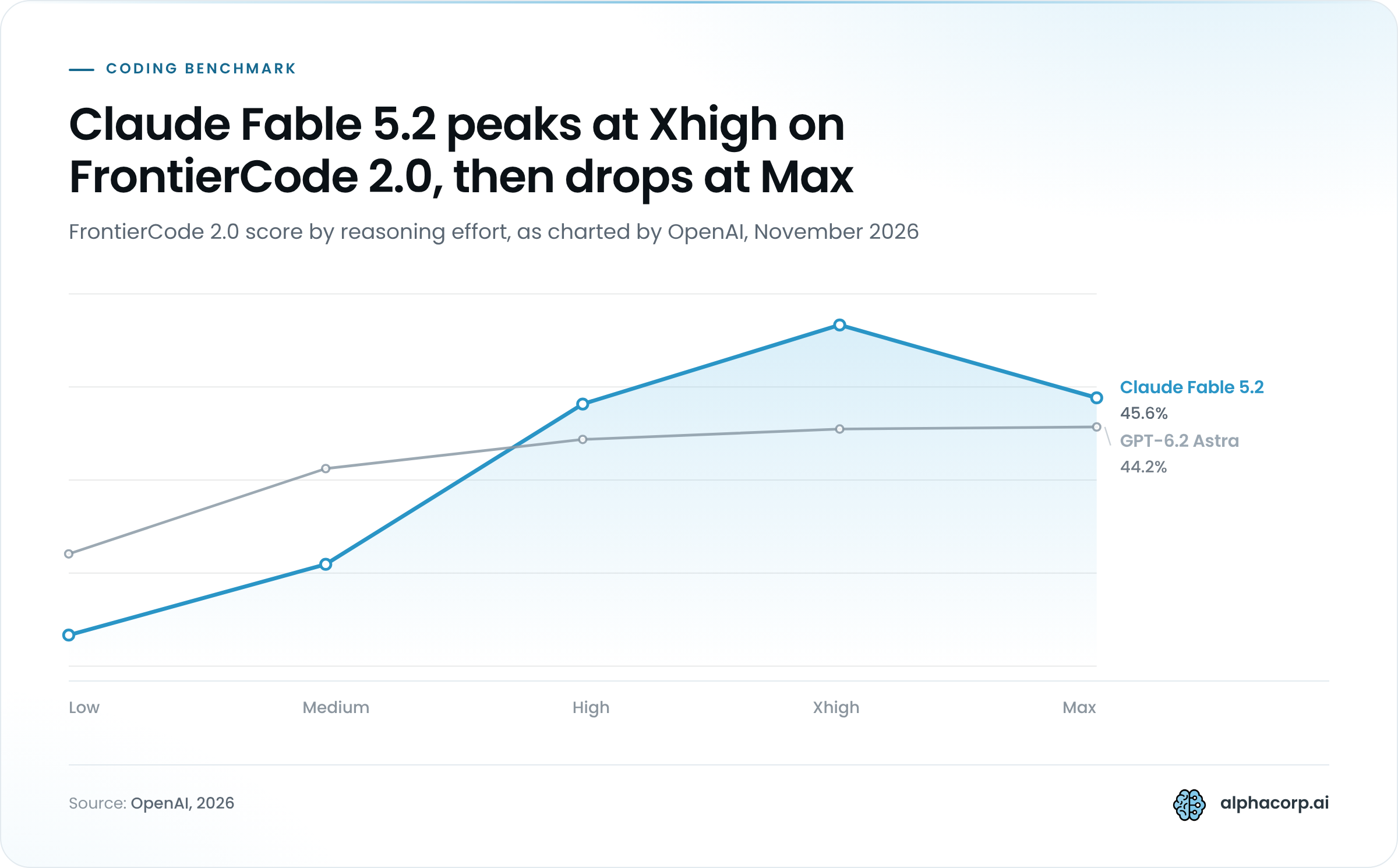
Look at the last row. Fable 5.2 drops 3.5 points when effort goes from Xhigh to Max, so a team that sets everything to Max by default gets the worse result on this benchmark. Astra's curve has a different shape: it leads at Low and Medium, then barely moves, gaining 0.6 points from High to Max.
The other two leads are thinner. On the Artificial Analysis Intelligence Index v5.0.1, which combines nine evaluations across knowledge work, coding, science and general knowledge, Fable 5.2 scores 64.6 at Max against Astra's 62.1. BenchCAD 2.1 Core, which asks models to build 3D parts from engineering drawings and fit them into assemblies, goes to Fable 5.2 by a single point, both at Max. Below Max, Astra leads that CAD chart at every effort level OpenAI plotted (68.5% to 32.4% at Medium, for instance). And on AA-3D, the Artificial Analysis test where human judges vote between two blinded browser experiences built from one prompt, Astra ranks first as of November 2026:
- GPT-6.2 Astra: 1,318 Elo
- Claude Fable 5.2: 1,271 Elo
- GPT-6.2 Sol: 1,259 Elo
So 3D work splits by task. Fable 5.2 edges the engineering-drawing benchmark by a point, and Astra wins the human-preference vote on interactive 3D by 47 Elo. One more thing to weigh: on OpenAI's charts, each of Fable 5.2's three winning runs costs more per task than Astra's best run on the same benchmark.
What Does Each Model Cost per Task at Its Best Score?
GPT-6.2 Astra reaches its best score for less on all eight dollar-priced charts OpenAI published on November 17, 2026: Claude Fable 5.2's best run costs between 2.1 and 20.8 times more per task.
Every dollar figure here comes from OpenAI's own runs, Fable 5.2's included, so treat the multiples as vendor-reported. The table lists the cost per task of each model's best-scoring run in November 2026, widest gap first.
| Benchmark (as charted by OpenAI) | GPT-6.2 Astra best run | Claude Fable 5.2 best run | Fable 5.2 cost multiple | Higher score |
|---|---|---|---|---|
| Agents' Last Exam v1.1 | $2.89 | $60.05 | 20.8x | GPT-6.2 Astra |
| BenchCAD 2.1 Core | $5.43 | $50.77 | 9.3x | Claude Fable 5.2 |
| Artificial Analysis Intelligence Index v5.0.1 | $4.00 | $26.54 | 6.6x | Claude Fable 5.2 |
| Terminal-Bench-Science 0.1 | $7.15 | $45.21 | 6.3x | GPT-6.2 Astra |
| Harvey-LAB-AA v1.1 | $6.35 | $39.84 | 6.3x | GPT-6.2 Astra |
| AutomationBench 1.0.6 | $0.83 | $4.64 | 5.6x | GPT-6.2 Astra |
| FrontierCode 2.0 | $5.97 | $14.19 | 2.4x | Claude Fable 5.2 |
| Vals Science Index v1 | $4.17 | $8.79 | 2.1x | GPT-6.2 Astra |
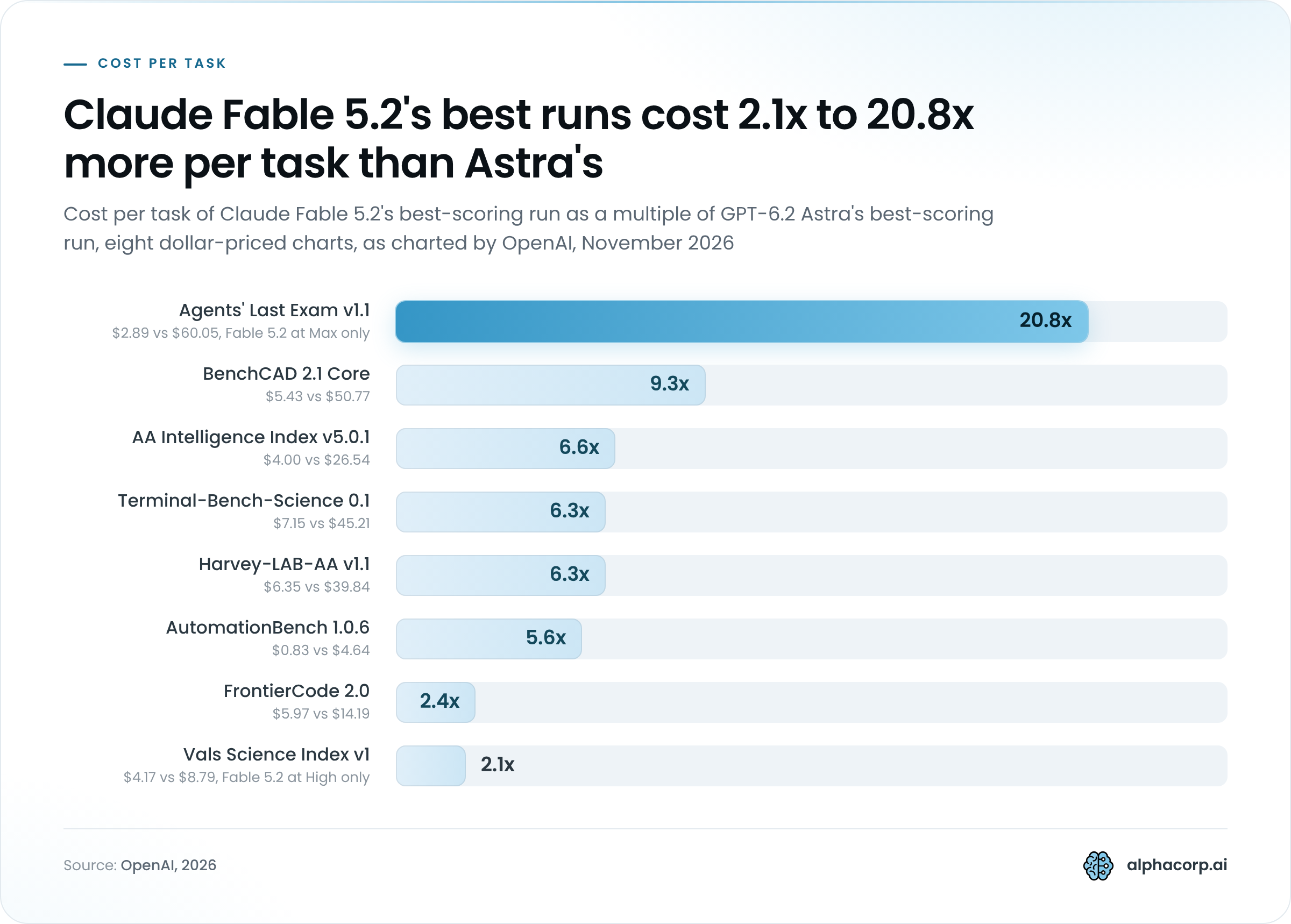
Three rows need a caveat:
- Agents' Last Exam v1.1: OpenAI plotted Fable 5.2 at Max only, and the leaderboard result excludes nine tasks that used a fallback model. The 20.8x gap is the widest and the hardest to read, because no cheaper Fable setting appears.
- Terminal-Bench-Science 0.1: the $45.21 belongs to the Artificial Analysis run in the mini-swe-agent harness, where Fable 5.2 scores 73.3% at Max against Astra's 77.1%. Anthropic reports 74.6% at max reasoning in Claude Code, a different source and harness with no cost on OpenAI's chart.
- Vals Science Index v1: Fable 5.2 appears at High only, so the 2.1x multiple sets a High run against Astra's Max run.
Curious what AI could do for your business?
No jargon and no hard sell. Just a friendly look at where AI fits, and where it doesn't.
Fable 5.2's three wins cost 2.4, 6.6 and 9.3 times what Astra's best runs cost. BenchCAD 2.1 Core is the hardest one to defend: a single extra point, 83.5% against 82.5%, for $50.77 instead of $5.43.
FrontierCode 2.0 is the exception. Fable 5.2's runs on that benchmark, per OpenAI's November 2026 chart:
- High: 45.3% for $6.72
- Xhigh: 49.1% for $14.19
- Max: 45.6% for $44.70
The High run still beats Astra's best (44.2% at $5.97), so a 1.1-point coding lead costs $0.75 more per task. The full 4.9-point lead at Xhigh costs $8.22 more. Max is the trap: about three times the Xhigh price for a lower score.
Output Tokens on GDPval v2 and Why Token Efficiency Changes the Bill
GPT-6.2 Astra wins on token efficiency: Claude Fable 5.2 wrote 222,344 output tokens to reach its best GDPval v2 score and Astra wrote 35,812, a 6.2x gap on OpenAI's November 17, 2026 chart. Astra also scored higher, 50.4% to 44.8%, both at Max effort. One caveat on the source: GDPval v2 is an internal OpenAI benchmark of long-horizon knowledge work, and OpenAI ran both models and counted the tokens.
Why does a token count belong in a pricing decision? Both labs list output at $40 per million tokens in November 2026. Same rate, different volume. A model that writes 6.2 times the tokens costs 6.2 times as much on the output line of the invoice.
GDPval v2 score and output tokens by reasoning effort, from OpenAI's November 2026 chart:
| Effort level | GPT-6.2 Astra score | GPT-6.2 Astra output tokens | Claude Fable 5.2 score | Claude Fable 5.2 output tokens |
|---|---|---|---|---|
| Low | 28.9% | 2,112 | 39.5% | 34,961 |
| Medium | 39.3% | 4,987 | 40.3% | 41,334 |
| High | 45.0% | 12,796 | 41.5% | 89,343 |
| Xhigh | 47.8% | 19,640 | 44.1% | 149,959 |
| Max | 50.4% | 35,812 | 44.8% | 222,344 |
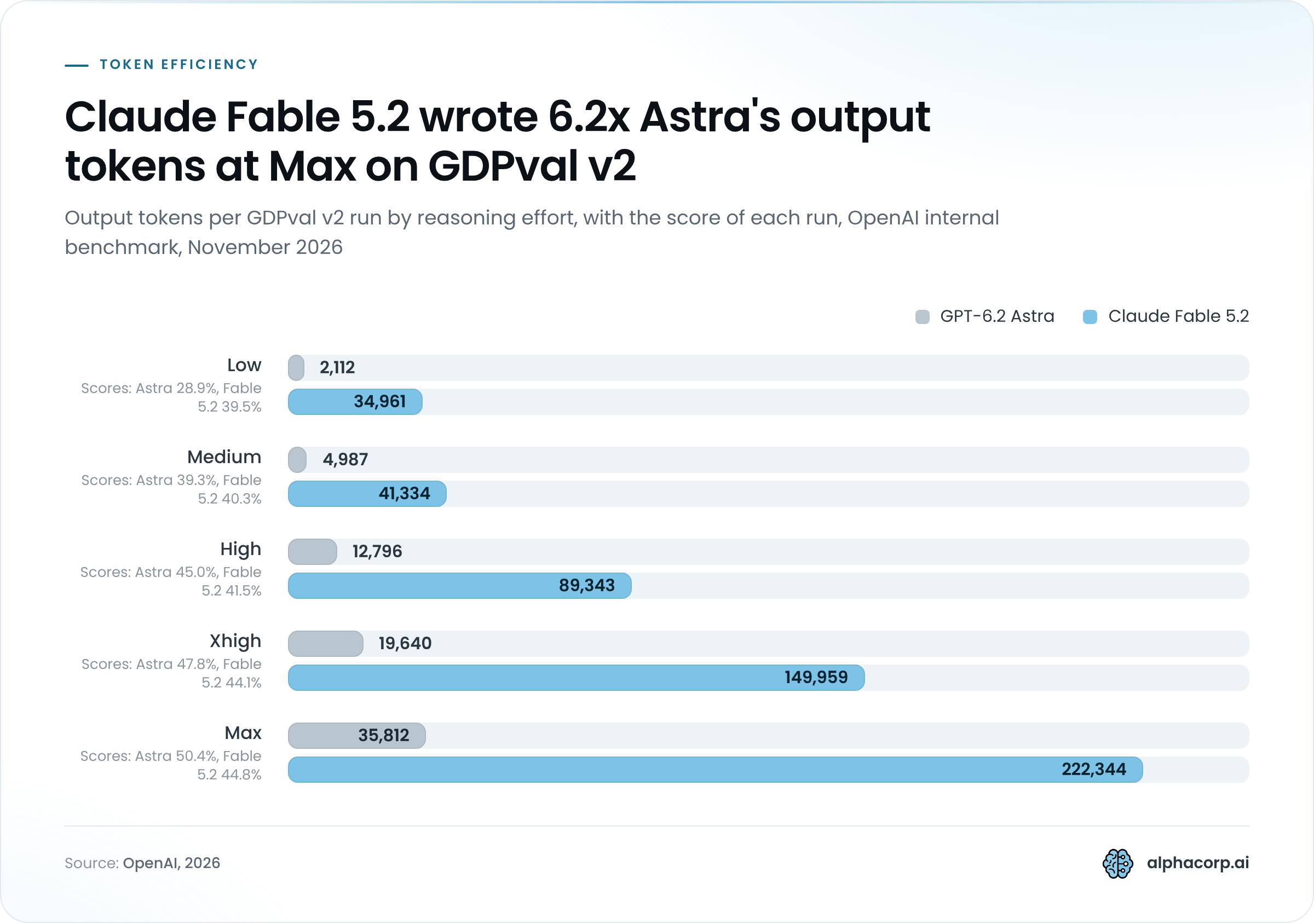
Three patterns in those rows:
- Higher floor for Fable 5.2: at Low it scores 39.5%, which is 10.6 points above Astra at Low, and it writes 16.6 times the tokens to get there.
- Equal spend favors Astra: Fable 5.2 at Low (34,961 tokens) and Astra at Max (35,812 tokens) write nearly the same amount, and Astra scores 10.9 points higher.
- Flatter curve for Fable 5.2: going from Low to Max multiplies its tokens 6.4 times for 5.3 more points. Astra's tokens multiply 17 times for 21.5 points.
Anthropic's own documentation for Fable 5.2 points the same way. It warns that subagent delegation can account for a large share of session cost.
So here is AlphaCorp AI's token-first rule for anyone building AI agents: log output tokens per task next to quality before you open a price sheet. List price tells you the rate. Tokens tell you the bill.
API Pricing and Availability for GPT-6.2 Astra and Claude Fable 5.2
On list price, GPT-6.2 Astra and Claude Fable 5.2 tie: both cost $8 per million input tokens and $40 per million output tokens as of November 17, 2026. Fable 5.2 is cheaper on cached reads and on very long prompts, and Astra keeps a cache alive longer.
Both prices are a 20% cut from the previous flagship, since GPT-6 Astra and Claude Fable 5.1 each cost $10 and $50. The rates in this table come from Anthropic's Fable 5.2 model page and OpenAI's GPT-6.2 Astra model page, both checked on November 17, 2026.
| Item (November 2026) | Claude Fable 5.2 | GPT-6.2 Astra |
|---|---|---|
| Input / output per 1M tokens | $8 / $40 | $8 / $40 |
| Cached input read per 1M tokens | $0.20 | $0.40 |
| Cache write per 1M tokens | $10 (5 minutes), $16 (1 hour) | $10 (30 minutes), $20 (12 hours) |
| Batch | 50% off | 50% of standard |
| Fast mode | $16 / $80 | 2x standard. Ultrafast is 3x through February 28, 2027, then 6x |
| Context window | 1M tokens | 1,050,000 tokens (922,000 max input) |
| Max output | 128K tokens | 128,000 tokens |
| Requests above 272K input tokens | Standard rates, per Anthropic's pricing docs | 2x input and cache rates, 1.5x output, on the whole request |
| Knowledge cutoff | June 2026 | May 18, 2026 |
Check the long-context row first. Once a request crosses 272K input tokens on Astra, the whole request reprices to $16 per million input and $60 per million output. Anthropic's pricing documentation says models from 4.6 onward, Haiku 5.5 excepted, include the full 1M window at standard rates, which covers Fable 5.2. If your prompts carry whole codebases or contract sets, that one rule can outweigh every other row.
Caching cuts both ways. Fable 5.2 reads cached input at half Astra's rate, but its cache lasts 5 minutes or 1 hour, against 30 minutes or 12 hours on Astra. An agent that waits two hours for a human sign-off comes back to a live cache on Astra and a cold one on Fable 5.2.
Where each model runs, as of November 2026:
- API surfaces: Fable 5.2 is on the Claude API, Amazon Bedrock, Google Cloud and Microsoft Foundry. Astra supports Chat Completions, Responses and Batch, without Realtime, Assistants or fine-tuning.
- Subscriptions: Astra is in ChatGPT Work and Codex for Plus, Pro, Enterprise and Edu users, and absent from regular Chat. Fable 5.2 counts for up to 50% of weekly usage limits on Pro plans and standard Team seats.
- Data rules: Fable 5.2 requires 30-day data retention unless Anthropic expressly authorizes zero data retention. Anthropic's US-only inference option adds a 1.1x multiplier.
- Inputs: both models take text and images and return text.
Neither flagship is the cheap option in its own family. GPT-6.2 Sol costs $2 input and $10 output per million tokens in November 2026, Claude Opus 5.5 costs $4 and $20, and Claude Sonnet 5.5 costs $2 and $10. Anthropic itself recommends starting with Opus 5.5 for most coding and knowledge work and moving up to Fable 5.2 only when the task demands it. A vendor steering buyers away from its top model is unusual. Take the hint.
Why Scores From OpenAI's Page and Anthropic's Page Do Not Line Up
Scores from OpenAI's page and Anthropic's page do not line up because the two labs tested different OpenAI models, in different harnesses, at different effort levels. Anthropic published its table on November 9, 2026, eight days before GPT-6.2 Astra launched, so its OpenAI column is GPT-6 Astra.
That timing rules out the obvious shortcut. Take Fable 5.2's score from Anthropic's table and Astra's score from OpenAI's chart, and you have set one lab's run beside another's. Different sources, and often different conditions.
Four mismatches, as of November 17, 2026:
- Harness: OpenAI charts Fable 5.2 at 73.3% at Max on Terminal-Bench-Science 0.1, as run by Artificial Analysis in the mini-swe-agent harness. Anthropic reports 74.6% at max reasoning in Claude Code.
- Effort: Anthropic's table shows each model's highest available effort unless a cell says otherwise, with Fable 5.2 at Xhigh on FrontierCode 2.0 and High on the Remote Labor Index. OpenAI plots up to five effort levels per model.
- Missing runs: OpenAI charts Fable 5.2 at Max only on Agents' Last Exam v1.1 and at High only on Vals Science Index v1.
- Excluded tasks: the Agents' Last Exam leaderboard result for Fable 5.2 leaves out nine tasks that used a fallback model.
Where both pages report the same model on the same benchmark, the figures can be checked against each other:
| Same model, same benchmark | Anthropic's page (November 9, 2026) | OpenAI's page (November 17, 2026) |
|---|---|---|
| Claude Fable 5.2, FrontierCode 2.0 | 49.1% at Xhigh | 49.1% at Xhigh |
| Claude Fable 5.2, AutomationBench | 51.4% | 51.4% at Max, version 1.0.6 |
| GPT-6 Astra, Terminal-Bench-Science 0.1 | 68.1% | 68.1% at Max |
| Claude Fable 5.2, Terminal-Bench-Science 0.1 | 74.6% in Claude Code | 73.3% at Max in mini-swe-agent |
| Claude Opus 5.5, Terminal-Bench-Science 0.1 | 58.7% | 63.3% at Max |
AlphaCorp AI's overlap check: three of the five rows agree to the decimal, and both rows that disagree are Claude models on the terminal benchmark. Opus 5.5 moves 4.6 points between the two pages, and OpenAI's chart doesn't name the harness for that run. That swing is wider than Astra's 3.8-point lead over Fable 5.2 on the same benchmark.
No neutral test of GPT-6.2 Astra against Claude Fable 5.2 under identical conditions exists as of November 17, 2026. Until one does, the only like-for-like comparisons are the ones run on a single page, and all of those sit on OpenAI's.
What Anthropic Reports for Claude Fable 5.2 That OpenAI's Charts Do Not Cover
Anthropic's November 9, 2026 launch post reports eight benchmarks and four long-running projects for Claude Fable 5.2 that OpenAI's charts leave out, and where it names an OpenAI model at all, that model is GPT-6 Astra. None of these figures can be set beside a GPT-6.2 Astra score.
Fable 5.2 results as published by Anthropic in November 2026, each at the model's highest available effort unless marked:
| Benchmark | Claude Fable 5.2 | GPT-6 Astra | Claude Opus 5.5 |
|---|---|---|---|
| FrontierSWE v2 | 69.9% | 65.5% | 62.3% |
| OSWorld 2.1 (offline set, partial) | 89.3% | 79.5% | 87.2% |
| RoboDojo Sim (run internally by Anthropic) | 64.9% | 29.8% | 39.4% |
| Remote Labor Index | 41.3% (High effort) | 20.8% | 21.3% |
| Humanity's Last Exam (with tools) | 74.2% | 57.2% | 67.7% |
| WANDR (relaxed score) | 82.1% | not published | 72.3% |
| AA-Briefcase v1.1, rubric score | 66.1% | 52.0% | 61.2% |
| AA-Briefcase v1.1, Elo | 1785 | 1569 | 1800 |
| Chartography (no tools) | 73.4% | 71.0% | 64.4% |
The two widest gaps are RoboDojo Sim, where Fable 5.2 leads the older Astra by 35.1 points on Anthropic's own internal run, and the Remote Labor Index, where 41.3% is nearly double 20.8%. Chartography is the thin one at 2.4 points. One row goes against Fable 5.2 inside its own family: Opus 5.5 leads on AA-Briefcase Elo, 1800 to 1785.
The four projects come from Anthropic's prerelease testing in 2026:
- Fermat's Last Theorem: about 1,000 Fable 5.2 agents formalized the proof in Lean in 30 hours. Opus 5.5, with the same setup, had 26% done at 18 hours.
- Operating system: starting from an empty folder, Fable 5.2 coordinated over 1,000 subagents for eight days and produced a system that boots on a laptop.
- Physics: Fable 5.2 solved two open problems about black holes, each written up in a preprint.
- Hardware: working with board maker Diode, it designed three devices. Each board was ready for manufacturing in under a day, and all three worked without electrical changes.
These are vendor-picked demonstrations. The Fermat chart shows a single run per model, and Anthropic's post gives no dollar cost for either thousand-agent job. I'd read them as evidence of what Fable 5.2 can do with a very large agent budget. They say nothing about how Astra would handle the same work.
Tester quotes don't break the tie either.
"In an internal research automation benchmark, it achieved a full 10% lower error than the next best model."
Lucas Baker, Head of LLM R&D at Jump Trading, in Anthropic's Fable 5.2 launch post, November 9, 2026
Eight days later, another Jump Trading engineer appeared on OpenAI's launch page praising GPT-6.2 Astra. IMC and Harvey are named as testers on both pages too. Praise from early testers won't settle this one.
Cybersecurity and Biology Safeguards That Restrict What Each Model Will Do
Both models restrict security and biology work as of November 17, 2026, and Anthropic has the clearer route for vetted teams: Mythos 5.2 is the same model as Claude Fable 5.2 without certain cyber and biology safeguards, while OpenAI's Daybreak program doesn't carry GPT-6.2 models yet.
| Restriction (November 2026) | Claude Fable 5.2 | GPT-6.2 Astra |
|---|---|---|
| Cybersecurity | Classifiers block penetration testing, exploit generation and binary vulnerability work | Rated Critical under OpenAI's Preparedness Framework, with tighter safeguards on higher-risk cyber help |
| Biology | Classifiers block most research-biology tasks | Rated High for biological and chemical capability, with added dual-use limits |
| Route for vetted teams | Mythos 5.2, through Anthropic's Cyber and Life Sciences Verification Programs | Daybreak, which offers GPT-6 Sol, a GPT-6 Astra alpha and GPT-6 Cyber |
| AI research capability | Held to about Opus 5.5's level by training choices | Rated High for AI self-improvement |
On Fable 5.2, a blocked request still returns an answer, written by Opus 4.8 for cyber or Opus 5 for biology. Anthropic's November 2026 launch post reports about 55% fewer blocks than Fable 5.1 in early testing (about 60% fewer in cyber, 40% fewer in biology). Blocks still happen. If your evals touch these areas, log which model answered, because a fallback reply from an older model can look like a quality drop in Fable 5.2.
OpenAI is frank about the cost of its own limits. Its launch post says the tighter cyber protections "also restrict some legitimate vulnerability research and security testing workflows". The cyber results it published were also run with safeguards and classifiers disabled, a configuration customers don't get, with methodology in OpenAI's GPT-6.2 Astra and Sol system card.
On AI research, the two labs went opposite ways:
- OpenAI: Astra is its first externally released model to meet the High threshold for AI self-improvement.
- Anthropic: training choices hold Fable 5.2 to about Opus 5.5's level on accelerator kernel optimization and LLM architecture work.
- Fallbacks: Fable 5.2 hands a small set of these topics to Opus 5, including kernel development on certain nonstandard accelerators.
ML infrastructure teams should test that last point before they commit.
One alignment finding matters to anyone running agents. In OpenAI's November 2026 blocker test, which removes something the agent needs (the file it was asked to edit, for example) and checks whether it tells the user, Astra left the obstacle unmentioned 22.28% of the time without OpenAI's Codex developer prompt and 8.04% with it. GPT-6 Astra scored 11.09% without the prompt, so the new model omits blockers about twice as often when unprompted. One instruction closes most of that gap, which makes prompt engineering part of the safety work for any Astra agent running outside Codex.
Which Model to Choose for Coding, Legal, Science and 3D Design Work
Choose GPT-6.2 Astra for legal deliverables, scientific terminal work, long-horizon professional tasks and cost-sensitive agents, and choose Claude Fable 5.2 for merge-quality coding, CAD from engineering drawings and prompts above 272K input tokens. That split follows the charts OpenAI published on its own page on November 17, 2026, so re-test it on your own tasks before you commit budget.
Picks by workload, with each model's best score and the cost per task of that run where OpenAI charted one (November 2026):
| Workload | Pick | Evidence |
|---|---|---|
| Merge-quality coding | Claude Fable 5.2 | FrontierCode 2.0: 49.1% at Xhigh ($14.19) vs 44.2% at Max ($5.97) |
| CAD from engineering drawings | Claude Fable 5.2, by one point | BenchCAD 2.1 Core: 83.5% ($50.77) vs 82.5% ($5.43), both at Max |
| Interactive 3D in a browser | GPT-6.2 Astra | AA-3D: 1,318 Elo vs 1,271 |
| Legal deliverables | GPT-6.2 Astra | Harvey-LAB-AA v1.1: 15.0% ($6.35) vs 7.2% ($39.84), both at Max |
| Scientific terminal work | GPT-6.2 Astra | Terminal-Bench-Science 0.1: 77.1% at Max ($7.15) vs 73.3% in mini-swe-agent per Artificial Analysis ($45.21), or 74.6% in Claude Code per Anthropic |
| Long-horizon professional agents | GPT-6.2 Astra | Agents' Last Exam v1.1: 78.3% at Xhigh ($2.89) vs 72.8% at Max ($60.05). Only Max plotted for Fable 5.2, nine fallback-model tasks excluded |
| Prompts above 272K input tokens | Claude Fable 5.2 | Standard rates across the 1M window. Astra charges 2x input and 1.5x output on the whole request |
Choose GPT-6.2 Astra if you run agents at volume and the bill matters: legal teams producing graded deliverables, research groups working in a terminal, operations teams running multistep workflows. Across the eight dollar-priced charts, its best runs cost $0.83 to $7.15 per task.
Choose Claude Fable 5.2 if a rejected pull request costs you more than the $8.22 per-task premium of its Xhigh run, or your prompts carry whole codebases past 272K tokens, where Anthropic's API pricing documentation keeps standard rates. Run it at Xhigh for coding. Max scored lower, 45.6%, for $44.70.
Consider something else if the work is routine. On OpenAI's November 2026 charts, GPT-6.2 Sol at Max scores 73.0% on Agents' Last Exam v1.1 for $1.32, a hair above Fable 5.2's 72.8%, and 43.8% on FrontierCode 2.0 for $1.29. It lists at $2 input and $10 output per million tokens. Anthropic recommends starting with Claude Opus 5.5 ($4 and $20) for most coding and knowledge work.
My default for a mixed agent workload would be Astra, with Fable 5.2 at Xhigh routed in for the hard pull requests.
What could a custom AI agent take off your plate?
We build production-grade AI systems that quietly handle the busywork, so your team can focus on the work that actually matters.
GPT-6.2 Astra vs Claude Fable 5.2 FAQ
The short answer on GPT-6.2 Astra vs Claude Fable 5.2, as of November 17, 2026: Astra leads six of nine OpenAI-published charts and costs less per task, Fable 5.2 leads on coding, and both list at $8 input and $40 output per million tokens.
Is GPT-6.2 Astra better than Claude Fable 5.2?
On most of the charts OpenAI published on November 17, 2026, yes: GPT-6.2 Astra has the higher best score on six of nine. Claude Fable 5.2 leads on FrontierCode 2.0, BenchCAD 2.1 Core and the Artificial Analysis Intelligence Index v5.0.1. OpenAI published every one of those runs, and no neutral test under matched conditions exists yet.
Which is cheaper, GPT-6.2 Astra or Claude Fable 5.2?
GPT-6.2 Astra is cheaper per task. On the eight dollar-priced charts in OpenAI's November 2026 launch post, Astra's best runs cost $0.83 to $7.15 per task and Fable 5.2's cost $4.64 to $60.05. OpenAI ran both models for those figures.
Which is better for coding?
Claude Fable 5.2 scores higher on FrontierCode 2.0. Its 49.1% at Xhigh effort appears on both Anthropic's and OpenAI's pages, against 44.2% at Max for GPT-6.2 Astra on OpenAI's November 2026 chart. The Fable 5.2 run costs $14.19 per task and the Astra run $5.97, per OpenAI.
Do they cost the same per token?
Yes. Both list at $8 per million input tokens and $40 per million output tokens in November 2026, per each vendor's documentation. Cached input reads cost $0.20 on Fable 5.2 and $0.40 on Astra, and Astra charges more on requests above 272K input tokens.
What is the difference between Claude Fable 5.2 and Mythos 5.2?
They are the same underlying model, per Anthropic's November 9, 2026 launch post. Fable 5.2 carries cybersecurity and biology safeguards and is open to all users. Mythos 5.2 drops certain of those safeguards and is limited to organizations vetted through Anthropic's Cyber and Life Sciences Verification Programs.
Are these benchmarks independent?
No. Third parties built several of the tests (Cognition made FrontierCode 2.0, and Artificial Analysis ran Fable 5.2's Terminal-Bench-Science 0.1 result), but OpenAI chose and published all nine head-to-head charts. Anthropic's November 9, 2026 table compares Fable 5.2 with GPT-6 Astra, the older model.
What are the API model ids and context windows?
The ids are gpt-6.2-astra and claude-fable-5-2. As of November 2026, GPT-6.2 Astra has a 1,050,000-token context window with 922,000 tokens of maximum input, and Claude Fable 5.2 has a 1M-token window. Both cap output at 128,000 tokens.
Where to Start Testing Both Models on Your Own Workload
Start with a sample of your own tasks, run on both models at matched effort levels, with cost per task and output tokens logged beside quality.
- Pull real work from production: merged pull requests, finished contract reviews, closed tickets.
- Run gpt-6.2-astra and claude-fable-5-2 at the same effort setting, and sweep High, Xhigh and Max. Neither model always peaks at Max.
- Log cost per task and output tokens next to a quality grade.
- Test GPT-6.2 Sol and Claude Opus 5.5 on the same sample first.
- Send any security, biology or ML-infrastructure prompts through both, and record every block and fallback.
Two porting notes from Anthropic's Fable 5.2 documentation: forced tool use returns a 400 error, and its thinking blocks are readable only by Fable 5.2 and Mythos 5.2, so a mid-conversation model swap loses the reasoning.
Every score in this GPT-6.2 Astra vs Claude Fable 5.2 comparison is a launch-day vendor number from November 2026. Independent results should follow in the coming days and weeks. If you'd like engineers to build and run that head-to-head eval on your own agent workload, get in touch with AlphaCorp AI.