
Wave of light particles flowing through faint circuit traces on a dark background
Stack

Azure Consulting Services

Azure architecture, migration, security, and cost governance for teams putting AI workloads into production on Microsoft's cloud.

AlphaCorp AI's Azure consulting services cover assessment, landing-zone architecture, migration planning, security configuration, and cost governance for workloads running on Microsoft Azure, with a focus on the AI agents, retrieval pipelines, and Copilot rollouts that now generate most new Azure spend. We scope every engagement against Microsoft's Cloud Adoption Framework and the five pillars of the Well-Architected Framework, then build and hand over inside your tenant. The service is for mid-to-large enterprises whose Azure bill, security posture, or AI workloads have outgrown what Microsoft's free FastTrack guidance covers.

RustyRAG logo
Track record

Creators of RustyRAG

Realtime RAG, built in Rust
Ignas Vaitukaitis, Founder and CEO of AlphaCorp AI10+ years delivering AI solutionsIgnas Vaitukaitis · Founder & CEO

Read RustyRAG’s source before you sign.
Shipped for
  • Versar logoVersarWashington, DC
  • Gynisus logoGynisusNew York
  • CampusReel logoCampusReelNew York
  • Luniq logoLuniqGermany
  • HospitalityFlow logoHospitalityFlowSingapore

Azure consulting services by the numbers in 2026

Azure consulting demand in 2026 is driven by three measurable forces: Azure's own growth, a backlog of contracted enterprise work, and AI spend that finance teams cannot yet predict.

43%year-over-year growth in Azure and other cloud services revenue, taking full-year Azure past $100 billionMicrosoft FY26 Q4, 2026
$678BMicrosoft commercial remaining performance obligation: contracted work someone still has to implementSEC 8-K, 2026
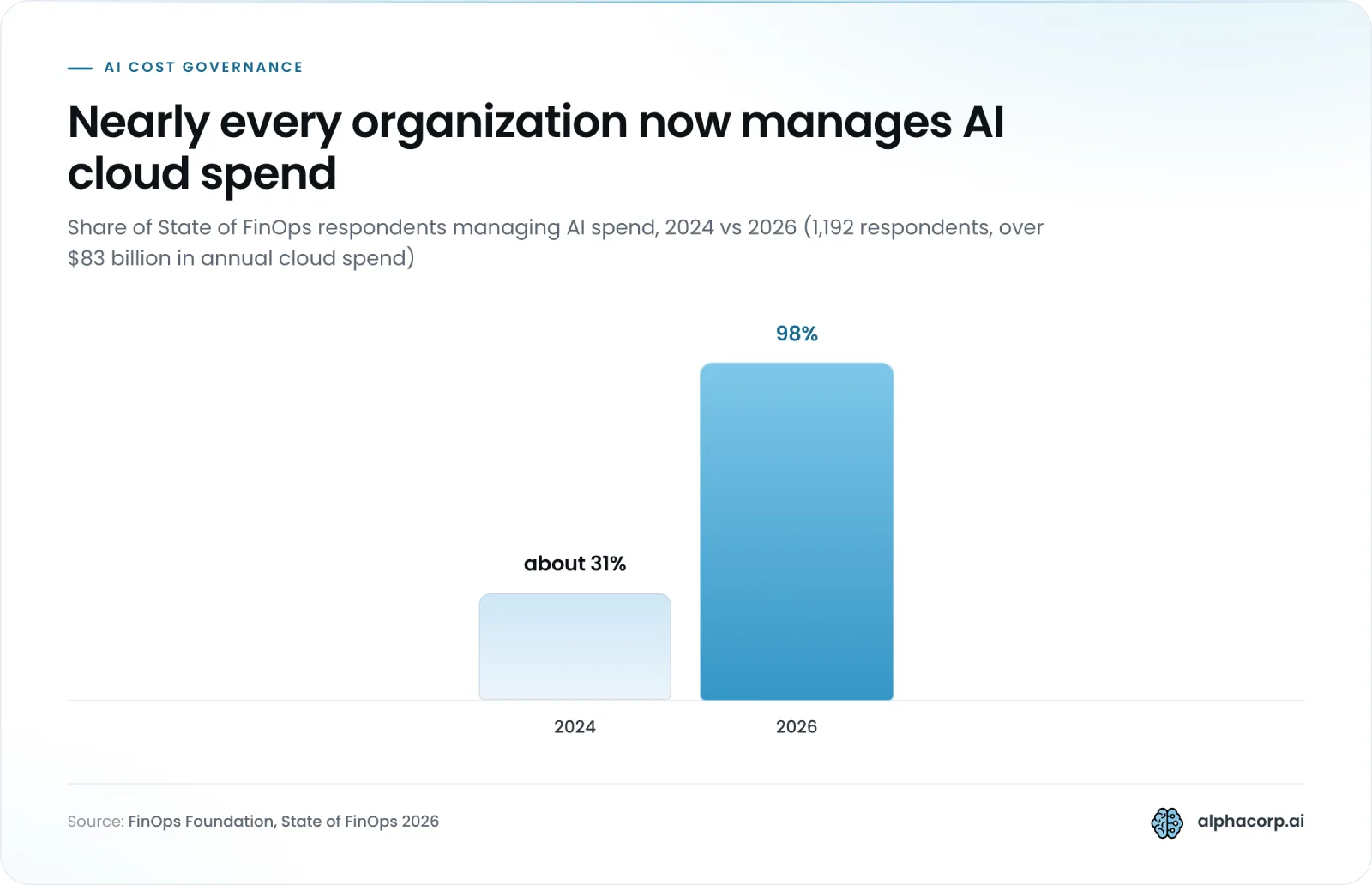
98%of organizations now manage AI spend, up from about 31% two years earlierFinOps Foundation, 2026
Overview

What our Azure consulting services cover

Six areas, each mapped to a phase of Microsoft's Cloud Adoption Framework and built so the AI workload you are shipping has somewhere reliable to run.
01

Landing zones for AI workloads

We design the subscription layout, identity, networking, and policy guardrails, the Cloud Adoption Framework's ready phase, so the agents we build through AI agent development land in a tenant that is already governed.

02

Migration and modernization planning

Discovery, dependency mapping, and a wave plan for moving workloads onto Azure, using the agentic assessment tooling Microsoft added to Azure Migrate and Modernize in 2026 to compress the inventory stage.

03

Well-Architected reviews

A structured review of an existing workload against the five Well-Architected pillars: reliability, cost optimization, operational excellence, performance efficiency, and security, with Azure Advisor findings triaged into a prioritized fix list.

04

Azure cost governance (FinOps)

Tagging, budgets, anomaly alerts, and a standing review cadence for the consumption lines AI introduces: model inference, vector storage, and Copilot add-ons. The 2026 FinOps data shows teams treating this as a permanent function reporting to the CTO or CIO, 78% in 2026, up 18 points from 2023.

05

Security baselines and shared responsibility

Tenant inventory, continuous-monitoring configuration, and hardened baselines for the controls Microsoft leaves to you, plus the newer AI-specific risks: prompt injection, data leakage, and agent sprawl.

06

Retrieval infrastructure on Azure

Deployment of RustyRAG or a custom pipeline from our RAG development practice onto Azure compute, storage, and networking sized for production query volumes.

Column chart comparing the share of State of FinOps respondents who manage AI cloud spend. In 2024 the share was about 31%. In 2026 it was 98%, the highlighted value. Based on 1,192 respondents representing over $83 billion in annual cloud spend.
The share of organizations managing AI cloud spend reached 98% in 2026, up from about 31% two years earlier. FinOps Foundation, State of FinOps 2026
03Stack

The Stack We Ship On

We pick the best tool for each job, not the trendiest. This is what runs behind the agents, retrieval pipelines and automation we put into production.

Languages
PythonRustTypeScript
Foundation Models
AnthropicOpenAIGeminiLlamaMistralHugging Face
Fast Inference
GroqCerebrasOpenRouterReplicateOllamavLLM
Agents & Orchestration
LangGraphLangChainLlamaIndexCrewAIn8n
Vector & Memory
MilvusPineconepgvectorChromaWeaviateRedis
Voice, Image & Fine-Tuning
ElevenLabsLiveKitVapiComfyUIPyTorch / LoRAModal
Cloud & Delivery
AWSAzureGoogle CloudDockerKubernetesVercel
Evals & Observability
LangSmithLangfuseWeights & BiasesGrafana
Process

How an Azure consulting services engagement runs

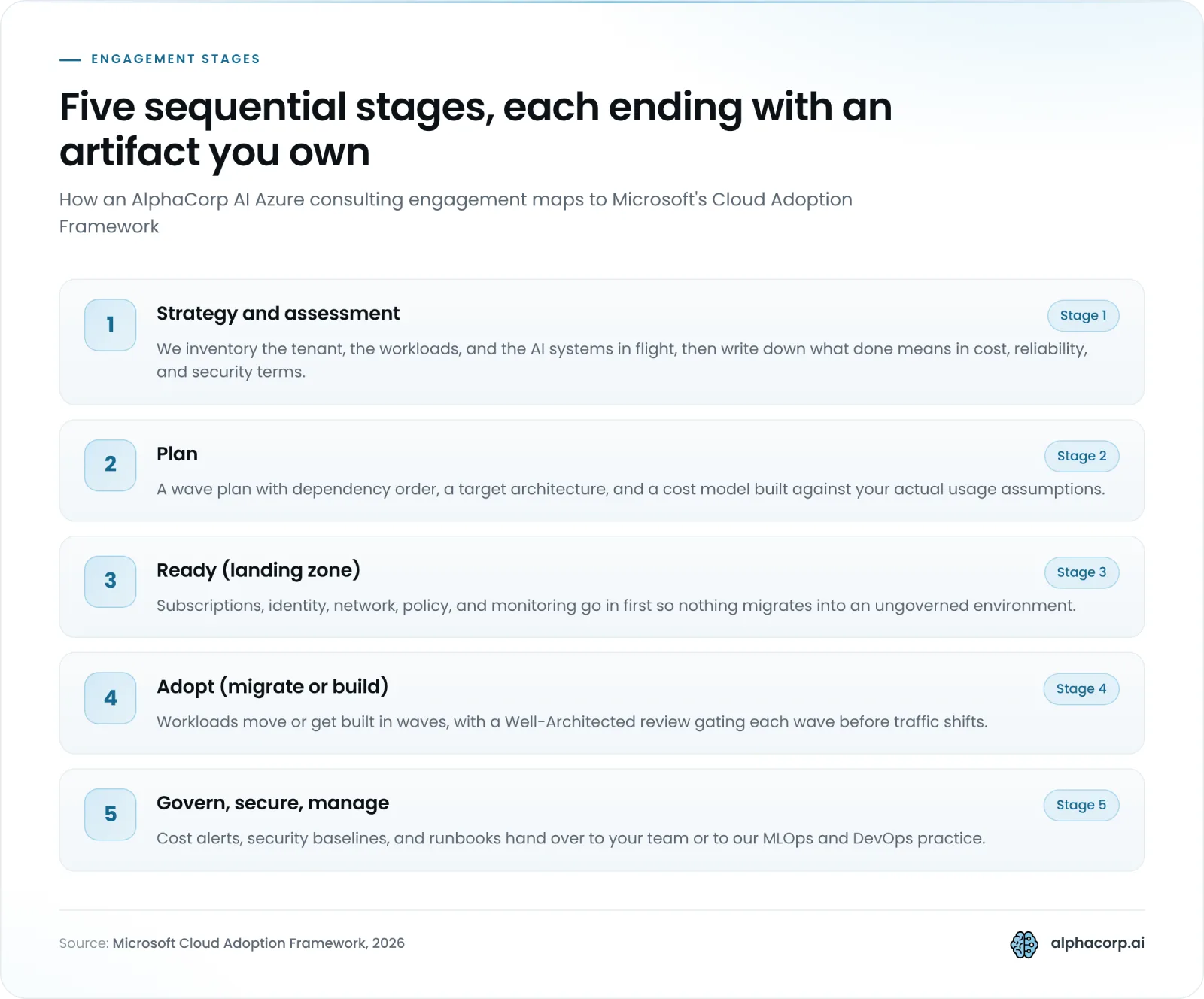
Five sequential stages that follow the Cloud Adoption Framework's phases, and every stage ends with an artifact you own.
01

Strategy and assessment

We inventory the tenant, the workloads, and the AI systems in flight, then write down what done means in cost, reliability, and security terms.

02

Plan

A wave plan with dependency order, a target architecture, and a cost model built in the Azure pricing calculator against your actual usage assumptions.

03

Ready: the landing zone

Subscriptions, identity, network, policy, and monitoring go in first so nothing migrates into an ungoverned environment.

04

Adopt: migrate or build

Workloads move or get built in waves, with a Well-Architected review gating each wave before traffic shifts.

05

Govern, secure, manage

Cost alerts, security baselines, and runbooks hand over to your team or to our MLOps and DevOps practice for ongoing operation.

Vertical process diagram of five sequential engagement stages. Stage 1, strategy and assessment: inventory the tenant, workloads, and AI systems in flight, then define done in cost, reliability, and security terms. Stage 2, plan: a wave plan with dependency order, a target architecture, and a cost model built against actual usage assumptions. Stage 3, ready (landing zone): subscriptions, identity, network, policy, and monitoring go in first so nothing migrates into an ungoverned environment. Stage 4, adopt (migrate or build): workloads move or get built in waves, with a Well-Architected review gating each wave before traffic shifts. Stage 5, govern, secure, manage: cost alerts, security baselines, and runbooks hand over to your team or to the MLOps and DevOps practice.
Every AlphaCorp AI Azure engagement runs through five sequential stages, with governance arriving in the landing zone before the first workload moves. Microsoft Cloud Adoption Framework, 2026
Benefits

Why invest in Azure consulting services now

Azure consulting pays off when the cost of getting the tenant wrong exceeds the cost of the engagement, and in 2026 five things push that threshold down.

01

AI cost lines are new and hard to forecast

The State of FinOps 2026 report names AI cost governance as the top skill organizations say they need to build. A consultant who has already priced inference, embeddings, and Copilot consumption saves you the months of learning it on your own invoice.

02

Misconfiguration is the customer's failure mode

CISA issued Binding Operational Directive 25-01 because, in its words, improper configuration of security controls in cloud environments introduced substantial risk and resulted in actual compromises. Those controls sit on your side of the shared-responsibility line.

03

FastTrack stops where the hard work starts

Microsoft's free FastTrack for Azure runs about four to six weeks and explicitly excludes custom development, complex migrations, third-party integration, governance frameworks, and managed services. That list is most of what an enterprise AI rollout actually needs.

04

Lock-in is a design decision you make early

Containerization and a multi-cloud posture are the most cited ways to keep a negotiating position with a single vendor. They are cheap to design into a landing zone and expensive to retrofit.

05

Smaller regulated teams carry more risk

A 2026 arXiv study of SMEs in critical infrastructure found them adopting cloud with varied deployment models while carrying higher exposure than larger, better-resourced adopters. Resilience and security scoping is where outside expertise closes that gap fastest.

Why AlphaCorp AI

Why AlphaCorp AI for Azure consulting services

AlphaCorp AI is an AI engineering studio founded by Ignas Vaitukaitis, remote-first from Rio de Janeiro, working US Eastern hours in English, Portuguese, and Spanish, and the team behind RustyRAG, a sub-200ms open-source retrieval stack. Azure consulting here is done by engineers who ship agents and RAG systems on the same platform they advise on. Hire us when the workload on the other end is an AI system that has to run in production.

Engineers advise, then build. The architect who writes your landing-zone spec deploys the agent into it. There is no handoff from a slide deck to a delivery team that never read it.

We scope around the AI workload. Most Azure partners start from infrastructure and treat the AI system as one more VM. We start from the agent, the retrieval pipeline, or the Copilot rollout, and size the tenant around its inference, storage, and governance needs.

We name the tradeoff. If you need a pure SAP, Oracle, or mainframe lift onto Azure with no AI component, one of the 500-plus partners enrolled in Azure Migrate and Modernize will do it cheaper than we will. Our edge is narrow on purpose.

Governance ships with the build. The deployment gotcha we see most often is an agent going live with working code and a tenant where diagnostic logging, cost alerts, and least-privilege identities were phase two. Our engagements put the Cloud Adoption Framework's govern and secure phases in the first wave. Want to meet the team first? The About AlphaCorp AI page explains how the studio works.

Security and compliance in our Azure consulting services

We treat security configuration as a line item in every engagement, because on Azure the controls that fail are almost always the ones the customer owns.

Our working model follows CISA's Cloud Security Technical Reference Architecture and the shared-responsibility framing in NIST Special Publication 800-145: Microsoft secures the platform, you secure the tenant, identities, data, and workloads. In practice that means tenant inventory, continuous-monitoring tooling, hardened baselines, and least-privilege access reviewed before anything reaches production. Client data stays in your Azure tenant. We work through your identity provider with scoped, time-bound access, and never copy workload data into AlphaCorp AI systems.

For AI workloads we add a review layer that traditional cloud-security playbooks skip: prompt injection paths, data leakage through model context, and autonomous-agent sprawl, risk classes that 2026 academic work on cloud-hosted generative AI now treats as their own category.

Azure Government and FedRAMP High work is a separate compliance track from commercial Azure, and Microsoft's partner designations do not score sovereign clouds. If your requirement is public-sector, raise it on the first call so we can confirm fit.

FAQ

Azure consulting services FAQs

What are Azure consulting services?

Azure consulting services are professional services for planning, building, securing, and operating workloads on Microsoft Azure, covering assessment, migration, architecture, security, cost governance, and managed operations. Microsoft structures this work through its Cloud Adoption Framework (strategy, plan, ready, adopt, govern, secure, manage) and validates designs with the Well-Architected Framework. AlphaCorp AI delivers it with a focus on AI workloads.

How much do Azure consulting services cost?

Scope decides the price, and a working session prices it. The variables that move the number are the count of workloads, whether a landing zone exists, the depth of security baseline work, and whether you want ongoing cost governance or a one-time review. AlphaCorp AI prices each engagement as a fixed scope after an assessment session, so you see the number before any build starts.

How long does an Azure consulting engagement take?

Timeline follows scope: a Well-Architected review of one workload is a short engagement, and a multi-wave migration with a new landing zone runs much longer. For reference, Microsoft's own FastTrack for Azure guidance runs in three stages over roughly four to six weeks and covers only setup and best practices. Anything involving custom development, complex migration, or governance frameworks extends beyond that window.

How do Azure consulting services compare to FastTrack for Azure?

FastTrack for Azure is free guidance from Microsoft engineers for eligible subscribers. Paid Azure consulting covers what FastTrack excludes: custom development, complex migrations, third-party integration, governance frameworks, and ongoing managed services. The two work together. AlphaCorp AI often runs alongside FastTrack during setup and takes over for the build, governance, and operations stages.

How should I evaluate an Azure consulting partner?

Check for a Microsoft Solutions Partner designation in Data and AI, Infrastructure, or Digital and App Innovation, which as of August 2026 requires a partner capability score of at least 70 points across customer adds, certifications, usage growth, and deployments, recalculated from live telemetry. Then ask who will do the work. A designation proves the firm clears a scoring bar. It does not tell you whether the engineer on your project has shipped your kind of workload.

What happens after the Azure consulting engagement ends?

You own every artifact: the landing zone, the architecture documents, the cost model, the security baselines, and the runbooks. Your team can operate the tenant with what we hand over, or AlphaCorp AI can stay on for cost governance reviews and operations. Either way, nothing depends on us remaining in the loop.

The Shift
AlphaCorp AI
0:000:00