

On this page(14)
- Quick answer: what is agentic architecture?
- Why a chatbot is not an agent, and why that distinction matters
- The layers of an agentic AI architecture
- Reasoning and state: the workflow engine in disguise
- Tool interoperability with MCP
- The knowledge layer: RAG, GraphRAG, and the long-context trap
- The lost-in-the-middle problem
- How should you route between models?
- Cost is no longer measured in tokens
- Security: agents are a new kind of insider
- When does multi-agent architecture actually pay off?
- Governance: the law hasn’t caught up, so the architecture has to
- A reference shape for an agentic system
- What to do with this if you’re starting now
Most teams discover the hard way that their “AI agent” is really just a chatbot with extra steps. It answers questions, it calls a tool and sometimes it loops. Then it falls over the moment the work spans more than two decisions. Agentic architecture is the engineering response to that failure mode: a layered system design that lets AI software plan, retrieve, act, remember, and stay inside guardrails while it does multi-step work. As of right now, the strongest production patterns are converging on a recognisable stack, and the differences between teams that ship and teams that prototype are almost entirely architectural.
Quick answer: what is agentic architecture?
Agentic architecture is the set of design patterns, control layers, and governance mechanisms that let an AI system perceive context, choose tools, run multi-step plans, persist state, and coordinate with other agents under bounded autonomy. It is not a single framework. It is an integrated control plane that sits around a language model and makes its actions reliable, auditable, and economically viable.
Why a chatbot is not an agent, and why that distinction matters
A traditional LLM app generates text in response to a prompt. An agentic system decides when to retrieve, when to call a tool, when to escalate, and when to ask a human. That shift changes everything around the model: memory, orchestration, security, billing, and logging all become first-class concerns.
At the end, this is a systems engineering problem, not a prompting problem. IBM frames the Model Context Protocol as a connectivity standard that complements orchestration frameworks rather than replacing them. Scalekit splits the work into three layers in its unified tool-calling architecture writeup: reasoning and state (LangChain/LangGraph), role-based orchestration (CrewAI), and stateless tool exposure (MCP).
That division is the cleanest mental model I’ve seen and most teams who think they have an “agent problem” actually have a layering problem.
The layers of an agentic AI architecture
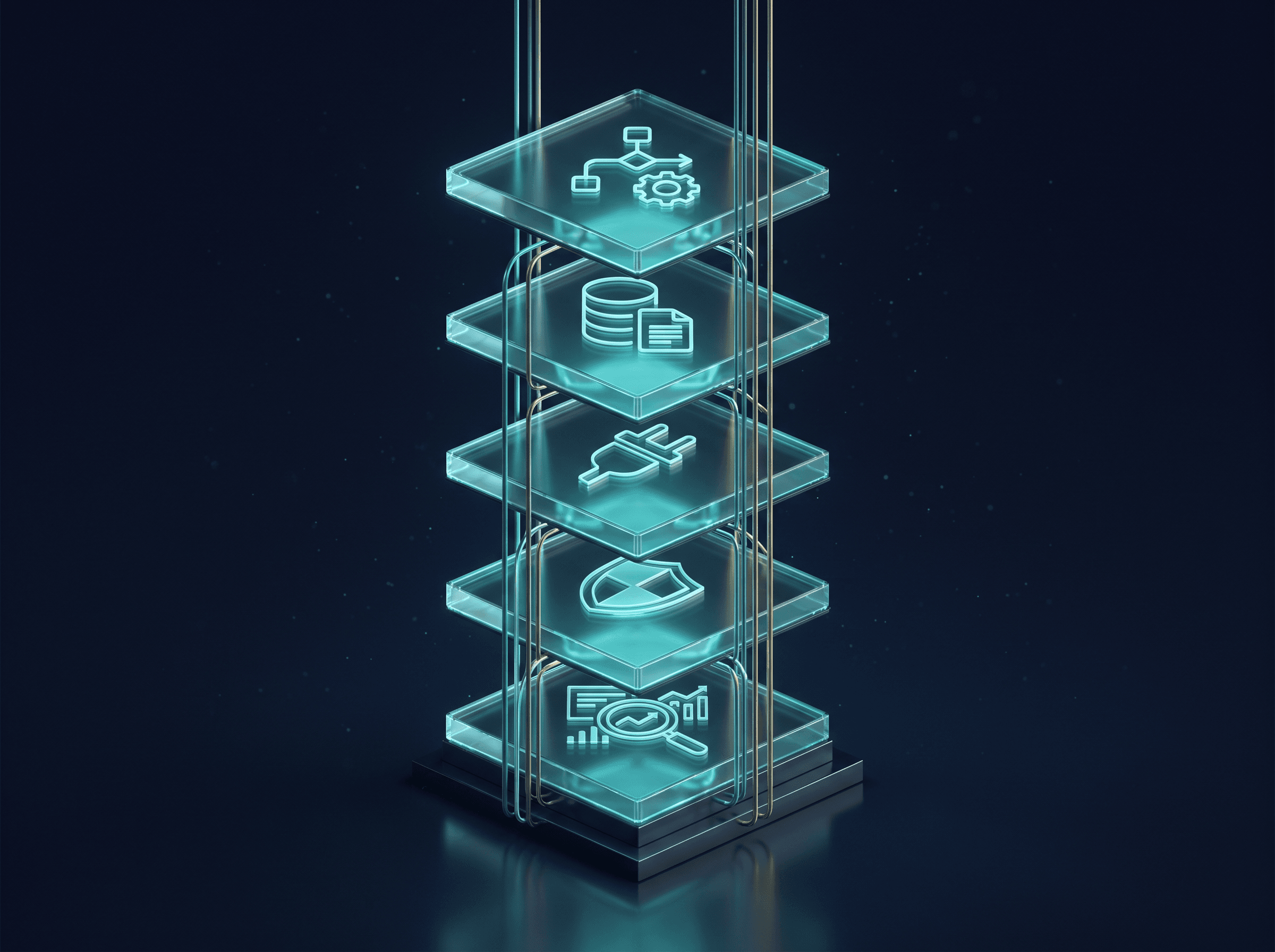
A working agentic system stacks six functional layers. Each does one job. Each fails in a recognisable way when you skip it.
Curious what AI could do for your business?
No jargon and no hard sell. Just a friendly look at where AI fits, and where it doesn't.
| Layer | What it does | Common technologies |
|---|---|---|
| Reasoning / orchestration | Plans steps, branches, manages state | LangGraph, LangChain, CrewAI |
| Tool integration | Standardised access to external systems | MCP |
| Retrieval / memory | Grounds context, persists state | RAG, GraphRAG, vector and structured stores |
| Model routing | Sends tasks to the right model | Cascading, classifier routing |
| Observability | Logs, traces, evaluates, audits | LangSmith, system tables, monitoring |
| Security / governance | Limits blast radius | Least privilege, sandboxing, behavioural analytics |
Skip orchestration and the system collapses into an unmanageable prompt loop. Leave behind retrieval and context bloats until the model loses the thread. Avoid security and you’ve handed a stranger the keys to your CRM.
Reasoning and state: the workflow engine in disguise
LangGraph and similar tools give you graph-based stateful workflows with conditional branching and persistence. Memgraph’s walkthrough of LangGraph plus MCP shows the practical shape of this: the agent doesn’t “decide” things in a free-form prompt loop, it moves through a graph where each node has clear inputs, outputs, and retry behaviour.
This is the single most important design distinction in the field. A system becomes agentic because its runtime can branch, retry, escalate, and reintegrate tool results without the prompt turning into spaghetti. The model is not the agent. The runtime is.
Tool interoperability with MCP
MCP has become the connective tissue. It exposes tools as discoverable, schema-validated, stateless endpoints that any compliant client can call. Add a tool to the server once. Use it from LangGraph, from Claude Desktop, from CrewAI, from an IDE. No bespoke bindings.
Most agentic systems fail at the integration layer, not the model layer. MCP is the part of the stack that quietly removes a category of failure rather than adding a new capability.
The knowledge layer: RAG, GraphRAG, and the long-context trap
A defining feature of agentic architecture is that it does not lean on the model’s parametric memory, in fact it uses explicit memory systems.
You’d think million-token context windows would have killed retrieval, however, they haven’t. The EITT 2026 guide to AI agents estimates that loading a 1M-token context can be roughly 100 times more expensive than retrieving a few hundred relevant chunks, on top of worse latency and stale data. RAG is still the production default in 2026 for the same reasons it was in 2024: cheaper, faster, fresher.
RAG remains the production standard in 2026 because it lowers cost, reduces latency, and preserves freshness. (EITT, 2026)
GraphRAG is the part that’s genuinely new. Vector RAG is great at “find me the relevant passage”. It is bad at “what are the recurring themes across ten million documents?” GraphRAG, as covered in Meta-Intelligence’s context engineering writeup, builds knowledge graphs and community summaries so the agent can answer global, multi-hop questions instead of point lookups. Use vector retrieval for evidence. Use GraphRAG for synthesis. Most production agents will eventually want both.
The lost-in-the-middle problem
Even when long context is technically free, performance degrades as the window fills. Signal-to-noise drops. The model misses things buried at position 380,000. Structured retrieval and summarisation are architectural requirements, not optimisations.
How should you route between models?
Use small models for cheap work, big models for hard work, and switch between them automatically. Two patterns do most of the lifting:
- Cascading: start with a small model, escalate only when confidence or quality thresholds fail.
- Heterogeneous assignment: a strong model for the planner, smaller models for workers and tool callers.
Both push the system toward what it should be doing anyway: paying flagship-model prices only when the task needs flagship reasoning. A production agent that uses GPT-class frontier models for every routine tool call is leaking money on every request.
Cost is no longer measured in tokens
This is the finding that catches teams off-guard. The right cost unit for an agentic system is the resolved task, not the token.
The argument from Timeless’s agentic FinOps research is that unit economics (cost per resolved task, cost per useful thought) is the only KPI that matches how agents actually consume resources. A system with cheap tokens but high retry rates can easily cost more per outcome than one with expensive tokens and a clean first-pass plan.
| Cost element | Chatbot | Agentic system |
|---|---|---|
| Model calls per request | Usually one | Often many |
| Tool use | Rare | Frequent |
| Memory and retrieval | Optional | Core |
| Retries and escalations | Limited | Common |
| Infra overhead | Small | Sandboxes, caches, logs |
| Right KPI | Cost per token | Cost per resolved task |
TechTarget’s FinOps coverage adds the supporting detail: tool calls, retrieval queries, storage writes, and repeated model invocations all enter the bill. If your dashboard only shows tokens, you don’t actually know what your agent costs.
Security: agents are a new kind of insider
This is the section I’d argue is least appreciated by teams building their first agent. The moment you give an LLM real credentials and real tool access, you’ve created something with the access patterns of an employee and none of the accountability.
Exabeam’s analysis treats AI agents as a new insider-threat category. The AWS Security Blog’s agentic AI scoping matrix catalogues the new surface area: autonomy, persistent memory, tool orchestration, identity, external integrations. Each adds attack vectors that stateless model use simply doesn’t have.
The architectural responses fall into two buckets:
- Least privilege and containment. Scoped tokens. Ephemeral sandboxes. Network micro-segmentation. The agent should not be able to do anything it does not need to do right now.
- Continuous behavioural analytics. Static input filters miss prompt injection. Runtime monitoring of tool-call sequences, data access patterns, and semantic drift catches what filters don’t.
The mature pattern is dynamic least privilege: permissions that adjust in real time based on observed behaviour. That is a materially harder security model than static role assignment, and increasingly the only one that makes sense for autonomous workflows.
When does multi-agent architecture actually pay off?
Less often than people think. The temptation to build a “crew” of eight specialised agents is strong. The bill that follows is sobering.
EITT reports that early multi-agent systems running 8 to 15 agents became expensive, unpredictable, and hard to productionise, with LLM costs running 3 to 10 times higher than single-agent equivalents. Multi-agent designs are justified when at least one of the following is true:
- The work spans genuinely distinct competencies.
- Independent review is a hard requirement.
- Parallelism cuts latency in a way the user notices.
- Different permissions must be isolated between roles.
- Communication between agents can be tightly bounded and audited.
Otherwise, one well-structured agent with routing, retrieval, and tool use beats a crew. Most teams should start with one agent. The research is unambiguous on this, and so am I.
Governance: the law hasn’t caught up, so the architecture has to
Liability is the open question. The AI governance landscape analysis from Hung Yichen makes the point that the EU AI Act and NIST AI RMF were built for systems that assist human decisions, not systems that act independently. Policymakers have mostly rejected “electronic personhood” in favour of human-centred liability. Strict liability. Adapted negligence. A real person on the hook.
That pushes responsibility back into the architecture. If the law needs an accountable human, the system needs human-in-the-loop or human-on-the-loop checkpoints for high-risk actions, plus audit logs detailed enough to reconstruct what happened. NIST’s reported 2026 AI Agent Standards Initiative focuses on exactly this: identity and authentication, action logging and auditability, containment boundaries.
Governance is becoming architecture. It is no longer a policy document filed somewhere.
A reference shape for an agentic system
Putting the layers together:
User / system request
↓
Policy and identity
↓
Orchestrator / planner (LangGraph, CrewAI)
↓
Model router / cascade
↓
Retrieval and memory (RAG, GraphRAG, structured memory)
↓
Tool access (MCP, APIs, databases, SaaS)
↓
What could a custom AI agent take off your plate?
We build production-grade AI systems that quietly handle the busywork, so your team can focus on the work that actually matters.
Execution sandbox
↓
Observability, audit, FinOps
↓
Behavioural analytics
↓
Human oversight when required
A research assistant working across legal, financial, and technical material would use LangGraph for branching, vector RAG for evidence, GraphRAG for global synthesis, MCP for document store access, model routing for cost control, and a human review gate for sensitive outputs. A workflow automation agent that files tickets and updates CRM data would put more weight on scoped tokens, action logging, behavioural monitoring, and approval gates for anything irreversible. Different workloads load different layers. The stack stays the same.
What to do with this if you’re starting now
If you’re designing your first agentic AI system, work the layers in this order: orchestration, retrieval, tool access via MCP, model routing, observability with real dollar costs, and security with least privilege from day one. Resist the urge to spin up multiple agents until a single one is clearly insufficient. Measure cost per resolved task, not per token. Build the audit log before you need it, because you will need it. The winning pattern now isn’t full autonomy. It’s bounded autonomy: a layered system with stateful orchestration, standardised tools, grounded retrieval, dynamic routing, continuous monitoring, and a human still accountable somewhere in the chain. Systems missing any of those layers tend to stay prototypes.