



On this page(13)
- What makes Claude Opus 5 different?
- Where Claude Opus 5 leads on benchmarks
- How much does Claude Opus 5 cost?
- What Opus 5 is like to actually use
- Alignment and safety: the quieter headline
- Claude Opus 5 FAQ
- Is Claude Opus 5 better than Opus 4.8?
- How much does Claude Opus 5 cost?
- Is Opus 5 better than Fable 5?
- Can I use Claude Opus 5 for cybersecurity?
- What is the difference between Opus 5 and Mythos 5?
- When was Claude Opus 5 released and where can I use it?
- How to start using Opus 5
Anthropic launched Claude Opus 5 on 24 July 2026, and it resets what a top-tier model is supposed to cost. It gets close to the frontier intelligence of Claude Fable 5, for about half the price. As of 2026 it is the new default on Claude Max and the strongest model on Claude Pro. Below is what actually matters: the benchmarks, the price, the safety record, and whether it is worth switching.
Claude Opus 5 is Anthropic’s new flagship. It costs $5 per million input tokens and $25 per million output tokens, the same as Opus 4.8, while roughly doubling Opus 4.8’s score on hard coding work. It leads coding and knowledge-work benchmarks, sits behind Mythos 5 on offensive cybersecurity by design, and rates as Anthropic’s most aligned model so far.
What makes Claude Opus 5 different?
Opus 5 is built for daily use, not for saving up for hard problems. It runs more efficiently than other models, which is why Anthropic made it the default on Max. You get a near-frontier model priced like a mid-tier one. That is the whole pitch, and the numbers back it.
Here is Anthropic’s own framing:
Claude Opus 5 comes close to the frontier intelligence of Claude Fable 5 at half the price.
The other lever is effort. You can dial effort up when you want more intelligence, or down when you want faster, cheaper answers and are willing to spend fewer tokens. Same model, two very different cost profiles.
Where Claude Opus 5 leads on benchmarks
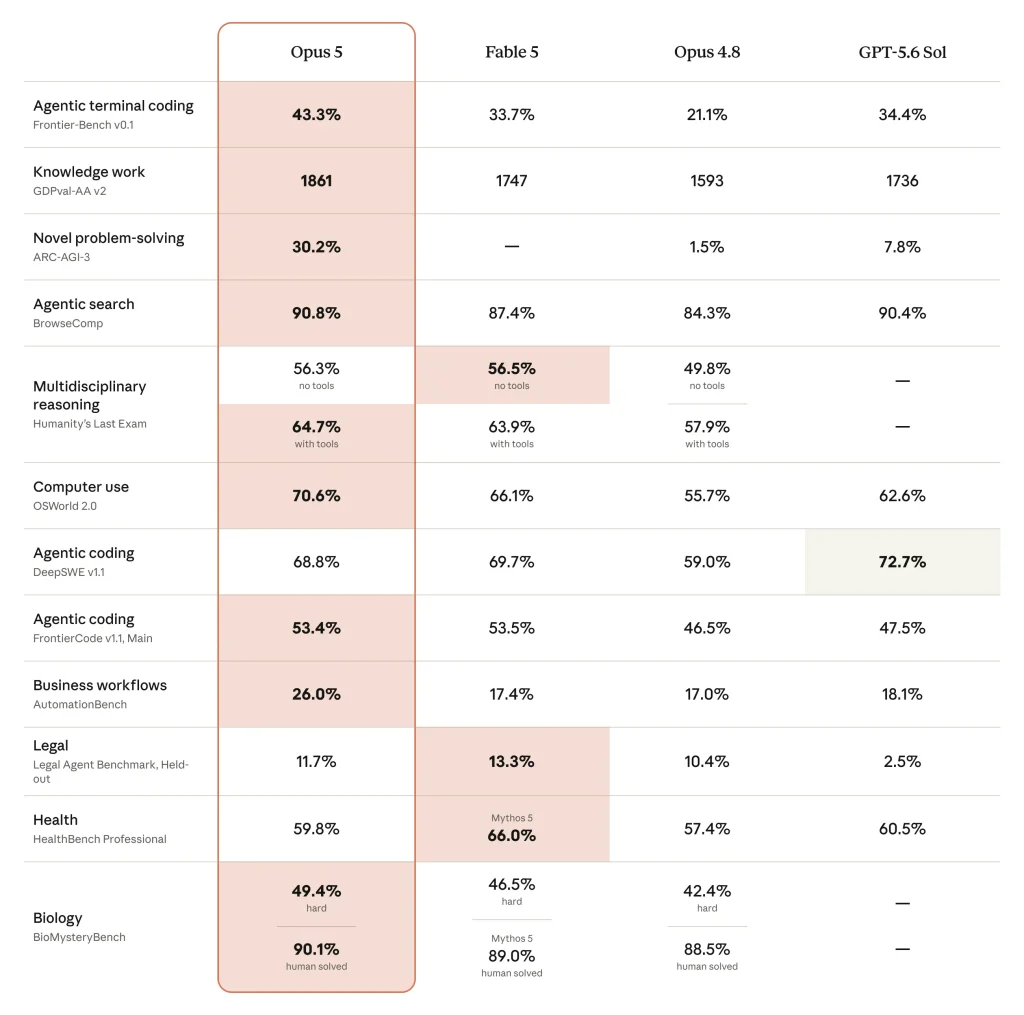
Short version: coding and agentic knowledge work. On Frontier-Bench v0.1, Opus 5 beats every other model and more than doubles Opus 4.8’s score, at a lower cost per task. On CursorBench 3.2 at max effort, it lands within 0.5% of Fable 5’s best score for half the cost per task.
The knowledge-work results are where it gets hard to ignore:
- ARC-AGI 3 (solving novel problems): about three times the next-best model’s score. The ARC-AGI benchmark exists to test fluid reasoning a model has not seen before, so a 3x gap here is not a rounding error.
- Zapier AutomationBench (business tasks start to finish): roughly 1.5 times the next-best pass rate at the same cost per task. Even at its lowest effort, it passes more tasks than any other model.
- OSWorld 2.0 (computer use): beats every model at any given cost, and tops Fable 5’s best result at just over a third of the cost. OSWorld drops an agent into a real desktop and grades whether it finishes the task, which most models fail.
It also rates as Anthropic’s best and most cost-efficient model on GDPval-AA v2, Humanity’s Last Exam, and DeepSearchQA.
The visual outputs got noticeably better too. Anthropic showed Opus 5 rendering airflow over aerodynamic and non-aerodynamic shapes in an interactive wind-tunnel demo, plus a labeled cell illustration. If your work leans on diagrams or data visualization, that is worth a look.
The lab results moved as well. Opus 5 beats Opus 4.8 on every one of Anthropic’s life-sciences evaluations. The biggest jumps show up in organic chemistry, where it scores 10.2 percentage points higher on reading molecular structures from spectroscopy data, and in protein work, where it is 7.7 points higher at predicting how sequence changes affect function.
One caveat, stated plainly. On cybersecurity, Opus 5 is not the leader, and that is on purpose. More on that below.
How much does Claude Opus 5 cost?
Claude Opus 5 costs $5 per million input tokens and $25 per million output tokens, identical to Opus 4.8. The performance jump carries no extra sticker price. Developers call it as `claude-opus-5` on the Claude API.
Fast mode runs Opus 5 at about 2.5 times the default speed. It costs twice the base price on the Claude Platform, and it is available through usage credits in Claude Code.
Here is how the current Claude lineup stacks up on the facts Anthropic published:
| Attribute | Claude Opus 5 | Claude Opus 4.8 | Claude Fable 5 |
|---|---|---|---|
| Role at launch | New flagship, new default on Max, strongest on Pro | Predecessor, now the fallback model | Frontier-intelligence tier |
| Price (input / output per M tokens) | $5 / $25 | $5 / $25 | About double Opus 5 |
| Coding benchmarks | State of the art (Frontier-Bench, GDPval-AA) | Behind Opus 5 | Very high; Opus 5 nearly matches it |
| Cybersecurity | Improved, still behind Mythos 5 on exploits | Baseline | Higher; flagged requests fall back to Opus 4.8 |
| Best for | Everyday high-intelligence work | Fallback and prior deployments | The longest, hardest autonomous tasks |
For high-volume, cost-sensitive work, the interesting detail is that low-effort Opus 5 already clears the bar other models need full effort to reach.
Curious what AI could do for your business?
No jargon and no hard sell. Just a friendly look at where AI fits, and where it doesn't.
What Opus 5 is like to actually use
Benchmarks miss the thing people notice first: Opus 5 checks its own work and keeps going until the job is actually done. Three examples from Anthropic’s testing and early access make the point.
Given a drawing of a machine part and told to rebuild it as a 3D CAD model, but with no way to see the drawing, Opus 5 wrote its own computer vision pipeline to pull the geometry from raw pixels, then rebuilt the full part. It did that more than once. No competing model with the same setup solved it in five tries.
Handed a real bug in a popular open-source package manager, it found the root cause and fixed an edge case the community’s own patch had missed. A rival model patched the surface symptom and reported the bug fixed.
And at a trading firm, an engineer used Opus 5 to build a market data feed for a new exchange in a single session, something earlier models could not finish even with detailed plans. With no live feed to test against, Opus 5 built its own test harness to confirm its parser read the exchange’s data correctly.
That is the pattern worth remembering. It does not just attempt the task. It verifies.
Alignment and safety: the quieter headline
Opus 5 is Anthropic’s most aligned model to date, according to its automated behavioral audit. It follows Claude’s Constitution more closely than Opus 4.8, Sonnet 5, or Fable 5, shows the lowest rates of deceptive behavior, and is the hardest to trick into misuse. On the audit’s overall misaligned-behavior score, it lands at 2.3, the lowest of Anthropic’s recent models. If you track model trustworthiness against public standards like NIST’s AI Risk Management Framework, this is the leg of the release that deserves the most attention.
On dual-use risk, Anthropic held the line. Opus 5 does not push the frontier on dangerous capability. It stays behind Mythos 5 on both biology research and offensive cybersecurity. Anthropic deliberately did not train it on cyber tasks, though it still got better at finding vulnerabilities simply by becoming more capable in general. The gap shows on OSS-Fuzz: Opus 5 nearly matches Mythos 5 at spotting vulnerabilities, but lags far behind at writing working exploits for them.
Safeguards moved in one narrow way. Opus 5’s cyber classifiers are less restrictive than Fable 5’s, expected to step in about 85% less often, and flagged requests fall back to Opus 4.8 by default in Claude.ai, Claude Code, and Claude Cowork. Teams doing legitimate security work can apply to the Cyber Verification Program for a version with fewer restrictions. Biology requests that used to get blocked on Fable 5 now route to Opus 5 instead. The full detail sits in Anthropic’s Opus 5 System Card.
Claude Opus 5 FAQ
Is Claude Opus 5 better than Opus 4.8?
Yes, on the benchmarks Anthropic published. It more than doubles Opus 4.8 on Frontier-Bench v0.1, beats it on every life-sciences evaluation, and rates as more aligned, all at the same price.
How much does Claude Opus 5 cost?
It costs $5 per million input tokens and $25 per million output tokens, the same as Opus 4.8. Fast mode costs twice the base price and runs about 2.5 times faster.
Is Opus 5 better than Fable 5?
Not across the board. Anthropic positions Fable 5 as the frontier tier. Opus 5 gets close to it for about half the price and matches it on some tests, but Fable 5 still leads on the longest, hardest autonomous work.
Can I use Claude Opus 5 for cybersecurity?
Partly. Its classifiers allow finding vulnerabilities in source code, but block binary-based scanning, penetration testing, and exploit generation. Flagged requests fall back to Opus 4.8. The Cyber Verification Program gives vetted users fewer restrictions.
What is the difference between Opus 5 and Mythos 5?
Mythos 5 stays ahead on the riskiest dual-use work: turning vulnerabilities into exploits, and long-running autonomous biology research. Opus 5 is the general-purpose flagship, and Anthropic deliberately did not train it on cyber tasks.

What could a custom AI agent take off your plate?
We build production-grade AI systems that quietly handle the busywork, so your team can focus on the work that actually matters.
When was Claude Opus 5 released and where can I use it?
It launched on 24 July 2026. It is live on every platform, including the Claude API as `claude-opus-5`, and it is the default model on Claude Max.
How to start using Opus 5
Claude Opus 5 is live today on every platform, as `claude-opus-5` on the Claude API. If you pay for Max, you are already on it. Two beta features ship alongside it: mid-conversation tool changes that do not invalidate the prompt cache, and automatic fallbacks that route flagged API requests to another model instead of blocking them. For the settings that get the most out of it, Anthropic published a prompting guide for Opus 5. Prior Opus models had no data retention requirement for general access, and Opus 5 keeps that. If you run cost-sensitive pipelines, test it at low effort first. The pass rates suggest you may not need to pay for anything more.